The 5 Cannabis Growth Stages (and How Long the Whole Thing Takes)
Every cannabis plant runs through the same five stages, whether it is an autoflower on a balcony or a photoperiod plant in a commercial room. What changes is how long each stage lasts, and one of them is largely up to you.
Here is the whole life cycle at a glance:
- Germination (3 to 10 days): the seed cracks open and pushes out a white root. This is the plant waking up.
- Seedling stage (2 to 3 weeks): the first real cannabis leaves appear and a small root system establishes. The plant is fragile and grows slowly.
- Vegetative stage (3 to 8+ weeks): fast leafy growth. The plant builds the frame that will hold your buds. This is when you train it, and this is the stage you can make longer or shorter.
- Flowering stage (8 to 11 weeks): the plant stops growing tall and puts its energy into buds. For photoperiod plants this only starts when the light drops to 12 hours a day.
- Harvest, drying and curing (about 3 to 6 weeks after the cut): you cut the plant when the resin is ripe, dry it slowly, then cure it in jars.
Add it up and an indoor photoperiod grow is about 3 to 5 months from seed to the day you cut, and about 4 to 6 months from seed to a smokable, cured jar. An autoflower is faster, roughly 2 to 3 months to the cut and 3 to 4 months to the jar, because it spends far less time in the vegetative stage. Outdoors, a photoperiod plant follows the sun: you plant in spring and harvest in autumn, no light switch required.
The single most useful thing to understand before we walk through each stage: the vegetative stage is the only one whose length you truly control. Germination takes as long as it takes, flowering length is fixed by the plant's genetics, and drying and curing have their own fixed clock. Veg is the dial. A longer veg means a bigger plant and a bigger harvest but a longer total grow; a shorter veg gets you to the finish faster with a smaller plant. Every "how long does this take" question comes back to that one decision.
A few words you will need
This guide is written for a first grow, so here are the handful of terms that come up in every stage:
- Photoperiod plant: a normal cannabis plant that flowers based on how many hours of light it gets. It keeps growing leaves until you shorten its light to 12 hours.
- Autoflower: a plant bred to flower automatically after a few weeks of age, no matter the light schedule.
- Node: the point on the stem where leaves and branches grow out. New nodes stacking up is how you see the plant growing.
- Pistil: the little white hair that appears where branches meet the stem. Pistils are the plant's first flower parts and a sign it is female.
- Trichome: the tiny mushroom-shaped resin gland that coats the buds and the small leaves around them. The color of the trichomes on the buds, not the calendar, tells you when to harvest.
- The flip: switching your grow light to 12 hours on and 12 hours off to trigger flowering in a photoperiod plant.

How Long Does It Take to Grow Weed?
From seed to the day you cut, plan on 3 to 5 months for an indoor photoperiod plant and 2 to 3 months for an autoflower. Drying and curing add another 3 to 6 weeks on the end, so a finished jar is about 4 to 6 months out for a photoperiod and 3 to 4 for an auto. That is the honest answer, and the spread exists because one stage is a choice, not a fixed number.
Break the timeline into its parts and it stops being mysterious:

Germination is about a week. Flowering is 8 to 11 weeks and is set by the strain, not by you: an indica-leaning plant commonly finishes in 8 to 9 weeks of flower, a sativa-leaning one at the top of that range or a little beyond. Drying and curing add another 3 to 6 weeks before the jar is really ready. Those three blocks are close to fixed. The variable is the vegetative stage, anywhere from about 3 weeks (a fast, small grow) to 8 weeks or more (a big, heavily trained plant). Stretch veg and the whole grow gets longer; keep it short and you finish sooner.
Autoflowers compress the whole thing because they skip the long veg. They flower on age, typically starting to flower on their own around 3 to 5 weeks from seed and finishing the entire run in about 9 to 11 weeks from seed, with some larger cultivars running to 13. You trade the ability to control plant size for speed and simplicity.
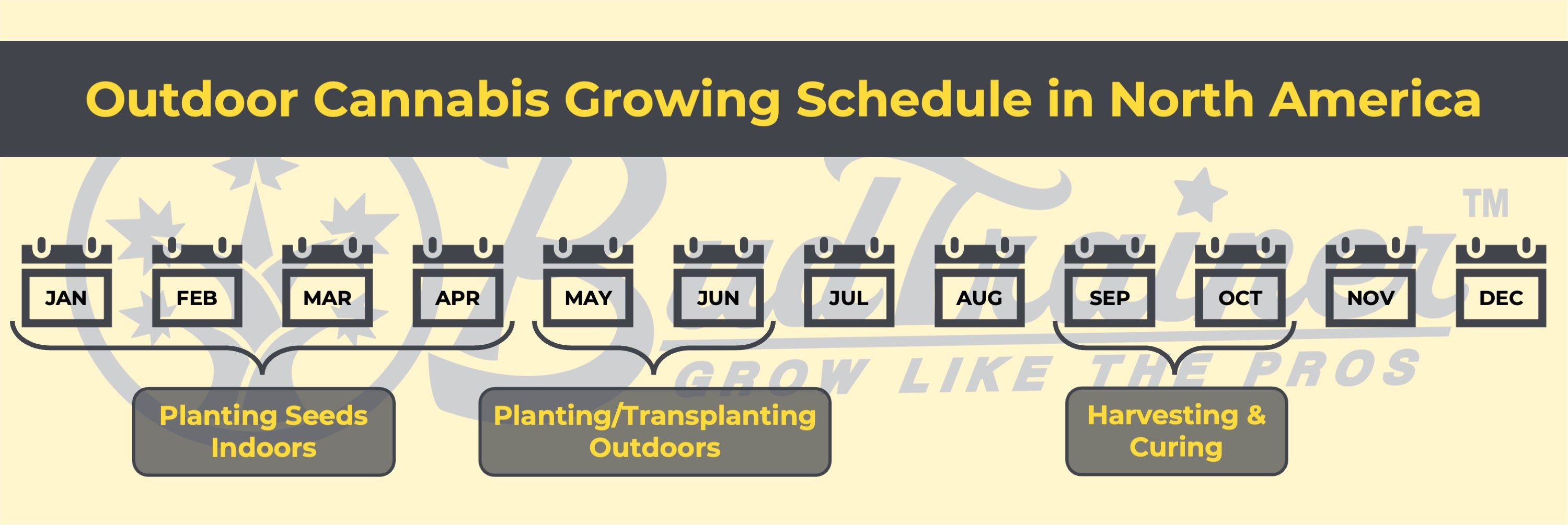
Growing outdoors changes the clock again. You are on the sun's schedule, so a photoperiod plant vegetates through spring and summer and flowers as the days shorten in late summer, with harvest usually landing between late September and early November in the northern hemisphere, depending on region and cultivar.
Here is how the common scenarios shake out:
| Type of grow | Seed to harvest | Why |
|---|---|---|
| Autoflower, indoor | 9 to 11 weeks (some to 13) | Short built-in veg, flowers on age |
| Photoperiod, indoor, short veg | ~3 to 3.5 months | About 3 to 4 weeks of veg, then flip |
| Photoperiod, indoor, long veg | 4 to 5 months | 8+ weeks of veg for a bigger plant |
| Photoperiod, outdoor | Plant spring, harvest autumn | Flowers when the days shorten naturally |
Add 3 to 6 weeks of drying and curing to every number above before the harvest is genuinely ready to enjoy. If you want the full walkthrough of a grow from start to finish, our how to grow weed guide covers the whole process; this page is about the stages and the timing.
Stage 1: Germination (3 to 10 Days)
Germination is the seed waking up. Given water, air and warmth, the shell splits and a single white root, the taproot, pushes down. Most fresh, healthy seeds crack within 24 to 120 hours, and the whole stage is done inside about 3 to 10 days.1 Temperature is the lever that matters most: seeds germinate fastest and most reliably in the low-to-mid seventies Fahrenheit, roughly 22 to 25 degrees Celsius, and get slow and unreliable when it is cold.2

You know germination is finished when the taproot is 5 to 13 mm (about a quarter to half an inch) long. That is the moment to plant it, root pointing down, about 1 cm (half an inch) deep. Wait much longer and the fragile root can tangle or dry out. The biggest beginner mistake here is drowning the seed in soggy soil or planting it too deep; seeds need oxygen as much as water. Overdoing the water stays the top mistake all the way through a grow: wrong watering led the first-grow confessions of 440 surveyed growers, with overwatering three times as common as underwatering. For the four proven germination methods and the exact temperature, water and pH numbers, see our germinating cannabis seeds guide.
Stage 2: The Seedling Stage (2 to 3 Weeks)
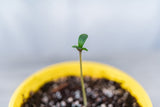
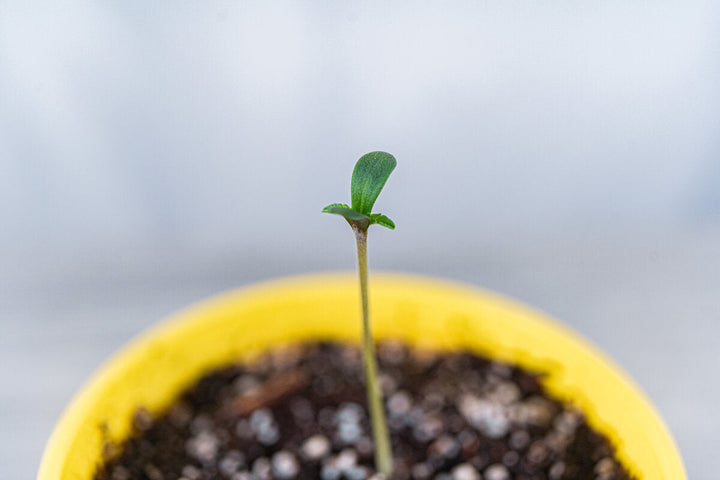
Once the sprout breaks the surface, the plant is a seedling for the next 2 to 3 weeks. The first two leaves you see are the round "seed leaves" (cotyledons) that were folded inside the shell. They are not true cannabis leaves; they are the plant's packed lunch. The first real leaves come next, and they arrive in a telltale sequence: a single-fingered leaf, then a set with three fingers, then five, then seven. Watching that finger count climb is the clearest sign the seedling is healthy and progressing.

A seedling has a tiny root system and almost no ability to drink much water, which is why the number one killer at this stage is overwatering, not underwatering. Wet, airless soil suffocates the young roots. Water lightly around the base, let the top of the medium dry between waterings, and resist the urge to feed heavily; a seedling needs very little in the way of nutrients at first. Self-draining starter pots like the BudCups help here because the removable bottom plate lets you pop the plant out and actually look at the roots, so a struggling seedling gets diagnosed instead of guessed at. Our guide to starting seedlings covers watering and light for these first weeks, and how to plant a sprouted seed covers getting it into the pot.

How you know it is over: the seedling stage blends into the vegetative stage once the plant has three or four sets of true leaves and starts stacking new growth quickly rather than inching along. When growth visibly speeds up, you are in veg.
Stage 3: The Vegetative Stage (3 to 8+ Weeks, the Stage You Control)
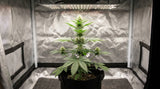
The vegetative stage is where the plant does its growing up. With plenty of light (photoperiod plants are usually kept on 18 hours of light and 6 of dark here), it puts out leaves and branches fast, sometimes visibly taller day to day, stacking node after node. Nothing about buds happens yet; the plant is building the frame that will hold them. This stage runs anywhere from about 3 weeks to 8 weeks or more, and, as promised, the length is your call.
As it takes off, the plant quickly outgrows its starter container. Moving up pot sizes as the roots fill in keeps growth from stalling; the rule we use for fabric pots is to jump to a container 3 to 5 times the current volume, not the 2 to 4 times you will often read. Fabric pots such as the BudPots dry evenly and air-prune the roots, which keeps the root zone healthy between waterings. The transplanting guide covers the timing and the 3-to-5x rule in detail.

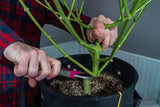
This is also the only stage where training pays off, because the plant is growing fast and healing easily. Topping (cutting the main growing tip to split it into two) and low-stress training (gently bending branches to flatten the canopy) both happen in veg, and together they turn a single Christmas-tree cola into a wide, even canopy of many bud sites. LST clips like the BudClips make the bending simple and repeatable. Start with our full plant-training guide, then go deeper on topping and low-stress training as you need them.

Somewhere in weeks 4 to 6 of veg, most plants show their sex at the nodes: tiny pre-flowers. Females produce a pair of white hairs (pistils); males produce small round pollen sacs on short stalks, which swell into teardrop shapes as they develop and eventually split open to release pollen. You want females, and spotting a male early lets you remove it before it pollinates the room. If you are not sure what you are looking at, learn how to tell a male from a female plant at a glance.

How you know it is over: veg ends when you decide it does. For a photoperiod plant, you end veg by flipping the light to 12/12. A common rule of thumb is to flip when the plant has filled about half of your final space, because most plants grow by half to double in height during the first few weeks of flower (the "stretch"). Autoflowers do not wait for you; they leave veg on their own internal schedule.
One important split: photoperiods and autoflowers want different training. A photoperiod plant can take two toppings plus continuous low-stress training across a long veg. An autoflower cannot. It is on a fixed clock, so it gets low-stress training plus at most a single topping, and only when you are taking very little plant material and the plant is visibly vigorous. A slow or stressed auto should not be topped at all. If the timing is ever in doubt on an auto, just do LST and skip the cut.
Stage 4: The Flowering Stage (8 to 11 Weeks)
Flowering is when the plant stops trying to get bigger and starts building buds. For a photoperiod plant, this stage does not begin on its own indoors. It begins when you cut the light to 12 hours on and 12 hours off. That uninterrupted long night is the signal the plant reads as "summer is ending, make seeds now," and it is a genuine hormonal switch: short days shift the plant's growth hormones and flip it from making leaves to making flowers.34

A crucial point that trips up beginners: flowering starts at the flip, not when you first see pistils. Those early white hairs can show up late in veg as pre-flowers; they are not the start of flowering. Some cultivars throw far more of them than others; our reviewer, Scott Golem, sees them all the time on mother plants that have never been flipped. The clock starts when the light changes. Autoflowers are the exception once again - they begin flowering on age, with no flip required, which is why they can sit under 18 to 20 hours of light for their whole life.
Once flowering begins, it runs on a fairly predictable arc over 8 to 11 weeks:

Weeks 1 to 3, the stretch: the plant shoots up, often adding 50 to 100 percent of its height, driven by a burst of the growth hormone gibberellin.4 This is why you flip at about half your final height.

Weeks 3 to 4, bud sites set: stretch slows and white pistils cluster at every branch tip, marking where buds will form.

Weeks 4 to 6, fattening: those sites swell into real buds and the first frosting of trichomes appears.

Weeks 6 to 9 and beyond, bulking and ripening: buds gain density and weight, aroma peaks, pistils darken, and the trichomes mature toward harvest.

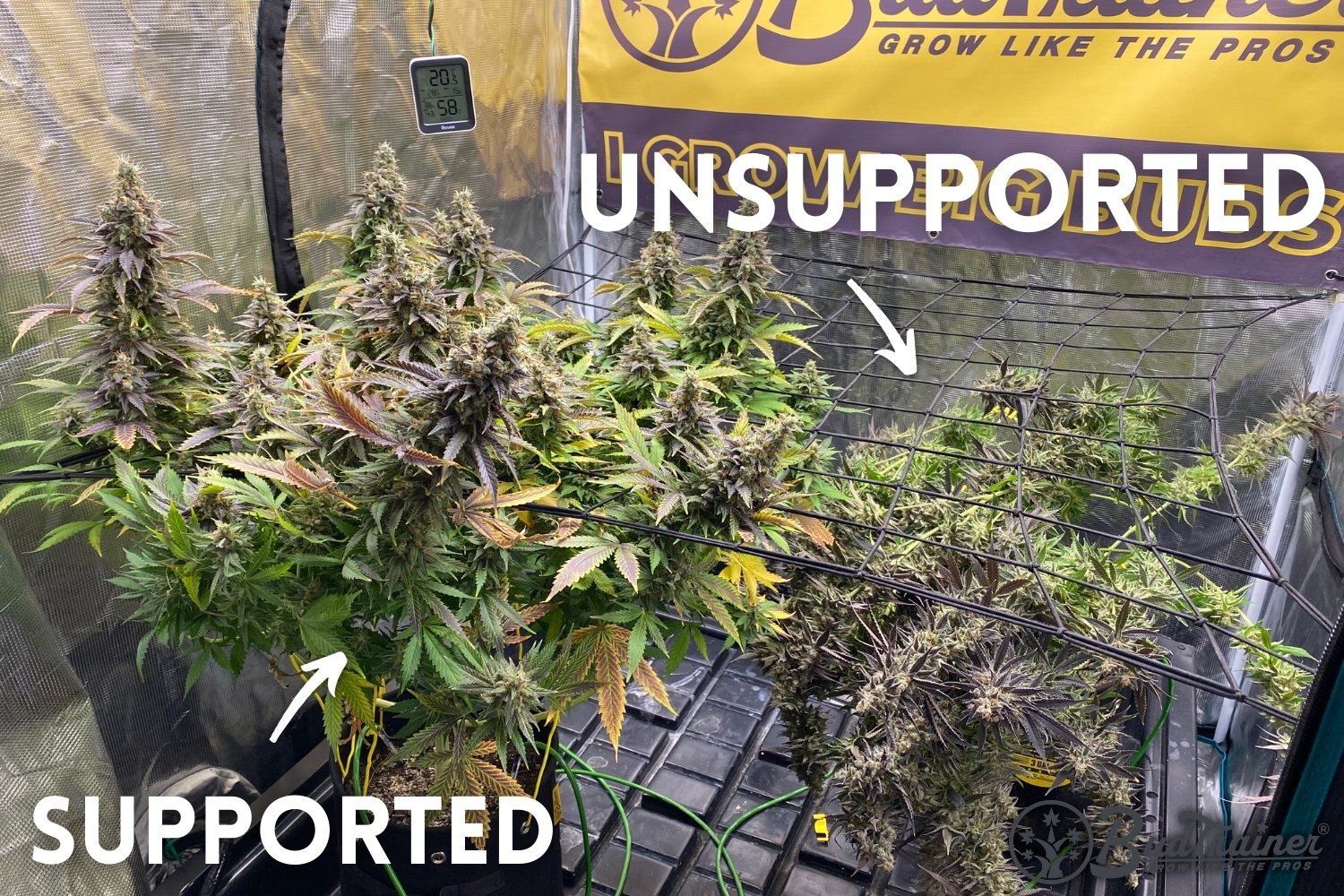
Heavy training is over by now; the plant's structure is set. The one exception is the net: if you are running a trellis, keep tucking each branch back under the screen as it climbs, exactly the way a SCROG does, and stop when the stretch stops, around day 21. Otherwise what it needs during flower is support, because those fattening colas get heavy enough to bend or snap a branch. Soft branch ties like the BudHuggers hold the canopy up without cutting into the stems. (Note the switch: BudClips are your veg-stage bending tool, BudHuggers are the flower-stage support tool.) This is a summary of the flowering arc; for the full week-by-week detail, including the environment and feeding shifts, see our dedicated flowering stage guide.
Stage 5: Harvest, Drying and Curing (the Finish)
The last stage is the one people rush and regret. Harvest timing is decided by the trichomes - those resin glands on the buds - not by the calendar and not by the strain's stated flowering time. Under a cheap magnifier, trichomes go from clear to a milky, cloudy white and then to amber. The sweet spot for most growers is when the heads on the buds are mostly milky with a small fraction turning amber. Milky is peak potency; amber means the THC is oxidizing into more sedative compounds.5

Cutting the plant is a single day's work, but it is not the finish line. Fresh buds have to be dried slowly, hung in a dark space at 60 to 68 degrees Fahrenheit (15 to 20 degrees Celsius) for about 7 to 14 days, with the humidity stepped up as they lose water: 50 percent for the first two days, then 55 percent from day 3 until the stems snap. You can hang the whole plant at once or cut it into individual branches first; either way, slow and dark is what protects the terpenes.

Then the buds are trimmed and cured in sealed jars at 58 to 62 percent humidity for 14 to 30 days, which is what actually makes cannabis smooth and aromatic instead of harsh. Fourteen days is the floor and about a month is where it gets good. Skipping or rushing the cure wastes everything the previous months built.

Each of these has its own detailed guide: how to read trichomes and time the cut in the harvesting guide, the slow-dry method in the drying guide, cleaning up the buds in the trimming guide, and the jar routine in the curing guide.
Photoperiod vs Autoflower: Two Different Clocks
Almost every timing question about cannabis has two answers, because there are two kinds of plant running on two different clocks. Getting this straight explains most of what confuses new growers.

A photoperiod plant flowers in response to light. It will vegetate indefinitely under long days and only starts flowering when nights get long, indoors at your command with the 12/12 flip, outdoors when the season turns. That gives you control: you decide how big the plant gets before you flip it.
An autoflower flowers on age, not light. This trait comes from Cannabis ruderalis genetics and has been traced to specific flowering-time genes, so an autoflower will start flowering a few weeks after germination whether it is getting 12 hours of light or 20.6 Because light no longer controls flowering, you keep autos on a long light schedule (often 18 to 20 hours; we run 18/6) for their entire life to feed maximum growth. Our light schedule guide explains where autoflowering came from and which schedule we run. You give up size control, and you gain speed and simplicity - which is exactly why autos are popular for a first grow or a short season. Just remember the training difference from the veg section: autos get low-stress training and, at most, one topping, taken only when very little material comes off and the plant is visibly vigorous, never the heavy sequence a photoperiod can handle.
How to Tell Which Stage Your Plant Is In
If you are standing in front of a plant wondering where it is in the life cycle, use the visible markers rather than counting days. This table is the quick diagnostic - what to look for, and what to do about it.
| Stage | How long | What you see | What to do |
|---|---|---|---|
| Germination | 3 to 10 days | Seed splits, white taproot emerges | Plant when the taproot is a quarter to half an inch (6 to 13 mm) long |
| Seedling | 2 to 3 weeks | Round seed leaves, then 1-, 3-, 5-blade true leaves; slow growth | Water lightly, do not overfeed, give bright but gentle light |
| Vegetative | 3 to 8+ weeks | Fast leafy growth, nodes stacking, pre-flowers at the nodes | Train and top, transplant up |
| Flowering | 8 to 11 weeks | Stretch, then pistils and buds forming and fattening | Flip a photoperiod to 12/12 to start it, then support heavy branches, no new training (only net tucking, to about day 21), watch trichomes |
| Harvest and cure | 3 to 6 weeks | Trichomes turning milky with some amber | Cut, dry slowly (50 to 55% RH in steps, 60 to 68°F or 15 to 20°C), then cure in jars |
The most common real question behind "what stage is this" is "what should my plant look like at week four?" It depends entirely on which week four: four weeks from seed is usually a young plant in early veg with a few sets of fan leaves, while week four of flower is a plant with defined, fattening buds. Always anchor the question to a stage, not just a number.
The Most Common Mistake in Each Stage
Most failed grows come down to a stage-specific error, and each one is avoidable:
- Germination: planting too deep or in soaking-wet soil. Seeds need oxygen; keep them shallow and merely damp. See the germination guide.
- Seedling: overwatering. A tiny plant cannot drink much; wet, airless roots are the usual cause of a sad seedling, not a lack of nutrients. Once it is bigger and genuinely hungry, follow a cannabis nutrient schedule so you feed the right amount at each stage.
- Vegetative: vegging with no plan. Either training too late to matter, or not at all, so the plant becomes a single tall cola instead of a wide canopy. Decide your training approach early.
- Flowering: treating flower like veg - heavy training or topping after the flip, or letting light leak into the dark period. Once you flip, the structure is set and your job is support - the one exception being tucking branches under a trellis net through the stretch, which stops around day 21.
- Harvest: cutting by the calendar or by pistils alone. The trichomes are the decision; everything else is a hint. Time it with the harvesting guide.
Frequently Asked Questions
How long does it take to grow weed from seed to harvest?
An indoor photoperiod plant takes about 3 to 5 months from seed to the cut, and an autoflower about 2 to 3 months. The main variable is how long you keep the plant in the vegetative stage. Add 3 to 6 weeks of drying and curing on top of that, so a finished jar is roughly 4 to 6 months out for a photoperiod and 3 to 4 for an auto.
What are the stages of growing weed?
Cannabis grows through five stages: germination (3 to 10 days), the seedling stage (2 to 3 weeks), the vegetative stage (3 to 8 weeks or more), the flowering stage (8 to 11 weeks), and harvest, followed by drying and curing (about 3 to 6 weeks). Each stage has its own tasks and its own signs that the plant is ready to move on.
How long is the vegetative stage?
For a photoperiod plant, the vegetative stage lasts as long as you want it to, commonly 3 to 8 weeks, because it ends only when you switch the light to 12 hours a day. Longer veg means a bigger plant and bigger harvest but a longer grow. Autoflowers have a short, fixed veg of roughly 2 to 4 weeks before they flower on their own.
When does the flowering stage start?
For a photoperiod plant grown indoors, flowering starts when you cut the light to 12 hours on and 12 hours off. It does not begin on its own, and it does not begin simply because you see the first white pistils, which can appear as pre-flowers in late veg. Outdoors, flowering begins as the days naturally shorten. Autoflowers begin flowering on age, with no light change needed.
What should a cannabis plant look like at 4 weeks?
It depends on which four weeks. Four weeks from seed, a plant is usually in early vegetative growth: a few inches to a hand-span tall with a few sets of fan leaves and no buds. Four weeks into flowering is very different: stretch has finished and defined buds are forming and starting to fatten at every branch tip. Always anchor the question to a stage.
How long do autoflowers take from seed to harvest?
Most autoflowers finish in about 9 to 11 weeks from seed, with some larger cultivars running to 13. They are quicker than photoperiod plants because they skip the long, grower-controlled vegetative stage and begin flowering on age, usually around 3 to 5 weeks from seed, regardless of the light schedule.
Can you speed up cannabis growth?
Within limits. Healthy roots, strong light, good temperatures and the right pot size all keep a plant growing at its natural pace, and a shorter vegetative stage or an autoflower gets you to harvest sooner. What you cannot safely rush is flowering, which is set by genetics, or the dry and cure, which need their full time to protect quality.
What week do buds grow the most?
Buds gain the most size and weight during the mid-to-late flowering weeks, roughly weeks 4 through 8 of flower, after the early stretch has finished and before final ripening. Early flowering is mostly about setting bud sites; the real bulking happens in the middle of the flowering stage.
How do I know when to switch to flowering?
Flip a photoperiod plant to 12/12 when it has filled about half of your final space, because most plants grow by half to double in height during the first few weeks of flower. That usually lands after 3 to 8 weeks of veg depending on the size you want. Autoflowers make this decision for you and should not be flipped at all.
How long does the seedling stage last?
About 2 to 3 weeks. It starts when the sprout breaks the surface with its round seed leaves and ends once the plant has three or four sets of true, serrated leaves and growth visibly speeds up, which marks the move into the vegetative stage.
Do autoflowers have a vegetative stage?
Yes, but a short one. Autoflowers spend roughly 2 to 4 weeks in vegetative growth before automatically switching to flowering based on age. Because that window is short and fixed, autos have little time to recover from heavy training, so they get low-stress training and at most a single early topping.
Why is my photoperiod plant not flowering?
Indoors, a photoperiod plant will not flower until its light is set to 12 hours on and 12 hours off with a genuinely dark, uninterrupted night. The most common causes of "it will not flower" are never switching the light schedule, or light leaking into the dark period from a nearby lamp or window, which can keep the plant in veg.
How long from seed to harvest outdoors?
Outdoor photoperiod plants follow the seasons: planted in spring, they vegetate through the long days of summer and flower as the days shorten, with harvest typically between late September and early November in the northern hemisphere. That is roughly a 5 to 7 month season. Autoflowers grown outdoors can finish faster and allow more than one crop in a long summer.
References
- Campiglia, E., Gobbi, L., & Marucci, A. (2022). Temperature Limits for Seed Germination in Industrial Hemp (Cannabis sativa L.). Crops, 2(4), 415-427. https://www.mdpi.com/2673-7655/2/4/29
- Small, E., & Brookes, B. (2012). Temperature and Moisture Content for Storage Maintenance of Germination Capacity of Seeds of Industrial Hemp, Marijuana, and Ditchweed Forms of Cannabis sativa. Journal of Natural Fibers, 9(4), 240-255. https://www.tandfonline.com/doi/abs/10.1080/15440478.2012.737179
- Spitzer-Rimon, B., Duchin, S., Bernstein, N., & Kamenetsky, R. (2019). Architecture and Florogenesis in Female Cannabis sativa Plants. Frontiers in Plant Science, 10, 350. https://pmc.ncbi.nlm.nih.gov/articles/PMC6454139/
- Alter, H., Sade, Y., Sood, A., Carmeli-Weissberg, M., Shaya, F., Kamenetsky-Goldstein, R., Bernstein, N., & Spitzer-Rimon, B. (2024). Inflorescence development in female cannabis plants is mediated by photoperiod and gibberellin. Horticulture Research, 11(11), uhae245. https://academic.oup.com/hr/article/11/11/uhae245/7748222
- Lindholst, C. (2010). Long term stability of cannabis resin and cannabis extracts. Australian Journal of Forensic Sciences, 42(3), 181-190. https://www.tandfonline.com/doi/abs/10.1080/00450610903258144
- Toth, J. A., Stack, G. M., Carlson, C. H., & Smart, L. B. (2022). Identification and mapping of major-effect flowering time loci Autoflower1 and Early1 in Cannabis sativa L. Frontiers in Plant Science, 13, 991680. https://www.frontiersin.org/journals/plant-science/articles/10.3389/fpls.2022.991680/full

About the Author
Henrique Dias is the CEO and co-founder of BudTrainer. He is a mechanical engineer who also holds a graduate certificate in Commercial Cannabis Production from Niagara College in Ontario, Canada - the first college-level cannabis cultivation program in North America. Before founding BudTrainer, Henrique worked with Health Canada licensed cannabis producers, where he gained hands-on experience in cultivation, processing, and post-harvest management of cannabis at commercial scale. He started BudTrainer to bring that same level of craft to home growers through better-designed gardening tools and clear, science-backed education.

About the Reviewer
Scott Golem, MSc reviewed this guide for technical accuracy in October 2026. Scott is the Associate Director of the Horticultural and Environmental Sciences Innovation Centre at Niagara College in Ontario, Canada, where he runs the college's controlled-environment cannabis research facility and its research greenhouse. He holds a BSc in Forensic Science from Trent University, an MSc in Biotechnology from Brock University and a graduate certificate in Commercial Cannabis Production from Niagara College, and has been teaching and researching in post-secondary education since 2009, at Brock University and Niagara College, across plant science, genetics, and greenhouse cultivation. Before moving into research, Scott was a Master Grower and Plant Scientist for licensed producers, where he led breeding and crop-optimization programs. He reviews these guides personally rather than on behalf of any institution.
DISCLAIMER: Everything taught and sold by BudTrainer® is to be used strictly for legal purposes. We do not endorse the production of illegal substances and it is your duty to ensure that you are complying with the law. The words "hemp," "cannabis," "weed," and "marijuana" are used interchangeably to refer to the same plant (legal hemp with less than 0.3% THC) for the purposes of this lesson.