Most grow tent humidity guides give you a target chart and a shopping list. The chart is fine. The shopping list is where people lose money, because it is never tied to the thing that actually makes the humidity: how much water goes into the tent each day. A tiny dehumidifier on a tent full of flowering plants is a toy. An exhaust fan pulling muggy August air into a flowering tent makes the problem worse, not better. And a big dehumidifier inside a small tent turns a humidity problem into a heat problem.
This guide works the problem the way an engineer would. First the targets, by stage, quoted from the guides that own them. Then where the water comes from, with the arithmetic for your own grow. Then how to measure it honestly, how to lower it in seven steps, how to size a dehumidifier, how to raise humidity when you need to, and what the research says high humidity actually costs you. If you want the plant-side view of the same numbers, our VPD chart for cannabis turns temperature and humidity into one number per stage.
The Short Answer: Grow Tent Humidity by Stage
Relative humidity (RH) is how full the air is of water vapor, as a percentage of the most it could hold at its current temperature. Here are the targets, stage by stage. Each row belongs to the guide that sets it, and we link to it rather than re-derive it.
| Stage | Target humidity | What drives it | Set by |
|---|---|---|---|
| Seedlings, first two weeks | 70-80% | Tiny roots cannot drink much yet | Planting guide |
| Seedlings, weeks 3 and 4 | 60-70% | Roots catching up, dome off | Planting guide |
| Vegetative growth | 55-65% | Fast growth, no buds to protect | Indoor growing guide |
| Flower, weeks 1 to 3 | 55-65% | The stretch, buds just forming | Flowering guide |
| Mid flower | 50-60% | Buds bulking, mold risk rising | Flowering guide |
| Late flower | 45-55% | Dense colas, highest mold risk | Flowering guide |
| Drying room | 50% for the first 2 days, then 55% | Dry slowly without mold | Drying guide |
| Curing jar | 58-62% | Even moisture inside the bud | Curing guide |
The one-line version: humid for babies, drier every week of flower, and the hardest number to hold is the last one in the tent, 45-55% in late flower, because the plants are at full size and still putting gallons into the air while the target is at its lowest. Everything below is about hitting that last band without cooking the tent or buying the wrong machine.
Where the Humidity in Your Tent Comes From
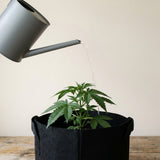
Here is the part every shopping list skips. In a closed tent, almost all of the water vapor in the air arrived through your watering can.
Plants do not store much of the water they drink. In their review of how water moves through plants, McElrone, Choat, Gambetta and Brodersen put the share a plant keeps for growth at less than 5% of what its roots absorb. The rest passes straight through and out of the leaves as vapor, a process called transpiration.1 A little more leaves off the surface of the pot. Only what runs out the bottom, and that you then carry out of the tent, does not end up in your air.

The pot matters too. A fabric pot loses water through its walls as well as its top. Jeff Million and Thomas Yeager grew holly in 18 L fabric and plastic containers for two 31-week runs and found the fabric pots needed 66% more irrigation water to make up for that sidewall evaporation.4 That was an outdoor nursery, not a tent, but the physics travels: every drop that leaves through the fabric leaves into your air. We make BudPots out of fabric on purpose, because a pot that dries fast is hard to overwater, and our fabric vs plastic comparison covers that trade. The honest cost is a little more water in the air, which your dehumidifier has to handle.

Do the arithmetic for your own grow
You do not need a sensor to estimate your humidity load. You need the watering numbers you already use. Our watering guide puts a 5 gallon (19 L) pot at 1.2 to 1.6 gallons (4.5 to 6 L) per watering, and mid flower at every 1 to 3 days. That works out to:
- One plant: 0.4 to 1.6 gallons (1.5 to 6 L) a day, or 3 to 13 pints a day. A typical rhythm of 1.4 gallons (5.3 L) every 2 days is 0.7 gallons (2.6 L), about 5.6 pints.
- Four plants on that typical rhythm: 2.8 gallons (10.6 L) a day, about 22 pints.
Subtract any runoff you collect and carry out of the tent, and that is the water your dehumidifier, your exhaust fan or both have to remove every day, just to stand still. Dehumidifiers are rated in US pints per day, which is why we keep the pint figure: 1 gallon is 8 pints, and 1 pint is about 0.47 L.

The load is not flat across the grow. It peaks during the stretch and mid flower, when the plants are biggest and drinking hardest, and falls in the last two or three weeks as growth stops and the older leaves fade. The bad news is that the lowest humidity target of the whole grow arrives in late flower, at the same time as plants that are still putting gallons into the air. Size for the peak.

If you already run a dehumidifier, empty its bucket into a measuring jug once. That is the load, measured. A bucket that fills every day with roughly what you poured is the whole argument of this section in one picture.
Measure It First: Where the Hygrometer Goes and How to Check It
Everything in this guide depends on one reading, so get it right before you buy anything. A hygrometer is the meter that reads relative humidity; most cheap ones read temperature too.
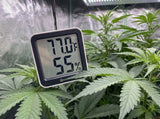
Put it at canopy height, in the shade of the leaves. Not on the tent wall, not on the floor, not in the light beam. The air the buds sit in is what matters. A min-max memory is worth having, because the most important reading of the day, just after lights-off, happens when you are not looking.

Then check it, because cheap hygrometers drift. The salt test is the free way to find out by how much. A sealed space over a damp paste of table salt settles at a known humidity: Lewis Greenspan's reference tables, published by the US National Bureau of Standards, put saturated sodium chloride at 75.5% RH at 68°F (20°C) and 75.3% at 77°F (25°C).5 Call it 75%.
- Fill a bottle cap with table salt and add a few drops of water until it is a damp paste, not a liquid.
- Seal the cap and the hygrometer together in a zip bag, at room temperature, out of the sun.
- Wait at least 8 hours, and read the hygrometer without opening the bag.
- Whatever it reads, the difference from 75 is its error. If it says 71, add 4 to every reading.

If you would rather not mix salt, a 2-way humidity pack calibration kit, such as the Boveda one-step kit at 75%, does the same job in a sealed bag. Either way, write the correction on a piece of tape on the meter. A meter reading 5 points low makes a 55% tent look like 50% and talks you out of the dehumidifier you need.

How to Lower Humidity in a Grow Tent, Step by Step
Work through these in order. The first three cost nothing or close to it, and they are often enough in veg or in a dry winter house. The later steps are for flowering tents that the cheap fixes cannot hold.
Step 1 - Measure what you pour, and stop pouring what the plant did not ask for
Water by the pot's weight, not on a schedule: lift the pot and water when it has lost about half the weight it gained at its last watering. Every unnecessary watering is water you then have to pull back out of the air.
That rule comes from our weight method for watering, and it is the cheapest humidity control there is. It matters most in late flower, when demand falls and keeping the mid-flower rhythm is the most common overwatering of the whole grow. A pot on a cheap bathroom scale makes it exact.

Step 2 - Get the runoff out of the tent
Runoff left standing in saucers or trays evaporates straight back into the tent air. Empty saucers within the hour, or stand pots on raised trays that drain to a container you carry out.
In coco or any bottle-fed medium you want 15 to 20 percent runoff every watering, so this is a real amount of water: on a 5 gallon (19 L) pot that is roughly a fifth of a gallon (0.8 L) or more per plant per watering, sitting under your canopy if you leave it. In an amended or living soil you want little or no runoff to begin with.

Step 3 - Check whether your exhaust air is actually drier
An exhaust fan swaps tent air for room air. It lowers the humidity only if the room air holds less water than the tent air. Check the room before you turn the fan up.
This is the step most guides get wrong, because "more exhaust" is the reflex answer. The number that decides it is the dew point: the temperature at which a given body of air would start to condense. The lower the dew point, the less water the air holds. Here are three real situations, worked out with the standard vapor pressure equation from the FAO's crop water guidelines:6
- Your flowering tent at 77°F (25°C) and 55%: dew point about 60°F (15°C).
- A heated house in winter at 68°F (20°C) and 35%: dew point about 39°F (4°C). This air is bone dry next to the tent. Exhaust works brilliantly.
- A basement in a humid summer at 72°F (22°C) and 70%: dew point about 62°F (16°C). This air holds more water than your tent. Turning the exhaust up pulls wetter air in, and the tent humidity climbs.

You do not need to calculate a dew point to use this. A quick rule that is always true: if the room is cooler than the tent and its humidity reading is the same or lower, the room air is drier, and exhaust will help. If the room reads more humid than the tent, exhaust will not help no matter how big the fan is, and you need Step 5 or Step 6.
Step 4 - Run the exhaust continuously, including lights-off
Leave the exhaust fan on around the clock, and let a controller speed it up when the humidity rises rather than switching it off with the lights. The hours after lights-off are the wettest hours of the day.
An inline fan pulling air out through a carbon filter, with a passive or ducted intake low on the opposite side, is the standard setup our indoor setup guide lists. A controller such as the AC Infinity Controller 69 can raise the fan speed on a humidity setpoint, which is genuinely useful here: it reacts at 3am when you will not. How big a fan to buy for your tent is its own question, and we leave it to a separate guide; for humidity, what matters is that it never stops. Our grow tent temperature guide sizes that fan from your light's watts.

Step 5 - Dry the room, not just the tent
If the room around the tent is humid, put the dehumidifier in the room, outside the tent, and let the tent's intake draw the dried air in. The tent stays cooler, and the machine sees the whole room's air.
For most home tents up to 4 ft by 4 ft (120 x 120 cm), this is our recommendation and the single change that fixes the most summer grows. It solves Step 3's problem at the source: the dehumidifier turns the room air into air that is drier than the tent, so the exhaust works again. It also keeps the dehumidifier's heat out of the tent, which matters more than most people expect.

Here is that heat, worked out. A dehumidifier does not destroy the water's heat; it turns it back into warm air. Every pint it condenses releases the energy that evaporated it (about 2.45 MJ per kg of water, the latent heat the FAO guidelines use6), and all the electricity it draws ends up as heat as well. Removing 20 pints (9.5 L) a day releases about 270 watts of heat from the condensing water alone. Add the machine's own power, roughly 220 watts on average for a unit that removes 1.8 liters per kilowatt-hour (the rating of the 65-pint General Electric unit that NREL tested; it measured 1.9 in their lab3), and you have close to 500 watts of heat running around the clock. Inside a 2 ft by 4 ft (60 x 120 cm) tent, that is a second heater.

So the order of preference is: dehumidify the room, and duct or draw that air into the tent. Put the dehumidifier inside the tent only when the tent is large enough to absorb its heat and you have a way to remove that heat, or when the tent sits in a space you cannot dehumidify, such as a closet in a shared room. If it does go inside, run its drain hose out of the tent to a container or a drain, so you are not opening the tent to empty a bucket every few hours.

Step 6 - Add a dehumidifier sized from your pour
Buy a compressor dehumidifier whose rated capacity in pints per day is at least twice the water you pour per day at peak, minus the runoff you carry out. For four plants in 5 gallon (19 L) pots, that is a unit rated around 45 to 50 pints.
The full sizing logic, what the rating means and why the little thermoelectric units do not work for a flowering tent, is in the next section. The short version: the box rating is optimistic for late flower, the humidity reading peaks after lights-off, and an undersized dehumidifier runs flat out and still loses.
Step 7 - Open the canopy and hold the setpoint through lights-off
Thin the dense interior of the canopy so air can move through it, run a fan under the canopy as well as over it, and set the controller or dehumidifier to hold the same humidity at night as by day.
The air inside a dense cola is wetter than the room around it. Our bud rot guide covers measurements of bud interiors running about 15% higher in humidity than the surrounding air, which is why a room at 55% can still grow mold. Defoliating in flower opens the canopy so air can reach those pockets, and fans placed over and under the canopy keep it moving.

Then deal with lights-off, which is where most tents actually fail. Relative humidity is relative to temperature, so it rises when the air cools even if no water is added. Our flowering guide recommends a lights-off drop of 5 to 10°F (3 to 6°C). Take a tent at 77°F (25°C) and 50% and let it fall 10°F (6°C) to 67°F (19°C) with the same water in the air: the humidity reads 70%. That is the line our bud rot guide sets for Botrytis spores to get in. Same water, no extra drop poured, and the tent has walked from the safe band to the danger line.

Two fixes, and you want both. Keep the dehumidifier and exhaust working through the night on a humidity setpoint, not a timer. And if your tent overshoots, take a smaller day-night drop in late flower, 5°F (3°C) rather than 10°F (6°C), which our flowering guide's range allows. Condensation on the tent walls or beads on the leaves when the light comes on is the sign you are losing this fight.

What Size Dehumidifier for a Grow Tent?
This is the most searched question in the whole topic, and the usual answer, a size per tent footprint, ignores the only thing that sets the load. Here is our rule and where it comes from.
Our rule: rated pints per day of at least twice your peak daily pour in pints, minus the runoff you carry out. The doubling covers three things the rating does not. First, the rating conditions. Second, the drop in performance at the humidity you actually want. Third, the jump in the humidity reading after lights-off.
What the pint rating on the box actually means
In the US, a portable dehumidifier's capacity is measured under the Department of Energy's test procedure, and since 2019 that test runs at 65°F (18°C) and 60% relative humidity.2 Before the change, the same machines were rated at 80°F (27°C) and 60%, which gave bigger numbers for the same box. ENERGY STAR's own conversion puts an old 70-pint rating at roughly 40 to 45 pints on the new test, and an old 50-pint rating at about 30. If you are buying used, or reading an older review, check which rating you are looking at.
Either way, the test point is 60% humidity. In late flower you are asking for 45 to 55%. Jon Winkler, Dane Christensen and Jeff Tomerlin at the National Renewable Energy Laboratory tested six home dehumidifiers across a wide range of temperatures and humidities and mapped how their performance changes. Every unit removed less water per kilowatt-hour as the air got drier and cooler. Reading their efficiency curves at about 80°F (27°C), the units managed roughly 15 to 25 percent less at 50% humidity than at 60%, and roughly 25 to 45 percent less at 40%.3 A dehumidifier works hardest exactly where you need it least, and loses ground as you approach the target.

Dehumidifier size by plant count
Using the typical mid-flower rhythm from our watering guide (1.4 gallons, or 5.3 L, every 2 days per 5 gallon pot, about 5.6 pints a day per plant) and the doubling rule:
| Plants in 5 gal (19 L) pots, mid flower | Water into the air per day | Rated capacity to buy | Where to put it |
|---|---|---|---|
| 1 plant | About 6 pints (2.6 L) | The smallest compressor units, about 20 pints | The room, outside the tent |
| 2 plants | About 11 pints (5.3 L) | About 25 pints | The room, outside the tent |
| 4 plants | About 22 pints (10.6 L) | About 45 to 50 pints | The room, or inside a 4 ft by 4 ft (120 x 120 cm) or larger tent with heat removal |
| 6 plants | About 34 pints (15.9 L) | About 70 pints, or two smaller units | The room |
Your own numbers beat ours. If your plants drink every day, double the water figure. If you run a smaller pot or water every three days, halve it. And if you grow in coco with 20% runoff that you remove, take a fifth off before you double. Grow-specific units such as the Spider Farmer and AC Infinity dehumidifiers, and ordinary home units from brands like Frigidaire and GE, all work; what matters is the rated pints on the current test, a continuous drain outlet so you are not emptying a bucket, and a setpoint you can trust at 45 to 55%.
Why mini dehumidifiers do not work in a flowering tent
The small white thermoelectric units sold for closets and grow tents, the Pro Breeze type, use a Peltier chip instead of a compressor. Their own listings put them at roughly 9 to 18 ounces of water a day, which is half a pint to just over a pint (about 0.25 to 0.5 L). One flowering plant on a typical rhythm puts about 5.6 pints into the air. A mini dehumidifier can keep a seed drawer dry. It cannot keep up with a single flowering plant, let alone a tent of them.


Desiccant dehumidifiers, which pull water out with a drying wheel instead of a cold coil, keep working at lower temperatures, but they run hotter, and in a warm grow room that heat is the last thing you want. For a tent, a compressor unit in the room is the right default.
What the Research Actually Says About High Humidity and Cannabis
Why bother with any of this? Because high humidity is not a comfort setting. It costs real yield and real potency, and it opens the door to the one disease that can take a whole harvest.
The clearest controlled trial is from Ingrid Carolina Corredor-Perilla, Tae-Hyung Kwon and Sang-Hyuck Park at the Institute of Cannabis Research at Colorado State University-Pueblo, who grew cannabis in two rooms that differed in humidity: one at 37 to 58% and one at 78 to 98%. Read from their raw measurements, the plants in the drier room produced 33.8 g of flower per plant against 9.9 g in the humid room, and carried 27.8 mg/g of CBDA, the acid form of CBD, against 5.7 mg/g, nearly five times as much. Flowering was also delayed in the humid room.7 That was a comparison of a dry room with a very wet one, not of 50% against 55%, so it tells you the cost of letting a tent run swampy, not the value of the last few points.

The disease is bud rot. Our bud rot guide sets out the evidence: Botrytis spores need humidity above about 70% to get into a bud, and the inside of a dense cola runs wetter than the room. That is why the late-flower band is 45 to 55%, and why the night spike in Step 7 matters more than the daytime reading.
Two humidity myths are worth clearing up while you are here, because both send growers in the wrong direction:
- Powdery mildew does not need wet leaves. Its spores germinate on dry leaves and free water on a leaf kills them. Humid air favors it, but no humidity threshold has been measured on cannabis, and humidity alone does not cause it. Our powdery mildew guide explains it, and keeps the same humidity bands as this one.
- Raising the humidity does not drown spider mites. Their eggs survive saturated air and hatch within hours of drying out. Our spider mite guide has the research. Keep the room on its normal bands and fight mites with a schedule.
There is a cost at the other end too, which is the next section. A tent that is too dry in veg makes plants work harder for water than they need to, and seedlings in dry air struggle until their roots catch up.
How to Raise Humidity in a Grow Tent
Raising humidity is a seedling, clone and veg job, and mostly a winter one, when a heated house runs dry. In flower, adding water to the air is rarely worth it: the bands only fall from here, and a few points under target is far safer than a few over.
Seedlings and clones: use a dome, not the whole tent
The 70-80% that seedlings want is far too wet for anything else in the tent, so do not try to bring the tent there. A clear dome over the tray or cup holds that humidity around the seedling alone, as our planting guide sets out, with daily venting and removal once the leaves touch the sides. Beads of water on the inside of the dome are normal; water pooling on the leaves means it is time to vent more.

Clones get the same treatment, with the venting schedule in our cloning guide. A BudCup takes an upside-down clear cup as a single-plant dome, which is how we start our own seedlings.

Slow the exhaust down
Before you buy anything, turn the exhaust fan down. In a dry house, the exhaust is what is pulling your plants' water out of the tent. A lower fan speed, or a controller that only speeds the fan up for heat, can lift a veg tent several points on its own. Do not switch the exhaust off entirely: the plants still need fresh air.
Add a humidifier, and fill it with clean water
For a veg tent in a dry house, a small humidifier on a humidity setpoint is the reliable answer. Grow-specific units such as the AC Infinity Cloudforge T3, listed by retailers at 12 pints a day, can sit outside the tent and push mist in through a tube; an ordinary room humidifier inside the tent works too. Point the mist into open air above the pots, never onto the leaves.

Fill an ultrasonic humidifier with distilled or reverse-osmosis water, not tap water. An ultrasonic unit throws the water's dissolved minerals into the air along with the mist. A team at Virginia Tech led by A. E. Sain and Andrea Dietrich ran an ultrasonic humidifier with waters of different hardness and found the particles it released carried the same minerals, in the same proportions, as the water in the tank, with harder water producing more and larger particles.8 In a tent, those minerals settle as a white film on the leaves and the floor, and you breathe them when you open the zipper. An evaporative humidifier, which blows air through a wet wick, does not throw minerals into the air, which makes it a good choice where you only have hard tap water.

Do not mistake that film for powdery mildew. Mineral dust sits evenly on everything, the tent floor and the humidifier included, and wipes off in one pass. Mildew grows in spots and blotches on the leaves and nowhere else, and it comes back after you wipe it.
How to raise humidity without a humidifier
These all work a little, and none of them work as well as a humidifier on a setpoint:
- A damp towel hung inside the tent. Big surface, cheap, and it adds a few points in a small tent. Re-wet it daily and wash it often so it does not sour.
- A wide tray of water. Weaker than a towel, because only the surface evaporates.
- More plant. A tent full of leaf makes its own humidity. A single small plant in a large tent will always read dry.
- Not misting the plants. Misting leaves lifts the reading for minutes, wets the leaves, and changes nothing an hour later. It is not a humidity control.

Common Grow Tent Humidity Mistakes
The ones we see most, roughly in order of how much they cost:
Buying a dehumidifier by tent size
The tent's footprint does not make the water. The plants do. A 4 ft by 4 ft (120 x 120 cm) tent with one small autoflower and the same tent with four big photoperiods in mid flower need very different machines. Work from what you pour.
Buying a thermoelectric mini dehumidifier for a flowering tent
It removes about a pint a day. One plant puts out five or more. It will run all day and change nothing you can measure.
Turning the exhaust up in a humid room
If the room air holds more water than the tent air, more exhaust means more water. Check the room first (Step 3), and dry the room if it is the problem (Step 5).
Putting a big dehumidifier inside a small tent
Close to 500 watts of heat for every 20 pints a day. Your humidity drops and your temperature climbs, which costs you terpenes and, at the tops, can start stress foxtailing.
Switching everything off at lights-off
The tent cools, the humidity jumps, and the night is when bud rot gets in. Keep the exhaust and dehumidifier running on a setpoint through the dark period.
Running a humidifier and a dehumidifier together in a grow tent
In a tent of living plants, two machines fighting each other burn power, add heat and swing the reading up and down all day. Pick the one your stage needs: a humidifier for seedlings and veg in a dry house, a dehumidifier for flower.
Drying is the exception. A drying room releases far more water in the first two days than later in the dry, so it can swing wet and then dry within a week. For that job Scott Golem runs both, each on its own humidistat, so one catches the room when it goes dry and the other when it goes wet. Our drying guide covers that setup.

Trusting an uncalibrated hygrometer
A meter that reads 5 points low is a meter that hides a mold problem. Do the salt test once and write the correction on the meter.
Leaving runoff under the plants
Standing runoff is a humidifier you did not buy. Empty the saucers.
Raising humidity in flower
A flowering tent a few points under its band is rarely a problem worth adding water to the air for. Check that the plants are watered and leave the air alone; a few points under is far safer than a few over.

Too Humid? What to Do First
When the reading is high and you do not know where to start, work this list top to bottom. Each line is cheaper than the one below it.
- Is the meter right? Salt test it.
- Are you overwatering? Lift the pots. Water by weight.
- Is runoff standing in the tent? Get it out.
- Is the exhaust running all the time? Keep it on through lights-off.
- Is the room air drier than the tent? If not, dry the room.
- Is your dehumidifier at least twice your daily pour? If not, size up.
- Is the canopy dense and still? Thin it and add a fan under it.
Frequently Asked Questions
What should the humidity be in a grow tent?
It depends on the stage. Seedlings want 70-80% for the first two weeks, then 60-70%. Veg runs at 55-65%. In flower, aim for 55-65% in weeks 1 to 3, 50-60% in mid flower and 45-55% in late flower. Drying rooms start at 50% for two days, then 55%, and curing jars sit at 58-62%.
How do I lower the humidity in my grow tent?
Start free: water by the pot's weight, empty standing runoff, and run the exhaust fan around the clock. Then check that the room air is drier than the tent; if it is not, dehumidify the room and let the tent draw that air in. If the tent still runs high, add a compressor dehumidifier rated at about twice the water you pour per day.
What size dehumidifier do I need for a 4x4 grow tent?
Size it from the water you pour, not the tent. Four plants in 5 gallon pots in mid flower put about 22 pints of water a day into the air, so look for a unit rated around 45 to 50 pints a day on the current US test. One or two plants need far less. Put it in the room outside the tent if you can.
Should the dehumidifier go inside or outside the grow tent?
Outside, in the room, for most home tents. A dehumidifier turns the water it removes back into heat, close to 500 watts around the clock for 20 pints a day, which overheats a small tent. Dry the room and let the tent's intake draw that air in. Put it inside only in a large tent with a way to remove the heat.
Does an exhaust fan lower humidity in a grow tent?
Only when the air it pulls in holds less water than the tent air. In a heated house in winter it works very well. In a humid summer basement the room air can hold more water than the tent, and more exhaust makes the tent wetter. If the room is cooler than the tent and reads the same or lower humidity, the exhaust will help.
Do mini dehumidifiers work in a grow tent?
Not in flower. Thermoelectric mini units, the Pro Breeze type, are listed at roughly 9 to 18 ounces of water a day, about half a pint to a pint. A single flowering plant on a typical watering rhythm puts about 5.6 pints a day into the air. They can keep a closet or a seed drawer dry, not a tent of plants.
Why does humidity go up when the lights go off?
Relative humidity is relative to temperature. When the lights go off the tent cools, and the same water in cooler air reads as higher humidity. A tent at 77°F and 50% that cools 10°F to 67°F reads 70% with no extra water added. Keep the dehumidifier and exhaust running through the night on a setpoint.
How do I raise the humidity in my grow tent without a humidifier?
Turn the exhaust fan down first, since it is usually what is drying the tent. A damp towel hung inside adds a few points in a small tent, and a wide tray of water adds a little. More leaf in the tent raises it too. Do not mist the plants: it lifts the reading for minutes and only wets the leaves.
Can I use tap water in a grow tent humidifier?
Not in an ultrasonic one. Research from Virginia Tech found ultrasonic humidifiers throw the water's dissolved minerals into the air in the same proportions as the tank water, and harder water makes more particles. In a tent they settle as white dust on the leaves. Use distilled or reverse-osmosis water, or an evaporative humidifier if you only have hard tap water.
Is the AC Infinity Cloudforge humidifier good for a grow tent?
For a veg tent in a dry house, a grow-specific humidifier like the Cloudforge T3, listed at 12 pints a day, is a convenient choice because it can sit outside the tent and feed mist in through a tube on a humidity setpoint. Fill it with distilled or reverse-osmosis water. In flower you rarely need one.
How do I know if my hygrometer is accurate?
Do the salt test. Seal the hygrometer in a zip bag with a bottle cap of damp table salt paste, wait at least 8 hours at room temperature, and read it without opening the bag. Saturated salt holds about 75% humidity, so the difference from 75 is your meter's error. A 75% two-way humidity pack calibration kit does the same job.
Is high humidity bad for cannabis in flower?
Yes. In a controlled trial by Ingrid Carolina Corredor-Perilla, Tae-Hyung Kwon and Sang-Hyuck Park, plants in a room at 78 to 98% humidity produced 9.9 g of flower each against 33.8 g in a room at 37 to 58%, with far less CBDA and delayed flowering. High humidity in late flower is also what lets Botrytis bud rot get into dense colas.
Do fabric pots raise the humidity in a grow tent?
A little. Fabric pots lose water through their walls as well as their top, so you water them more often, and that water ends up in the air. In one nursery trial fabric containers needed 66% more irrigation than plastic. It is the price of a pot that is hard to overwater, and a correctly sized dehumidifier handles it.
Where to Go From Here
If your humidity is under control and you want to fine-tune the climate, our VPD chart turns temperature and humidity into one number per stage. If you are fighting gray mold already, go straight to the bud rot guide's plan for what to do when you find it. And when the plants come down, the drying guide takes over the humidity schedule for the dry, and the curing guide for the jar.

References
- McElrone, A. J., Choat, B., Gambetta, G. A., & Brodersen, C. R. (2013). Water uptake and transport in vascular plants. Nature Education Knowledge, 4(5), 6. https://www.nature.com/scitable/knowledge/library/water-uptake-and-transport-in-vascular-plants-103016037/
- US Department of Energy. Uniform test method for measuring the energy consumption of dehumidifiers. Code of Federal Regulations, Title 10, Part 430, Subpart B, Appendix X1. https://www.ecfr.gov/current/title-10/chapter-II/subchapter-D/part-430/subpart-B/appendix-Appendix X1 to Subpart B of Part 430
- Winkler, J., Christensen, D., & Tomerlin, J. (2011). Laboratory test report for six ENERGY STAR dehumidifiers (NREL/TP-5500-52791). National Renewable Energy Laboratory. Results presented in Winkler, J. (2012), Laboratory performance testing of residential dehumidifiers, Building America Stakeholders Meeting. https://www.energy.gov/sites/default/files/2013/12/f6/lab_testing_dehumidifiers.pdf
- Million, J. B., & Yeager, T. H. (2022). Fabric containers increased irrigation demand but decreased leachate loss of nitrogen and phosphorus compared with conventional plastic containers during production of dwarf Burford holly. HortScience, 57(7), 743-749. https://doi.org/10.21273/HORTSCI16570-22
- Greenspan, L. (1977). Humidity fixed points of binary saturated aqueous solutions. Journal of Research of the National Bureau of Standards, Section A: Physics and Chemistry, 81A(1), 89-96. https://doi.org/10.6028/jres.081A.011
- Allen, R. G., Pereira, L. S., Raes, D., & Smith, M. (1998). Crop evapotranspiration: guidelines for computing crop water requirements. FAO Irrigation and Drainage Paper 56, Chapter 3. Food and Agriculture Organization of the United Nations. https://www.fao.org/4/x0490e/x0490e07.htm
- Corredor-Perilla, I. C., Kwon, T.-H., & Park, S.-H. (2025). Elevated relative humidity significantly decreases cannabinoid concentrations while delaying flowering development in Cannabis sativa L. Frontiers in Plant Science, 16, 1678142. https://doi.org/10.3389/fpls.2025.1678142
- Sain, A. E., Zook, J., Davy, B. M., Marr, L. C., & Dietrich, A. M. (2018). Size and mineral composition of airborne particles generated by an ultrasonic humidifier. Indoor Air, 28(1), 80-88. https://doi.org/10.1111/ina.12414

About the Author
Henrique Dias is the CEO and co-founder of BudTrainer. He is a mechanical engineer who also holds a graduate certificate in Commercial Cannabis Production from Niagara College in Ontario, Canada - the first college-level cannabis cultivation program in North America. Before founding BudTrainer, Henrique worked with Health Canada licensed cannabis producers, where he gained hands-on experience in cultivation, processing, and post-harvest management of cannabis at commercial scale. He started BudTrainer to bring that same level of craft to home growers through better-designed gardening tools and clear, science-backed education.
DISCLAIMER: Everything taught and sold by BudTrainer® is to be used strictly for legal purposes. We do not endorse the production of illegal substances and it is your duty to ensure that you are complying with the law. The words "hemp," "cannabis," "weed," and "marijuana" are used interchangeably to refer to the same plant (legal hemp with less than 0.3% THC) for the purposes of this lesson.