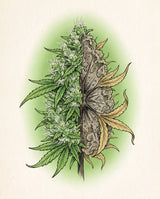
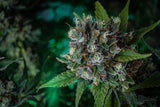
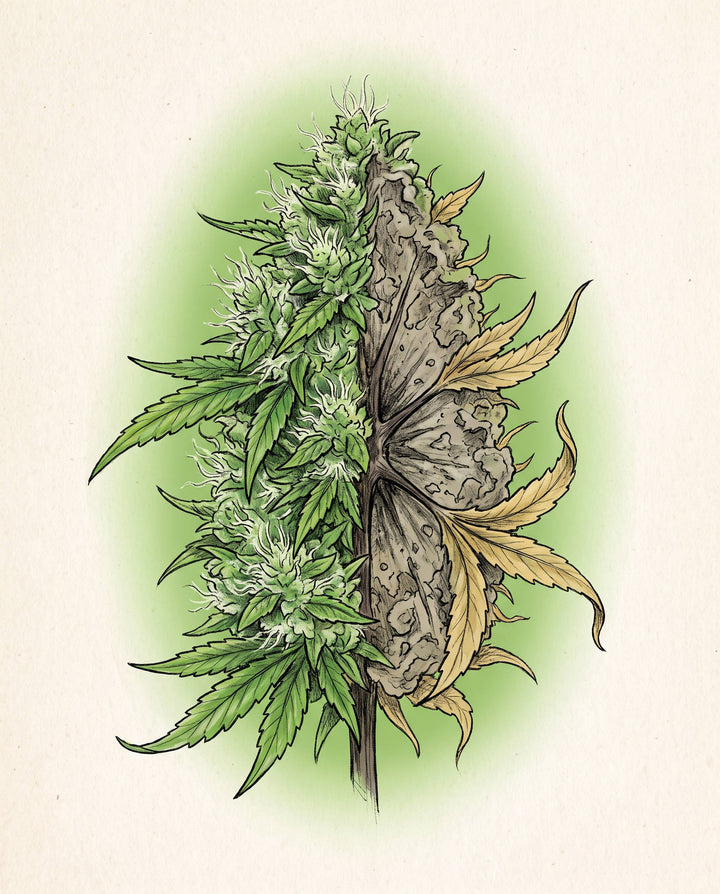
It usually starts with one leaf. A lower fan leaf, somewhere in the shade, with a faint gray-white dusting that looks like someone breathed flour at it. Two weeks later the patches have joined up, the leaves around it have them too, and there is a faint dust on the sugar leaves near your best colas.
This guide covers how to tell powdery mildew from the five things it gets mistaken for, why it behaves nothing like bud rot, what the cannabis spray trial actually measured, exactly how and when to spray (and when to stop), how to keep it out of your grow, and an honest answer on buds that have it.
What Powdery Mildew Actually Is
Powdery mildew on cannabis is a fungus. In US research it now goes by Golovinomyces ambrosiae; older papers call the same organism G. cichoracearum or G. spadiceus, because the DNA region early studies used could not tell those names apart.3 You do not need the Latin to fight it, but you will meet all three names if you read further, and they are the same enemy.
The one fact that explains almost everything about how it behaves: it can only live on living plant tissue. It cannot grow in soil or on a dead leaf. It lands on a leaf, pushes a tiny feeding structure into the outer layer of cells, and then lives on the surface, spreading as a flat mat of threads and throwing up chains of new spores for the air to carry away. Cameron Scott's thesis at Simon Fraser University puts the first new white patches within about 7 days of infection.4

That surface life is why the white powder rubs off with a finger, and also why rubbing it off does not cure anything. The feeding structures stay put in the leaf, and every spore your finger knocks loose is looking for a new leaf. It is also why it does not hide inside the plant. No peer-reviewed work has shown this fungus inside the stems or the vascular system of cannabis, and Scott's thesis says plainly that it is not known to spread systemically.4 It rides into grows on living plants, but on them, not in them.
The words you will meet in this guide
| Term | What it means here |
|---|---|
| Spore (conidium) | The microscopic seed of the fungus. Powdery mildew makes millions of them and the air moves them around. |
| Sugar leaves and bracts | The small resin-coated leaves that grow out of a bud, and the tiny leaf-like cups each flower sits in. Mildew on these is mildew on your harvest. |
| Colony | One white patch: a mat of fungal threads living on the leaf surface. |
| Obligate parasite | An organism that can only live on a living host. Powdery mildew is one, which is why it cannot live in soil. |
| Systemic | Spreading inside the plant through its plumbing. Powdery mildew is not known to do this on cannabis. |
| Potassium bicarbonate | A salt related to baking soda (which is sodium bicarbonate). It is the active ingredient in MilStop and GreenCure, and the best performer a home grower can buy in the cannabis trial. |
| Biological fungicide | A spray based on a living microbe or plant extract, such as Bacillus subtilis products or knotweed extract (Regalia). |
| Quarantine | Keeping a new plant away from your grow long enough for a hidden infection to show itself. |
What Powdery Mildew Looks Like on Cannabis, Stage by Stage
It almost always starts on older leaves in shade, low and deep inside the plant, and works outward and upward. The top of the canopy, in full light, is usually the last place to show it.
Stage 1: a faint haze
A barely visible grayish haze on the upper surface of a lower fan leaf, usually near the base of a leaflet or along the midrib, sometimes with a few fine specks. It is easy to mistake for dust. It does not blow off like dust, and in a few days there will be more of it.

Stage 2: dusty gray-white blotches
The haze thickens into soft, cloudy blotches with feathered edges, gray-white rather than bright white, and you can still see the green of the leaf through them. This is the stage most growers first notice, and it is the stage where treatment has its best chance. By now the spores are already airborne, so assume the leaves around it are infected even if they look clean.
Stage 3: patches merge and leaves pale
The patches join into a continuous dusty coating. The leaf underneath turns pale and yellowish, because the fungus is feeding on it and blocking its light. Scott and Punja note that colonies limit photosynthesis and can make leaves drop early.1

Stage 4: it reaches the flowers
In flower, the powder climbs onto the sugar leaves and bracts around the buds. Punja's group photographed spores stuck to the resin glands themselves.3 This is the stage that costs you the harvest, and it is the stage where your options get narrow, as the section on treating it explains.

Notice the two different pale coatings in that photo. The resin on the calyxes has a glassy shine. The mildew on the leaves is flat and dull. That is the first tell, and the next section has the rest.
Is It Really Powdery Mildew? Five Things It Gets Mistaken For
Before you spray anything, do the rub test. Wipe one patch with a fingertip. Powdery mildew smudges away and leaves a clean streak of green leaf behind it, with a trace of gray powder on your fingertip. Then wash your hands before you touch another plant.

| What it is | How it looks | The giveaway |
|---|---|---|
| Powdery mildew | A matte gray-white dusting on top of leaves, thin enough to see the green through, later on bracts | Rubs off with a finger and leaves the leaf behind |
| Trichomes | Glittering resin glands on calyxes and sugar leaves | They sparkle and do not rub off. Under a loupe each one is a round head on a stalk |
| Spider mites | Hundreds of tiny pale pinprick dots, sometimes fine webbing | The dots are in the leaf, not on it, and nothing rubs off |
| Spray or hard water residue | White crusty rings or spots where droplets dried | It appears the day after a spray, in droplet shapes, and does not spread |
| Pollen | Fine pale yellow dust on leaves under or near a male or hermaphrodite plant | Yellowish rather than white, and it blows off rather than smudging |
| Bud rot | Gray-brown decay inside a bud, a leaf that pulls out too easily | It is inside the bud and the bud goes soft. Powdery mildew stays on the surface |
Powdery mildew or trichomes?
This is the most common worry in late flower, and a loupe (a small jeweler's magnifier) settles it in seconds. Trichomes are individual glass-like stalks with a round head, spaced apart, glossy and bright. Powdery mildew is a flat tangle of threads with upright chains of spores, and it absorbs light instead of throwing it back. Our harvesting guide shows how to read trichomes under magnification, and the same 30x to 60x loupe does this job too.


Powdery mildew or spider mites?
Spider mite damage is pale speckling that is part of the leaf itself, where the mites have sucked out individual cells. Nothing rubs off, and if you flip the leaf you may see the mites or their webbing. Powdery mildew is a coating sitting on top of a leaf that is otherwise clean.


Powdery mildew or bud rot?
They are both fungi, both show up late in the season, and they want almost opposite things. Bud rot starts inside the densest part of a cola where water collects; powdery mildew lives on the outside of leaves and does not need them wet at all. If you are looking at gray or brown tissue inside a bud, you are in the wrong article. Our bud rot guide covers that one, including its own table of look-alikes.

What the Research Actually Says About Humidity, Water and Temperature
The standard advice is "powdery mildew is caused by high humidity, so drop your humidity." That is half right, and the half that is wrong sends growers after the wrong fix.
It is a dry-leaf disease
Unlike bud rot, powdery mildew spores do not need water on the leaf to sprout. University of California plant pathologists put it flatly: every powdery mildew species can germinate and infect without water on the plant surface, and water sitting on a leaf for long periods inhibits the spores and kills most of them (UC IPM). A. Sivapalan's rain experiments on several powdery mildew species found that falling drops knocked spores off leaves and held back the disease that followed.5

Humid air is a different thing from a wet leaf, and humid air does help it. The most precise measurement comes from grapevines, not cannabis: Carroll and Wilcox found grape powdery mildew got steadily worse as humidity rose to about 85 percent, while spore germination fell off sharply above about 87 percent.6 So the fungus likes air that is humid but not saturated, landing on leaves that are dry.
Two honest caveats. First, nobody has run that experiment on cannabis. Scott's thesis recommends keeping humidity below 50 to 60 percent, but it cites grape and tomato work to support the number, not a cannabis trial.4 Second, please do not read "water kills the spores" as "mist your plants." Wet leaves and wet buds are exactly what bud rot and a dozen other fungi want. The practical takeaway is not a new humidity number. It is that humidity is one factor among several, and not the one most growers are missing.
So what should your room run at?
Keep to the environment the rest of our guides already set, because it is built around bud rot as well as mildew. In veg that is 71-82°F (22-28°C) and 55-65% relative humidity, from our indoor growing guide. In flower it is 55 to 65 percent in weeks 1 to 3, 50 to 60 percent in weeks 4 to 6 and 45 to 55 percent in weeks 7 and 8, as our flowering stage guide sets out. If powdery mildew is a repeat problem in your room, run the bottom of each band, and hold it through lights-off, when humidity climbs on its own.
Temperature and shade matter as much as humidity
The UC IPM guidance puts the most favorable conditions for powdery mildew at moderate temperatures of 60-80°F (16-27°C) combined with shade, and notes that temperatures above 95°F (35°C) can suppress it. That describes the inside of a dense cannabis plant perfectly: comfortable temperature, still air, no direct light. It is why the disease starts where it does.

How Powdery Mildew Gets Into Your Grow
Because it can only live on living plants, it has to be carried in. There are three realistic routes.

- On a clone. This is the big one for indoor growers. Punja's group photographed powdery mildew developing on the leaves and stems of vegetative cuttings, and names propagation as a way the disease spreads.3 A cutting can look spotless the day you get it and show patches a week later.
- Through the air. The spores travel long distances on air currents. Outdoors that includes other plants: the species that infects cannabis is also recorded on plants in the daisy family, so a mildewed garden may be a source.
- From an older infected plant. The Pacific Northwest plant disease handbook's hemp guidance warns against overlapping crops, because young plants next to older mildewed ones is how epidemics start (PNW Handbooks). A mother plant with mildew in the same room as your seedlings is exactly this.
What it does not do is live in your soil. The overwintering structures some powdery mildews form have not been observed on cannabis plants, according to Scott's thesis.4 Reusing a medium is not what brought it back. Bringing in a plant, or keeping one, is.
Why It Shows Up in Late Summer and Fall
If you grow outdoors, powdery mildew is a September problem. Rivedal and colleagues surveyed hemp fields across Oregon and Washington in 2021 and 2022. In Oregon they found no powdery mildew at the early-season visits, 4.6 to 6.5 percent of fields with it mid-season, and 36.8 to 41.4 percent by the late-season visits.2

The survey does not say which weather variable drove that climb, so what follows is our reading, not their finding. By late season everything the fungus likes has stacked up at once. The plant is at its biggest and densest, so its interior is more shaded and still than at any other point. Summer heat has broken, so temperatures sit in that moderate band. And it has had months for a few airborne spores to build into an epidemic.

Outdoors, that means your prevention window is summer, not September. Thin the interior of the plant while you are still training it, as our outdoor growing guide describes, and start checking the shaded lower leaves every week from mid-summer. Outdoor photoperiods finish anywhere from late September to early November depending on your region and cultivar, which is a long time to carry an infection you did not catch early.
How to Prevent Powdery Mildew
No trial has measured airflow, pruning or spacing against powdery mildew on cannabis. What exists is the biology above and cannabis work on mold in general. Scott's own management advice for cannabis lists the same things: air movement, pruning and deleafing, and proper spacing.4 Here they are in the order we would do them.
1. Keep it out
Most indoor infections walk in on a plant. Start from seed where you can: no research has found this fungus carried on seed. If you take clones, take them from a mother you have watched closely, and if you bring in clones from anyone else, quarantine them.

Two weeks is our number, and here is the reasoning. A fresh infection shows its first patches within about a week,4 so two weeks gives any infection that arrived with the plant two full chances to show itself. Check the tops and undersides of every leaf with a loupe on day 0, day 7 and day 14. If a mother plant has ever had mildew, Scott and Punja's own method is worth copying: they gave their stock plants two weekly potassium bicarbonate sprays before taking any cuttings.1 Our cloning guide covers keeping a mother clean and disinfecting your blade between plants.

2. Open the canopy
A dense plant builds its own powdery mildew room inside itself: shaded, still, humid, comfortable. The fix is structural, and it starts in veg. Spread the branches wide with low stress training so there is space between them, using LST clips like the BudClips, then clear the lower third of the plant, where little light reaches and little bud forms. Our defoliation guide covers when and how much to take, and our low stress training guide covers opening a canopy without cutting anything.

In flower, holding heavy branches apart with garden wire like the BudHuggers keeps colas from closing back into a wall. To be clear about what we are claiming: no study has tested our clips or wire against powdery mildew. What the evidence supports is that shaded, still, crowded leaves are where the fungus starts, and you cannot get light and air into a plant you never opened.
3. Move air through the plants, not just over them
A fan pointed at the tent wall moves air past the canopy. What you want is gentle movement through it, so the leaves shimmer, plus one fan low enough to stir the air under the canopy, where it is stillest. Space plants so the leaves of neighbors do not interlock. In a study led by Punja, flower with fewer leaves around the buds and fans running during ripening carried lower total mold counts.7 That was mold in general, not powdery mildew specifically, but it points the same way.
4. Scout the shade every week
Powdery mildew is far easier to beat at stage 1 than stage 3, and stage 1 hides. Once a week, get down low with a flashlight and look at the lower and inner leaves, including a few undersides. It takes two minutes a plant.

5. Do not overfeed nitrogen
Soft, lush growth is easier for the fungus to colonize. The same Pacific Northwest hemp guidance says to keep nitrogen adequate but not excessive, because more succulent tissue is more susceptible. Feed to the plant's stage, as our nutrient guide sets out, rather than pushing extra nitrogen for growth.
6. Drop the strain that mildews every time
Genetics matter more than most growers think. In the Scott and Punja trial, 12 cannabis strains were exposed to the same mildew for two weeks, and 7 of them came out with significantly less disease than the other 5.1

Researchers have now found the genes behind some of this. Mihalyov and Garfinkel mapped a single dominant gene, PM1, that gave complete resistance to one Pacific Northwest isolate of the fungus (a single collected strain of it), while warning it may not hold against strains from elsewhere.8 Stack and colleagues at Cornell traced a recessive form of resistance to a broken copy of a susceptibility gene called CsMLO1: a quarter of the offspring in their crosses were resistant.9 None of this appears on seed packs yet. The practical version is simple: if one strain mildews every run while its neighbors stay clean, stop growing that strain, and if you have a keeper that never gets it, that is a clone worth taking.
You Found Powdery Mildew. Here Is What to Do
The right response depends almost entirely on where the plant is in its life. Spraying is on the table in veg, restricted in the first four weeks of flower, and off the table after that.

Step 1 - Confirm it is powdery mildew
Do the rub test and check the look-alike table above. If the patches smudge off and leave the leaf behind, it is powdery mildew. If they sparkle, or the dots are in the leaf, or the bud is soft inside, it is something else and the steps below are the wrong ones.
Step 2 - Bag the worst leaves before you cut them
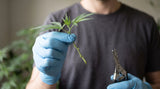
Hold an open zipper bag under the leaf, snip the leaf stem so the leaf drops straight in, and seal the bag before you walk it out of the grow. Shaking an infected leaf on the way out is how you seed the plant next to it. Take the leaves that are mostly coated; do not strip a plant bare, because a plant with no leaves has nothing to feed its buds with.

Be realistic about what this does. Punja notes that removing infected leaves is common practice, but the fungus reproduces so fast that cutting leaves off does not reliably slow the spread by itself.10 It lowers the spore load so the spray and the airflow have less to fight. It is not a treatment on its own.
Step 3 - Work out which window you are in
- Veg: you can spray the whole plant, weekly, for as long as it takes.
- Flower, weeks 1 to 4: you can spray leaves, but not the developing flowers, and your last spray is on day 28 of flower.
- Flower, week 5 until harvest: no more sprays. Remove leaves, fix the air, and check every bud.
Why day 28? Two reasons. Scott's thesis notes that sprays applied while the flowers are developing, including potassium bicarbonate and Regalia, can damage the pistils.4 And after about four weeks the buds are dense enough that anything wet you put on them becomes a bud rot risk. Our bud rot guide stops its preventive sprays at the same point, so the two guides agree.
Step 4 - Spray tops and undersides of the leaves
Use potassium bicarbonate at the label rate. In the trial, MilStop was mixed at 2.4 grams per liter, about 9 grams per gallon.1 Weigh it on a kitchen scale rather than guessing with a spoon, because a spoonful of fine powder varies a lot, and a stronger mix is not a better one on a leaf. Mix it fresh on the day you spray.

Spray with the grow light off or dimmed, so the leaves are not sitting wet under full intensity, and so they can dry with the fans running. Cover the tops of the leaves first, then lift the branches and spray up at the undersides, where the mildew hides and where most growers miss it. Wear gloves and eye protection.

If you would rather use neem oil, it was the second-best option you can buy at a garden center in the trial. Do not mix products or alternate at random: pick one. If you ever use sulfur, never follow it with an oil spray within two weeks, or the combination can burn the plant (UC IPM), and oils should not go on above 90°F (32°C). Whatever you use, it goes on the leaves and nowhere near the flowers.

Step 5 - Repeat weekly and watch the new growth
The trial applied treatments once a week for four weeks.1 Old patches will not vanish, because a spray stops the fungus rather than erasing the marks it already made. The sign it is working is that new leaves come in clean and the patches you have stop spreading. Wrap a twist tie around the stem of one marked leaf so you are checking the same leaf every week, not guessing.

If new growth is still coming in spotted after two weekly sprays, something is feeding the infection faster than you are spraying it: usually a shaded, crowded interior, or a second infected plant nearby.
Step 6 - Fix what let it in
Spraying without changing the conditions buys you a few weeks. Go back through the prevention list: open the canopy, move air through it, check your humidity through lights-off, and ask where it came from. If you brought in a clone in the last month, that is your answer.
What to Spray: The Trial, the Home Remedies, and the Chemicals to Avoid
Cameron Scott and Zamir Punja at Simon Fraser University ran the only controlled comparison of powdery mildew treatments on high-THC cannabis that we could find. They infected a susceptible strain, 'Copenhagen Kush', let the disease establish, then sprayed groups of four plants once a week for four weeks, and repeated the whole thing three times.1 Because the plants were already infected when spraying began, these numbers describe treating mildew, not just preventing it.

Three things stand out. Potassium bicarbonate was the best performer a home grower can buy, averaging within a point of a conventional fungicide that is not registered on cannabis at all. Neem oil did better than its reputation. And hydrogen peroxide, the product most often recommended online, reduced disease by 52 percent at best and by as little as 17 percent, and the authors grouped it with the less effective treatments. Scott and Punja also tested a handheld UV-C lamp, held 2 inches (5 cm) from the leaves for 3 to 5 seconds a day, which cut disease by 45.2 percent. UV-C burns eyes and skin, so it is a research result, not a weekend project.
A greenhouse trial on hemp in Tennessee, by Akinrinlola and Hansen, found stronger numbers still when sprays started around the time of infection: sulfur and MilStop both cut disease by 96 to 100 percent.11 That fits what the extension services say: nearly all of these products work best before the fungus is established, not after.
| Product | Evidence on cannabis or hemp | Our verdict | When |
|---|---|---|---|
| Potassium bicarbonate (MilStop, GreenCure) | 72 to 83 percent on cannabis; 96 to 100 percent on hemp | First choice | Veg; leaves only through flower day 28 |
| Neem oil | 60 to 81 percent on cannabis | Good second choice | Veg only; not above 90°F (32°C) or within two weeks of sulfur |
| Sulfur | 96 to 100 percent on hemp, preventive; never tested on high-THC cannabis | Works, but keep it to veg | Veg only; not above 85°F (29°C) |
| Bacillus and knotweed products (Rhapsody, Stargus, Regalia) | 32 to 80 percent on cannabis, inconsistent between trials | Middle of the pack | Veg; leaves only through flower day 28 |
| Hydrogen peroxide (ZeroTol) | 17 to 52 percent on cannabis | Weak; not our pick | Not recommended for mildew |
| Milk spray | No cannabis or hemp trial exists | Unproven on cannabis | Not recommended |
| Baking soda (sodium bicarbonate) | No cannabis or hemp trial; the tested salt is potassium bicarbonate | Use the tested one instead | Not recommended |
| Myclobutanil (Eagle 20, Rally) | Not permitted on cannabis; fails state testing | Never | Never |
A note on sulfur
Sulfur is an old, effective powdery mildew protectant, and the hemp trial backs it up. It is also fussy. The Pacific Northwest hemp guidance says it becomes damaging to plants above 95°F (35°C) and advises against using it above 85°F (29°C), and that it works as a protectant, so it has to go on before infection. We keep it to veg, and we never use a sulfur burner in a tent that holds flowering plants you intend to smoke.
Why never myclobutanil (Eagle 20)
Myclobutanil is a conventional fungicide sold as Eagle 20 and Rally, and it was behind two Canadian cannabis recalls in 2017. California fails inhalable cannabis that carries more than 0.1 micrograms per gram of it (California DPR), and in Canada it is not among the pesticides approved for use on cannabis.
You will read that burning myclobutanil turns into hydrogen cyanide. The chemistry is real: the safety data sheet for Rally, a myclobutanil product, lists hydrogen cyanide among its combustion products. But the scare version is overstated. When Health Canada measured recalled cannabis that carried trace myclobutanil, it calculated the extra cyanide at more than a thousand times lower than the cyanide cannabis smoke already contains, and rated the risk low (Health Canada). The real reasons not to use it are simpler: it is not allowed on cannabis, a home grower has no way to measure what residue is left on the flower, and in the cannabis trial potassium bicarbonate came within a point of a conventional fungicide without either problem.
Powdery Mildew on Buds: Can You Smoke It?
Here is the honest state of the evidence, followed by what we do.
- No study has measured the health effects of inhaling this particular fungus. Nobody has shown it is dangerous, and nobody has shown it is safe.
- It does end up in retail flower. A DNA survey of dispensary buds in northern California, reviewed by Punja's group, found Golovinomyces among the most commonly detected fungi.3
- A mold test may not catch it. Standard yeast and mold counts grow fungi on a lab plate, and this fungus cannot grow off a living plant. That is our reasoning from its biology, not a result anyone has published.
- It does not appear to change potency. In a two-season hemp field study, Ali Cala and colleagues at Cornell found that powdery mildew infection did not change the cannabinoid profile.12 Nobody has published a figure for how much yield it costs.
What we do: a fan leaf with mildew a month before harvest does not ruin a crop, so remove it and keep going. But any bud with white powder on it goes in the bin, not the jar. It does not get washed, it does not get made into extract, and it does not get mixed back in with the clean flower. A bud that grew mildew also sat in conditions other molds like, and a visibly contaminated bud is not worth the uncertainty.

If you find powdery mildew on buds that are already dry, the same rule applies: bin those buds, and check the rest of the batch under a loupe before it goes into jars. Our drying guide covers the drying room itself. Gray or fuzzy mold that appears during the dry is a different problem, and our rule for it is stricter still: bin the moldy bud and every bud that was touching it. The bud rot guide covers how that mold behaves after harvest.
Frequently Asked Questions
What does powdery mildew look like on cannabis?
A matte, gray-white dusting on the upper surface of leaves, like a light sprinkle of flour, with the green still showing through. It starts as a faint haze on shaded lower leaves, grows into soft cloudy blotches, then merges into a coating that turns the leaf pale. In flower it spreads to sugar leaves and bracts. Unlike trichomes it does not sparkle, and it smudges off with a finger.
What causes powdery mildew on weed plants?
A fungus, Golovinomyces ambrosiae, that can only live on living plants. It arrives on clones, on the air, or from an older infected plant nearby, then thrives on shaded leaves in still air at moderate temperatures. Humid air helps it, but it does not need wet leaves: its spores sprout on dry tissue, and water sitting on a leaf kills them.
How do I get rid of powdery mildew on cannabis?
Bag and remove the worst leaves, then spray the tops and undersides of the remaining leaves with potassium bicarbonate once a week. In the Scott and Punja cannabis spray trial it cut disease 72 to 83 percent. Spray freely in veg, spray leaves only in the first four weeks of flower, and stop after day 28. Then open the canopy and move air through it.
Can you smoke weed with powdery mildew?
No study has measured the effects of inhaling this fungus, so nobody can tell you it is safe or dangerous. We bin any bud with white powder on it rather than washing it, extracting it or mixing it back in. Leaves with mildew earlier in the grow do not ruin the harvest; buds with mildew on them are not worth the uncertainty.
Is powdery mildew the same as bud rot?
No. They are different fungi that want almost opposite things. Powdery mildew lives on the surface of leaves, is gray-white and dusty, and does not need wet leaves. Bud rot starts inside dense buds where water collects, turns the tissue gray and brown, and makes the bud soft. Powdery mildew rubs off with a finger; bud rot does not.
Does hydrogen peroxide kill powdery mildew on cannabis?
Not well. In the Scott and Punja cannabis trial, a 27 percent hydrogen peroxide product (ZeroTol) reduced disease by only 17 to 52 percent across three trials and was grouped with the less effective treatments. Potassium bicarbonate cut disease 72 to 83 percent in the same trial, and neem oil 60 to 81 percent. Hydrogen peroxide is the most repeated advice and one of the weakest options.
Does neem oil work on powdery mildew?
Yes, better than its reputation. Cold-pressed neem oil reduced powdery mildew on cannabis by 60 to 81 percent in the Scott and Punja trial, second only to potassium bicarbonate among products a home grower can buy. It reduces the disease rather than curing it. Keep it to veg, do not spray it above 90°F (32°C), and never within two weeks of a sulfur spray.
Does milk or baking soda work on powdery mildew on cannabis?
Nobody has tested either on cannabis or hemp. Milk sprays have been studied on other crops, but not on cannabis. Baking soda is sodium bicarbonate; the salt that was tested on cannabis, and worked, is potassium bicarbonate, sold as MilStop and GreenCure. If you want a bicarbonate spray, use the one with the evidence behind it.
Can I use Eagle 20 on cannabis?
No. Eagle 20 contains myclobutanil, which is not permitted on cannabis and fails state testing: California rejects inhalable cannabis carrying more than 0.1 micrograms per gram. It was behind two Canadian cannabis recalls in 2017. Claims that it turns into dangerous cyanide when smoked are overstated, but a home grower cannot measure residue, and in the cannabis spray trial potassium bicarbonate came within a point of a conventional fungicide.
Can I spray for powdery mildew during flowering?
Only early, and only on the leaves. In flower weeks 1 to 4, spray leaves with potassium bicarbonate but keep it off the developing flowers, and make day 28 your last spray. Sprays during flower development can damage pistils, and after about four weeks anything wet on dense buds becomes a bud rot risk. After that, remove leaves and fix the airflow instead.
Can a cannabis plant recover from powdery mildew?
Yes, if you catch it in veg or early flower. The patches already on a leaf will not disappear, but a weekly potassium bicarbonate spray stops the spread, and the new growth comes in clean. The plant can finish normally. A plant with mildew all over its buds late in flower is a different story, because those buds should be binned.
Is powdery mildew systemic, and does it live in the soil?
Neither, as far as the research shows. Powdery mildew can only live on living plant tissue, on the surface of leaves and stems, and no peer-reviewed work has found it inside cannabis stems or roots. It does not survive in soil. It gets into a grow on living plants, especially clones, or through the air, which is why quarantine matters more than replacing your soil.
How do I tell powdery mildew from trichomes?
Look through a 30x to 60x loupe. Trichomes are separate glassy stalks with a round head, and they sparkle. Powdery mildew is a flat, matte tangle of threads with chains of spores, and it does not reflect light. Without a loupe, rub a spot: mildew smudges off and leaves the leaf behind, while trichomes stay put and the bud keeps its shine.
Where to Go From Here
Powdery mildew is a disease of shaded, crowded, still plants, and the best defense is built in veg. Start with an open structure from our complete training guide, get your room into the right bands with the flowering stage guide, and learn the other late-season fungus with the bud rot guide. If you are growing outside this fall, keep one eye on the lower leaves and the other on when to harvest.
References
- Scott, C., & Punja, Z. K. (2021). Evaluation of disease management approaches for powdery mildew on Cannabis sativa L. (marijuana) plants. Canadian Journal of Plant Pathology, 43(3), 394-412. https://doi.org/10.1080/07060661.2020.1836026
- Rivedal, H. M., Wiseman, M. S., Richardson, B. J., Massie, S. T., Garfinkel, A. R., Ocamb, C. M., & Gent, D. H. (2024). Characterization of powdery mildew fungi affecting hemp in the Pacific Northwest. PhytoFrontiers, 4(2), 205-212. https://doi.org/10.1094/PHYTOFR-07-23-0099-R
- Punja, Z. K., Collyer, D., Scott, C., Lung, S., Holmes, J., & Sutton, D. (2019). Pathogens and Molds Affecting Production and Quality of Cannabis sativa L. Frontiers in Plant Science, 10, 1120. https://doi.org/10.3389/fpls.2019.01120
- Scott, C. A. (2022). Disease management approaches for Cannabis sativa L. [Master's thesis, Simon Fraser University]. https://summit.sfu.ca/_flysystem/fedora/2022-11/etd21571.pdf
- Sivapalan, A. (1993). Effects of impacting rain drops on the growth and development of powdery mildew fungi. Plant Pathology, 42(2), 256-263. https://doi.org/10.1111/j.1365-3059.1993.tb01498.x
- Carroll, J. E., & Wilcox, W. F. (2003). Effects of humidity on the development of grapevine powdery mildew. Phytopathology, 93(9), 1137-1144. https://doi.org/10.1094/PHYTO.2003.93.9.1137
- Punja, Z. K., Ni, L., Lung, S., & Buirs, L. (2023). Total yeast and mold levels in high THC-containing cannabis (Cannabis sativa L.) inflorescences are influenced by genotype, environment, and pre- and post-harvest handling practices. Frontiers in Microbiology, 14, 1192035. https://doi.org/10.3389/fmicb.2023.1192035
- Mihalyov, P. D., & Garfinkel, A. R. (2021). Discovery and genetic mapping of PM1, a powdery mildew resistance gene in Cannabis sativa L. Frontiers in Agronomy, 3, 720215. https://doi.org/10.3389/fagro.2021.720215
- Stack, G. M., Cala, A. R., Quade, M. A., Toth, J. A., Monserrate, L. A., Wilkerson, D. G., Carlson, C. H., Mamerto, A., Michael, T. P., Crawford, S., Smart, C. D., & Smart, L. B. (2024). Genetic mapping, identification, and characterization of a candidate susceptibility gene for powdery mildew in Cannabis sativa. Molecular Plant-Microbe Interactions, 37(1), 51-61. https://doi.org/10.1094/MPMI-04-23-0043-R
- Punja, Z. K. (2021). Emerging diseases of Cannabis sativa and sustainable management. Pest Management Science, 77(9), 3857-3870. https://doi.org/10.1002/ps.6307
- Akinrinlola, R. J., & Hansen, Z. R. (2023). Efficacy of organic fungicides against hemp powdery mildew caused by Golovinomyces ambrosiae in a greenhouse in Tennessee. Plant Disease, 107(6), 1867-1873. https://doi.org/10.1094/PDIS-09-22-2094-RE
- Cala, A. R., Schwartz, J. A., Day, C. T. C., Giles, G., Snyder, S. I., Rose, J. K. C., & Smart, C. D. (2026). Biorational fungicides reduce powdery mildew development on hemp without affecting cannabinoid content. Plant Health Progress. Advance online publication. https://doi.org/10.1094/PHP-04-26-0091-RS

About the Author
Henrique Dias is the CEO and co-founder of BudTrainer. He is a mechanical engineer who also holds a graduate certificate in Commercial Cannabis Production from Niagara College in Ontario, Canada - the first college-level cannabis cultivation program in North America. Before founding BudTrainer, Henrique worked with Health Canada licensed cannabis producers, where he gained hands-on experience in cultivation, processing, and post-harvest management of cannabis at commercial scale. He started BudTrainer to bring that same level of craft to home growers through better-designed gardening tools and clear, science-backed education.
DISCLAIMER: Everything taught and sold by BudTrainer® is to be used strictly for legal purposes. We do not endorse the production of illegal substances and it is your duty to ensure that you are complying with the law. The words "hemp," "cannabis," "weed," and "marijuana" are used interchangeably to refer to the same plant (legal hemp with less than 0.3% THC) for the purposes of this lesson.