It starts with a speckle. A fan leaf near the top of the plant looks faintly dusty, as if someone flicked salt at it, and the dots do not wipe off. Turn the leaf over and there is nothing obvious. Look closer, with a lens, and the underside is moving.
This guide covers how to be sure it is spider mites and not one of their look-alikes, how fast a colony grows at the temperatures a grow tent runs, what the research says about sprays, humidity and predators, how they get into an indoor grow, and a day-by-day plan to get rid of them in veg, in early flower and in the last weeks before harvest. It ends with an honest answer on buds that have had mites on them.
What Spider Mites Actually Are
The spider mite that attacks cannabis is almost always the two-spotted spider mite, Tetranychus urticae. It is an arachnid, a relative of spiders and ticks, with eight legs as an adult and no wings. An adult female is about half a millimeter long (1/50 inch), oval, and pale yellow-green to straw colored, with a dark blotch on each side of her body. Those two spots are her last meals, showing through a see-through body, and they give the mite its name.
If you have seen "red spider mites", that is usually the same animal. When the days shorten and the room cools, the two-spotted mite produces resting females that turn orange-red. Riahi and colleagues saw these winter-type females appear when young mites were raised at 63 and 68°F (17 and 20°C).3 A red mite in a cool fall room is not a new pest; it is the old one getting ready to sit out the winter in your tent's seams.

A spider mite feeds by piercing individual leaf cells and sucking out the contents. Each emptied cell turns pale, and those pale cells are the dots you see from above. One mite makes a handful. A colony of thousands makes the whole leaf look bleached, then bronze, and then the plant drops it.
On cannabis they are an indoor pest first. In their review of hemp pests across the United States, Whitney Cranshaw and colleagues call the two-spotted spider mite a key pest of cannabis wherever there is an indoor or greenhouse phase of production, with the serious problems on mother plants and the clones taken from them, and note that high populations do not seem to last once plants go out to the field.4 That tells you where they come from and where to guard.
The words you will meet in this guide
| Term | What it means here |
|---|---|
| Stippling | The pale pinprick dots on the top of a leaf where mites have emptied the cells underneath. |
| Webbing | The fine silk spider mites spin once a colony is large. It shelters them, and they ride it from leaf to leaf. |
| Larva and nymph | The young stages between egg and adult. The larva has six legs; the nymphs have eight and look like small adults. |
| Contact spray | A spray that only kills the mites it actually wets, such as insecticidal soap or oil. It leaves little or nothing behind. |
| Residual | How long a spray keeps killing after it dries. Soaps and oils have none; some biological sprays keep working for a week or more. |
| Miticide | A product made to kill mites. Many that farms use on other crops are not allowed on cannabis. |
| Mode of action | How a product kills. Two products with the same mode of action are one product as far as resistance is concerned. |
| Predatory mite | A mite that eats spider mites and their eggs, sold live in bottles or sachets. Phytoseiulus persimilis is the best known. |
| Quarantine | Keeping a new plant away from your grow long enough for a hidden infestation to show itself. |
How Fast Spider Mites Multiply
The reason spider mites catch so many growers off guard is arithmetic. A mite colony is not a steady trickle of damage; it compounds, and it compounds fastest at exactly the temperatures a vegetative tent is run at.
Riahi's team raised two-spotted spider mites at constant temperatures from 55 to 91°F (13 to 33°C) and measured every stage. Nothing developed at 55°F (13°C). Above about 57°F (14°C), a mite needs roughly 136 degree-days to get from egg to adult, and development was fastest at 81°F (27°C).3 Degree-days are simply the degrees above that 57°F (14°C) floor, added up day by day, so the warmer the room, the faster the clock runs.

Turned into days, that works out to roughly 22 days from egg to adult at 68°F (20°C), 16 days at 72°F (22°C), 12 days at 77°F (25°C) and 10 days at 81°F (27°C). A new female starts laying about a day and a half after she becomes an adult, and she lays two to three eggs a day. For comparison, our indoor growing guide runs veg at 71 to 82°F (22 to 28°C). The top of that band is the mite's favorite weather.

At 81°F (27°C), the same study measured the colony's growth rate at its highest, which works out to the population doubling about every three and a quarter days. Ten mites that arrive on a clone become roughly 80 in ten days and close to 900 in three weeks, with nobody noticing until the stippling is obvious from across the tent. That is why the first sign you see is never the start of the problem.
One honest caveat: those figures come from mites raised on peach leaves in a lab, not on cannabis, and host plants change the numbers. The University of California's pest note says a generation can take less than a week when temperature and food are favorable.5 Treat the day counts above as a floor on how fast things move, not a promise.

What Spider Mites Look Like on Cannabis, Stage by Stage
Damage often shows first on leaves near the top of the plant and spreads from there. Cannabis leaves are hairy, and the webbing and stippling are easy to miss against them until the colony is well established.
Stage 1: pinprick dots on the top of the leaf
Scattered pale dots, each about the size of a pinhead, on the upper surface of a few fan leaves. They are part of the leaf, not sitting on it, so nothing rubs off. From 3 feet (1 m) away the leaf just looks a little dull. This is the stage to catch them at, and most growers do not.

Stage 2: mites and eggs on the underside
Flip the leaf. Along the veins on the underside you will find tiny moving specks, pale or amber, and even smaller round, glassy eggs stuck to the leaf surface. With a lens you can see the two dark spots. There will be tiny black dots of mite waste too. The stippling on top is now dense enough to see from a distance.

Stage 3: webbing between leaves and at the tips
Fine silk appears where leaflets meet, along the petioles (leaf stalks) and at the growing tips. Mites crowd along it. The leaves turn yellow-white or bronze and start to curl and dry at the edges. At this point there are thousands of mites on the plant, and every day you wait adds more eggs than the day before.

Stage 4: webbing over the tops and the buds
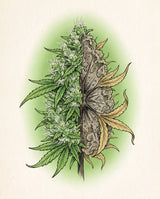
The top colas are wrapped in webbing that holds masses of mites, and the silk strands collect dust, dead mites and shed skins. Fan leaves are dropping. In flower, this is where buds get ruined, and the harvest decisions later in this guide come into play.

How to check a plant in two minutes
Once a week, and every time a new plant comes in, do both of these.
- The paper tap. Hold a sheet of white paper under a branch and tap the branch sharply. Spider mites that fall are specks that start walking; dust does not. The UC pest note recommends exactly this, because disturbed mites move fast and show up well against white.5
- The lens. Turn over five leaves from the top third of the plant and five from the middle and look at the undersides along the veins with a lens. The 30 to 60x loupe you use to read trichomes at harvest is ideal; a 10x hand lens is enough to see a spider mite, if not to count its spots.

Write down what you find: how many leaves had mites and roughly how many were on the worst one. You will need that number if you decide to buy predators, and it is the only honest way to tell whether a treatment is working.

Through the lens, a colony looks like this: pale oval mites with their two dark spots lined up along the veins, round glassy eggs among them, and tiny black dots of waste. If you see moving mites or eggs, you have spider mites. If you only see the dots on top of the leaf and nothing underneath, check a few more leaves before you decide.

Is It Really Spider Mites? Four Things They Get Mistaken For
Several problems make speckled or pale leaves. The fix for each is different, so a two-minute check before you spray saves you a week of spraying the wrong thing.
| Problem | What you see | How to tell it apart |
|---|---|---|
| Spider mites | Pale pinprick dots on top of the leaf, fine webbing later | Moving specks and round eggs on the underside; specks walk on white paper |
| Hemp russet mites | Dull gray or bronze leaves, sometimes edges rolling upward, stunted buds | No webbing and no dots; the mites are far too small to see without strong magnification |
| Thrips | Silvery streaks and patches rather than separate dots | Tiny black specks of waste in the silver; slender insects that run or fly |
| Powdery mildew | Gray-white powder sitting on the leaf | It smudges off with a finger; mite damage is in the leaf and does not |
| Nutrient or pH problems | Yellowing, spots or burnt edges in a pattern across the plant | No mites, no eggs, no webbing, and the pattern follows leaf age |
Russet mites deserve a second look, because they are the look-alike that is easiest to miss. Cranshaw's review describes their damage as subtle: a grayish or bronzed tint on heavily infested leaves, a slight upward roll of the leaf edge in some cultivars, and, when they reach the flowers, smaller buds with less resin.4 If your plant looks sick and a 10x lens shows nothing, go up to 30x and look again before you blame the feed.

Thrips leave a different pattern. Instead of separate dots, whole areas of the leaf go silvery, flecked with black. Our cannabis pest guide covers thrips, aphids, whiteflies and the other mix-ups by where the damage shows up. Powdery mildew is the other common mix-up, and our powdery mildew guide shows the two side by side. For pale or spotted leaves with no pests at all, start with the deficiency diagnosis guide.

What the Research Actually Says About Killing Spider Mites
Most spider mite advice online is a list of sprays, each promising to "kill them on contact". Most of those sprays do kill what they touch. The research explains why that is not enough, and what to do instead.
They are the most pesticide-resistant pest on record
Van Leeuwen and colleagues at Ghent University reviewed the resistance research on the two-spotted spider mite and gave it a title no grower wants to read: by the total number of pesticides that populations have become resistant to, it is the most resistant species there is.1 The review puts it down to three things: a short life cycle, a lot of offspring, and a quirk of breeding in which unfertilized eggs hatch as males, so a colony can start from very few mites. A spray that leaves a few survivors breeds a colony that the next dose of the same spray kills less well.

For a home grower, that means two rules. Never rely on one product. And never spray at a dose or interval that lets survivors breed in between.
Raising the humidity does not drown them
A popular fix is to crank the humidity, mist the plant or even dunk it, on the theory that spider mites like it dry. They do prefer hot, dry conditions, and water-stressed plants are more susceptible, according to the UC pest note.5 But Ubara and Osakabe tested what humidity does to the part of the colony you cannot see. Tetranychus eggs held in saturated air or completely underwater did not die. The embryos kept developing, many of the eggs simply held off hatching, and once the humidity dropped or the water drained, they hatched within one to three hours.2

So a humid week buys you a pause, not a kill, and in flower it costs you a bud rot risk you did not need. Keep your room on the humidity bands in the flowering stage guide and fight mites with the tools that work. A forceful spray of plain water does knock mites off a plant, and UC recommends it in gardens,5 but in a tent it is a knockdown for veg plants that can dry fast, not a cure.
A spray kills the mites it touches, and the eggs hatch after it dries
Cannabis-specific spray trials are rare, because until recently almost nobody could legally run them. The best one we found is from Tiziana Oppedisano, Silvia Rondon and Daniel Thompson at Oregon State University, who sprayed hemp plants in a greenhouse at 77°F (25°C) with four biopesticides at their label rates and then caged adult two-spotted spider mites on the leaves.6
- Mites put on right after spraying: after 7 days, the wormseed (Chenopodium) extract had killed 92.5 percent, Chromobacterium subtsugae 86.9 percent, heat-killed Burkholderia 85.6 percent and azadirachtin, the active compound in neem, 80 percent.
- Mites put on 7 days after spraying: the Burkholderia spray still killed 91 percent, the wormseed extract 88.1 percent and azadirachtin 80 percent, but C. subtsugae dropped to 65.6 percent.

That is good news: several products a home grower can buy kill most adult mites on cannabis. But the trial tested adults, from a single spray, in cages. It did not test eggs, and it did not test a colony living under its own webbing, and UC's pest note is blunt that soaps and oils only kill the mites they wet.5 That is the gap the schedule later in this guide is built to close.
Predators work when you release enough of them
Predatory mites are the one tool that eats eggs. The question is how many to buy. George Opit and colleagues at Kansas State University compared three strategies against two-spotted spider mites on bedding plants in commercial greenhouses: a miticide spray (bifenazate), a single early release of Phytoseiulus persimilis at one predator for every four spider mites counted on the plants, and a weekly release sized to the growing area instead of to a count.7
The single release sized to a count worked as well as the miticide, cutting mite numbers from the first week. Between 92 and 100 percent of those plants made top grade, against 84 to 95 percent for the spray and 15 to 33 percent with no treatment. The weekly release sized to the area did little or nothing. No controlled predator trial on cannabis has been published that we could find, so this is our best evidence, and it is from ornamentals. The lesson travels well: count first, then release to the count.

How Spider Mites Get Into an Indoor Grow
Spider mites do not appear from the soil, and they do not come out of nowhere. In a sealed tent, every infestation arrived on something.
- Clones and mother plants. The usual route, and the one Cranshaw's review flags.4 A cutting from a friend or a store can carry a few mites and a few dozen eggs that no casual look will find. Our cloning guide covers what else a clone inherits.
- You. Mites crawl onto clothes, hair and pets in a garden or a friend's grow room and walk off in yours. Visit your own grow first and anyone else's last.
- Houseplants and outdoor plants. The two-spotted spider mite feeds on a huge range of plants.6 A mite-ridden houseplant next to the tent, or an outdoor plant brought in for the winter, is a reservoir.
- Air. Mites use their silk to disperse, as the Oregon team notes.6 An intake fan pulling unfiltered air from beside a garden can bring them in during summer.

Stress makes a small arrival worse. The UC pest note says plants under water stress are highly susceptible,5 which is one more reason to water by the weight of the pot, as our watering guide explains, rather than letting plants droop between waterings. The UC note also warns that mites often flare up after spraying insecticides for something else, because the spray kills the predators that were keeping them in check.5
How to Prevent Spider Mites
Prevention is cheaper than any spray, and it is the only approach that works in late flower. These are the habits that keep a grow clean, in order of how much they matter.
1. Quarantine every new plant for 14 days
Keep every new clone or plant in a different room from your tent for 14 days, and check the undersides of its leaves with a loupe on day 0, day 7 and day 14. At 77°F (25°C) that covers a full egg-to-adult cycle, so a hidden colony has time to show itself. It is the same quarantine our powdery mildew guide uses, so one routine covers both. Root and hold new cuttings in their own cups on their own tray; self-draining nursery pots like BudCups make it easy to check each root ball and move each plant on its own.

2. Visit your grow first, not last
If you have been in a garden, a greenhouse or someone else's grow room, change your clothes before you open your tent. Keep pets out of the grow room.
3. Scout the undersides every week
Do the paper tap and the ten-leaf lens check from earlier in this guide once a week, every week, from seedling to harvest. It takes two minutes a plant. Finding ten mites is a spray. Finding ten thousand is a crop decision.
4. Keep plants watered and the room in its bands
Water-stressed plants and hot, dry rooms favor mites.5 Water by pot weight, and keep temperature and humidity in the bands for each stage. Our VPD chart shows how the two combine; a room running far above its VPD band is hot and dry, which is mite weather.
5. Keep the canopy open
You cannot spray what you cannot reach. A plant trained flat and open in veg, with the lower growth cleared, lets you see and wet every underside. Training with low-stress clips such as BudClips and regular defoliation do double duty here. Our training guide covers the whole routine.


6. Keep houseplants out of the grow room
Anything green in the same room is either a mite reservoir or a place you will not think to check. Outdoor plants coming in for the winter go through the same 14-day quarantine as a clone.
You Found Spider Mites. Here Is What to Do
This is the plan we follow. It is built around one fact from the research above: sprays kill the mites they touch and miss the eggs, so the job is to keep hitting each new hatch before it can grow up and lay.
Step 1 - Confirm it is spider mites and count them
Do the paper tap and the lens check. Confirm you see moving specks, round eggs or webbing, not just dots. Then write down how many of your ten leaves had mites and roughly how many were on the worst leaf. That is your baseline.
Step 2 - Bag the worst leaves before you remove them
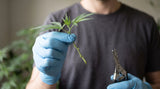
Leaves that are more bleached than green, and any webbed growth you can spare, come off. Slide a plastic bag over each one before you cut it so the mites fall into the bag and not onto the next plant, then seal the bag and put it in the trash outside. Clean your scissors in 10 percent household bleach for 2 minutes and rinse them before you touch another plant, the same routine our cloning guide uses for cutting tools.

Step 3 - Work out which window you are in
- Veg: you can spray the whole plant, tops and undersides, every 3 days.
- Flower, weeks 1 to 4: you can spray leaves, but not the developing flowers, and your last spray is on day 28 of flower.
- Flower, week 5 until harvest: no sprays at all. Predatory mites, leaf removal and a harvest plan are your tools.
Day 28 is the same cutoff our powdery mildew and bud rot guides use. After about four weeks the buds are dense enough that anything wet you put on them becomes a bud rot risk, and whatever you spray on a bud is what you smoke.

Step 4 - Spray the undersides with the lights off
Pick a contact spray from the table in the next section and mix it at the label rate. Spray with the grow light off or dimmed, so leaves do not sit wet under full light, and with the fans running so they dry. Start at the bottom of the plant and work up, lifting each branch and spraying up at the undersides of the leaves, which is where the mites live and where most growers miss. Then do the tops. Soaps and oils only kill mites they wet, so coverage is everything.5 Wear gloves and eye protection.

Step 5 - Repeat every 3 days for 12 days
Spray on day 0, day 3, day 6, day 9 and day 12. Five sprays. Here is the reasoning. At 77 to 81°F (25 to 27°C) a mite needs about 10 to 12 days to get from egg to egg-laying adult.3 Every egg that survives a spray hatches into a young mite that cannot lay for more than a week. A spray every 3 days kills each hatch long before it can breed, and by day 12 the eggs that were on the plant on day 0 have all hatched and been hit. Spray once a week instead and each generation gets a few days to lay before the next spray arrives, which is exactly how a colony that "keeps coming back" is made.

If your room runs cooler, the clock slows: at 72°F (22°C) the egg-to-adult time is closer to 16 days, so carry the schedule through day 15. This schedule is our reading of the development research, not a trial on cannabis, and we say so.
Step 6 - Alternate two products that kill in different ways
Pick two products with different modes of action and alternate them, one on each spray day. Insecticidal soap and a Burkholderia or wormseed product is a sensible pair. Two brands of the same oil are one product. Given the mite's record, a single product used over and over is how a home grow breeds its own resistant strain.1
Step 7 - Release predators against your count
Once the spray schedule has knocked the numbers down, predatory mites mop up what is left, including the eggs the sprays missed. Count again, estimate the mites on the plant, and release about one predator for every four spider mites, as a single release, the way Opit's team did.7 Wait until the last soap or oil spray has dried before you release, because contact sprays kill predators too, and check the label of any biological miticide for predator safety.

Phytoseiulus persimilis is the specialist: it eats almost nothing but spider mites, and eats them fast. It is shiny orange-red and pear shaped with no spots, and it runs; spider mites are paler, spotted and slow. Neoseiulus californicus eats more slowly but survives on other food when spider mites are scarce, so it is the one to leave in place as a guard, especially through late flower when you cannot spray.
Both are easy to buy online and ship live to your door. In the United States, ARBICO Organics, Nature's Good Guys, Tip Top Bio-Control and Buglogical all sell Phytoseiulus persimilis to home growers. In Canada, Koppert sells it direct through its retail webshop. Order so the mites arrive on the day you plan to release them, because they do not keep.

Step 8 - Check again on day 14 and day 21
Repeat your ten-leaf count on day 14 and day 21. New growth should come in clean, without stippling. The old dots never go away, so judge by the new leaves and by the undersides. If you still find moving mites on day 21, run the 12-day schedule again with a different pair of products.

What to Spray on Spider Mites: What Works, What Is a Guess, What to Avoid
Everything below is something a home grower can buy. Where a product has cannabis data, we say so. Where it does not, we say that too.
| Product | What it is | What the evidence says | Our verdict |
|---|---|---|---|
| Insecticidal soap (for example Safer Brand) | Potassium salts of fatty acids; kills on contact, no residual | Works only on mites it wets; must hit undersides; repeat applications needed | A good first product in veg, part of the rotation |
| Burkholderia (Venerate) | Heat-killed bacteria that break down the mite's outer skin | 85.6 percent of adults dead at 7 days in the Oregon hemp trial, and the longest-lasting residue: 91 percent a week after spraying | The strongest cannabis data of any product here |
| Wormseed extract (Chenopodium) | Plant extract that disrupts movement and breathing | 92.5 percent of adults dead at 7 days, 88.1 percent residual | Excellent rotation partner |
| Chromobacterium subtsugae (Grandevo) | Bacterial product that repels and disrupts feeding and breeding | 86.9 percent at 7 days, but the weakest residue at 65.6 percent | Works; respray on schedule, do not count on residue |
| Azadirachtin (AzaMax) and neem oil | The active compound from neem seeds, alone or in the whole oil | Azadirachtin killed 80 percent of adults at 7 days, the lowest of the four | Useful in veg; oil only in veg, never on flowers |
| Plain water spray | A forceful spray that knocks mites off | UC recommends it in gardens; it kills nothing and eggs survive water | A knockdown before a spray, not a treatment |
| Mighty Wash, rubbing alcohol, rosemary oil sprays | Popular grower remedies and blends | No published trial on spider mites on cannabis that we could find | Unproven; if you use one, keep it inside the same schedule |
| Abamectin (Avid), bifenazate (Floramite) | Synthetic miticides used on ornamentals and food crops | Not on the EPA list of products allowed on hemp; California fails smokable flower above 0.1 micrograms per gram of either | Never on cannabis |
The Oregon figures are from Oppedisano, Rondon and Thompson's greenhouse trial on hemp,6 and the trade names are the products sold with those active ingredients in the United States, not necessarily the exact products used in the trial. Their paper also notes the regulatory picture: of the 59 pest control products the EPA had approved for hemp by December 2019, 58 were biopesticides and the other was potassium salts of fatty acids, which is insecticidal soap.6 If a product is not on your state's or province's list for cannabis, do not use it.
Why never the "real" miticides
Growers reach for abamectin and bifenazate because they work on other crops. On cannabis they are the wrong answer for two reasons. They are not allowed on the crop, and what is sprayed on a plant that gets dried and smoked is concentrated into the smoke. California's cannabis testing rules fail inhalable flower that carries more than 0.1 micrograms per gram of either one. And given how quickly spider mites learn to shrug off any single product,1 even a miticide that works today is a one-season fix.
Spider Mites in Flower and on Buds: Can You Smoke It?
Mites found in the first four weeks of flower get the same plan as veg, with leaves-only sprays that stop on day 28. From week 5 on, the plan changes: no sprays, remove the worst leaves in bags, release predators against your count, and scout every few days. If webbing reaches the buds in the last two weeks, check the trichomes and, if they are anywhere near the window in our harvest guide, take the plant. A few days of ripening is not worth losing the colas.
On the buds themselves, here is the honest state of the evidence, followed by what we do.
- No study has measured the health effects of smoking flower that had spider mites on it. The mites are not known to be toxic, and nobody has shown that such flower is safe either.
- Webbing is a trap. It holds dead mites, shed skins, waste and dust in the bud, and a webbed bud has usually been sprayed more than a clean one.
- Stippled leaves are not a bud problem. Mite damage on fan and sugar leaves is cosmetic once those leaves are trimmed off.

What we do: a bud with webbing through it goes in the bin, not the jar. It does not get washed back into the harvest or made into extract. Buds that were near mites but carry no webbing get checked under the loupe during the trim, have any stippled sugar leaves trimmed away, and go on to dry as normal. Do not dry a mite-infested harvest in the room where your next crop is growing.
After the Harvest: Clean the Room So They Do Not Come Back
A tent that had spider mites still has them after the plants are gone. Resting females can shelter in seams, corners, pot rims and the zip of a tent. Before the next crop goes in, vacuum the tent and wipe every surface, pole and pot rim.

Then put reusable pots, trellis net and clips through 10 percent household bleach for 2 minutes, and rinse them. Throw out the old growing medium from infested plants rather than reusing it, as our soil guide advises after any serious pest problem. Then start clean: seeds, or clones that pass a 14-day quarantine.

Outdoors the picture is different. Cranshaw's review found that spider mite populations do not stay high once plants are growing in the field,4 where rain, wind and a whole community of predators work on them. Outdoor plants still get scouted weekly, as our outdoor growing guide recommends, and a hot, dry, dusty spell is the time to look hardest.
Frequently Asked Questions
What do spider mites look like on weed?
From above, pale pinprick dots on the tops of the leaves that do not wipe off. On the underside, tiny moving specks about half a millimeter long, pale yellow-green with two dark spots, along with round glassy eggs and black specks of waste. In a larger colony, fine webbing appears between leaves, at the growing tips and eventually over the buds.
How do I get rid of spider mites on my cannabis plants?
Remove the worst leaves in bags, then spray the undersides of the leaves with a contact product every 3 days for 12 days, alternating two products that kill in different ways. The repeats catch each hatch from the eggs the sprays miss. Then release predatory mites at about one for every four spider mites you counted, and check again on day 14 and day 21.
What kills spider mites instantly?
Insecticidal soap or an oil kills the adult mites it wets, and a strong spray of water knocks them off. Nothing kills the eggs instantly, and the eggs hatch after the spray dries. That is why no single spray ends an infestation. What ends it is a spray every 3 days for 12 days, so each new hatch is killed before it can lay eggs of its own.
Can you smoke weed that had spider mites?
No study has measured the health effects, so nobody can promise it is safe or harmful. The mites are not known to be toxic, and stippled leaves are trimmed away anyway. We bin any bud with webbing through it, because webbing traps dead mites, waste and dust, and a webbed bud has usually been sprayed more. Clean buds from the same plant are checked under a loupe and kept.
How do I get rid of spider mites during flowering?
In weeks 1 to 4 of flower, spray the leaves but not the developing flowers every 3 days, with your last spray on day 28. From week 5 to harvest, do not spray at all: remove the worst leaves in bags, release predatory mites against a count, and scout every few days. If webbing reaches the buds in the last two weeks and the trichomes are close, harvest.
Does neem oil kill spider mites? Is AzaMax good for spider mites?
Yes, partly. Azadirachtin, the active compound in neem and in AzaMax, killed 80 percent of adult spider mites on hemp within 7 days in the Oppedisano, Rondon and Thompson trial, the lowest of the four products tested. It is a reasonable rotation product in veg. Keep neem oil itself to veg, never on flowers, and use it inside a 3-day schedule rather than as a single spray.
Does Mighty Wash work on spider mites?
We could not find a published trial of Mighty Wash on spider mites on cannabis, so we cannot tell you how it compares. Like any contact spray, it can only work on mites it actually wets and it will not stop eggs hatching after it dries. If you use it, spray the undersides and keep it inside the every-3-days schedule, alternating with a product that kills a different way.
Will raising the humidity kill spider mites?
No. Spider mites prefer hot, dry conditions, but Ubara and Osakabe found that Tetranychus eggs held in saturated air or even underwater kept developing, and many hatched within one to three hours of drying out. A humid spell pauses a colony rather than killing it, and in flower it adds a bud rot risk. Keep the room on its normal humidity bands and use a spray schedule.
Where do spider mites come from in an indoor grow?
They arrive on something. The usual route is a clone or mother plant, followed by clothes, hair and pets that have been near infested plants, houseplants in the same room, and unfiltered intake air in summer. They do not come from the soil. A 14-day quarantine for every new plant, with loupe checks on day 0, 7 and 14, stops most of them.
Do predatory mites work on cannabis?
They are the only tool that eats spider mite eggs. We found no controlled trial on cannabis, but in commercial greenhouses Opit and colleagues found a single release of Phytoseiulus persimilis at one predator per four spider mites worked as well as a miticide, while weekly releases sized to the growing area did little. Count your mites first, knock them down with sprays, then release to the count.
Can a cannabis plant recover from spider mites?
Yes, if you catch them before webbing covers the tops. The stippled leaves never turn green again, but new growth comes in clean once the colony is gone, and a plant in veg has time to replace what it lost. Judge progress by the new leaves and the undersides, not by the old dots. A plant webbed over in late flower is usually a harvest decision instead.
How long does it take to get rid of spider mites?
About three weeks. The spray schedule runs 12 days at 77 to 81°F (25 to 27°C), longer in a cooler room, because it has to outlast one full egg-to-adult cycle. Predators then clean up the survivors, and you confirm with leaf counts on day 14 and day 21. If moving mites are still there on day 21, run the schedule again with a different pair of products.
Are russet mites the same as spider mites?
No. Hemp russet mites are far smaller, invisible without strong magnification, make no webbing and leave no pinprick dots. Their damage is a dull gray or bronze tint, sometimes an upward roll of the leaf edge, and smaller buds with less resin. If a plant looks sick and a 10x lens shows nothing, look again at 30x before blaming the feed.
Where to Go From Here
Spider mites are an indoor pest that arrives on plants and people, and the best defense is a quarantine and a weekly look at the undersides. Keep your room in the right bands with the indoor growing guide, build an open canopy with low stress training, and learn the two fungi that show up in the same late-season rooms with the powdery mildew and bud rot guides. If you take cuttings, start with a clean mother and the rest of our cloning guide.
References
- Van Leeuwen, T., Vontas, J., Tsagkarakou, A., Dermauw, W., & Tirry, L. (2010). Acaricide resistance mechanisms in the two-spotted spider mite Tetranychus urticae and other important Acari: A review. Insect Biochemistry and Molecular Biology, 40(8), 563-572. https://doi.org/10.1016/j.ibmb.2010.05.008
- Ubara, M., & Osakabe, M. (2015). Suspension of egg hatching caused by high humidity and submergence in spider mites. Environmental Entomology, 44(4), 1210-1219. https://doi.org/10.1093/ee/nvv080
- Riahi, E., Shishehbor, P., Nemati, A. R., & Saeidi, Z. (2013). Temperature effects on development and life table parameters of Tetranychus urticae (Acari: Tetranychidae). Journal of Agricultural Science and Technology, 15(4), 661-672. https://jast.modares.ac.ir/article_15234.html
- Cranshaw, W., Schreiner, M., Britt, K., Kuhar, T. P., McPartland, J., & Grant, J. (2019). Developing insect pest management systems for hemp in the United States: A work in progress. Journal of Integrated Pest Management, 10(1), 26. https://doi.org/10.1093/jipm/pmz023
- Godfrey, L. D. (2011). Spider Mites: Integrated Pest Management for Home Gardeners and Landscape Professionals (Pest Notes Publication 7405). University of California Statewide Integrated Pest Management Program. https://ipm.ucanr.edu/PMG/PESTNOTES/pn7405.html
- Oppedisano, T., Rondon, S. I., & Thompson, D. I. (2025). Effects of selected biopesticides on two arthropod pests of Cannabis sativa L. in northeastern Oregon. Agrochemicals, 4(4), 19. https://doi.org/10.3390/agrochemicals4040019
- Opit, G. P., Perret, J., Holt, K., Nechols, J. R., Margolies, D. C., & Williams, K. A. (2009). Comparing chemical and biological control strategies for twospotted spider mites (Acari: Tetranychidae) in commercial greenhouse production of bedding plants. Journal of Economic Entomology, 102(1), 336-346. https://doi.org/10.1603/029.102.0144

About the Author
Henrique Dias is the CEO and co-founder of BudTrainer. He is a mechanical engineer who also holds a graduate certificate in Commercial Cannabis Production from Niagara College in Ontario, Canada - the first college-level cannabis cultivation program in North America. Before founding BudTrainer, Henrique worked with Health Canada licensed cannabis producers, where he gained hands-on experience in cultivation, processing, and post-harvest management of cannabis at commercial scale. He started BudTrainer to bring that same level of craft to home growers through better-designed gardening tools and clear, science-backed education.
DISCLAIMER: Everything taught and sold by BudTrainer® is to be used strictly for legal purposes. We do not endorse the production of illegal substances and it is your duty to ensure that you are complying with the law. The words "hemp," "cannabis," "weed," and "marijuana" are used interchangeably to refer to the same plant (legal hemp with less than 0.3% THC) for the purposes of this lesson.