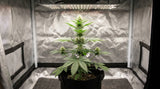
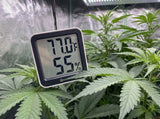
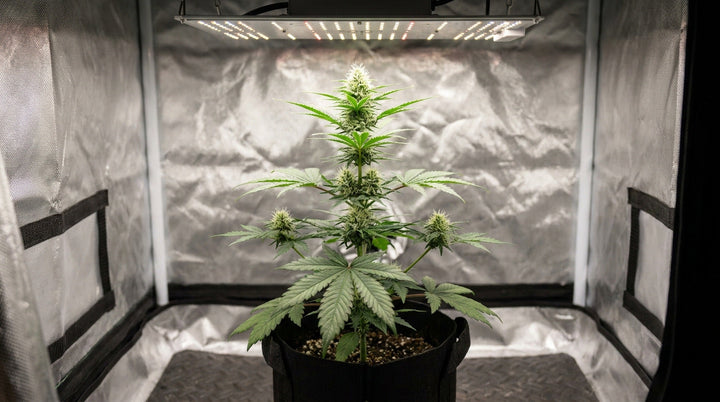
"How far should my grow light be from my plants?" is the question every first grow asks, and the internet answers it with a chart: so many inches for seedlings, so many for veg, so many for flower. The charts disagree with each other, and the reason is simple. A distance is not a dose. The same 18 inches (45 cm) puts a weak light's canopy in the dark and a strong light's canopy under a sunburn, and inside a tent with silver walls it does something most charts never mention at all.
This guide gives you the number that actually matters, which is PPFD at the canopy, by stage. It shows what really happens when you raise or lower a light in a tent, with the numbers from our model, and how to estimate your tent's light from the watts on your fixture. Then it walks through hanging a light in seven steps, measuring it with a meter, an app or a lux meter (with a PAR to lux calculator for the conversion), and spotting light burn before it costs you buds. If what you actually want to know is how many hours to run the light, that lives in our cannabis light schedule guide.
The Short Answer: How Far Should a Grow Light Be From Cannabis?
Start from the light level each stage needs, then use the height that spreads it evenly. These are the targets, and the starting heights we would hang a typical LED at in a tent, before you measure.
| Stage | Target at the canopy (PPFD) | Starting height, full-tent LED | How you get there |
|---|---|---|---|
| Clones, until rooted | 50 to 150 | 24 in (60 cm) or more | Dimmer at its lowest setting; most lights still need a shade cloth or a weaker fixture |
| Seedlings, weeks 1 and 2 | 200 to 400 | 18 to 24 in (45 to 60 cm) | Dimmer at roughly a quarter to a half, then measure |
| Seedlings, weeks 3 and 4 | 400 to 600 | 18 to 24 in (45 to 60 cm) | Turn the dimmer up; leave the height alone |
| Vegetative growth | 600 to 900 | 12 to 18 in (30 to 45 cm) | Dimmer up as the plants fill the tent |
| Flowering | 600 to 900, more if the tops stay cool | 12 to 18 in (30 to 45 cm) | Full power for most home lights; raise the light as the stretch lifts the canopy |
"Full-tent LED" means a light whose diodes cover most of the tent's footprint, like the bar-style lights most growers buy. A small square board in a big tent needs to hang higher, 24 to 30 inches (60 to 75 cm), because its light comes from a smaller patch and makes a stronger hot spot underneath. Two rules sit under the whole table. Measure height from the light to the tallest top, not to the pot. And when you want more or less light, reach for the dimmer before you reach for the ratchet hangers.

What PPFD Means, and the Other Light Words on the Box
Plants do not see light the way we do, so the numbers that describe a grow light are different from the ones on a household bulb. Five of them are worth knowing.

PAR (photosynthetically active radiation) is the band of light plants use for photosynthesis, from violet at 400 nanometers to deep red at 700. It is a range, not a reading.
PPF (photosynthetic photon flux) is the total PAR light a fixture puts out every second, in micromoles per second (µmol/s). A micromole is just a fixed, very large count of light particles, so PPF is a count of how many usable particles leave the light. It describes the fixture, not your plants.
PPFD (photosynthetic photon flux density) is how much of that light lands on one square meter of canopy each second, in micromoles per square meter per second (µmol/m²/s). It is the number a light meter reads and the number every target in this guide uses. Growers usually drop the units and say "800 PPFD."
DLI (daily light integral) is the day's total: PPFD multiplied by the hours the light is on. Our light schedule guide shows the arithmetic (DLI = PPFD x hours x 0.0036, in moles per square meter per day), and why 900 PPFD for 12 hours is the same dose as 600 PPFD for 18.
Efficacy, in micromoles per joule (µmol/J), is how much light a fixture makes from each watt of electricity. Paul Kusuma, Morgan Pattison and Bruce Bugbee reviewed independently tested horticultural fixtures and found the best white-and-red LEDs at 2.5 to 2.8 µmol/J, against 1.72 for a 1,000 W double-ended HPS lamp.1 Multiply efficacy by the watts the light actually draws from the wall and you have its PPF. A light drawing 480 W at 2.7 µmol/J puts out about 1,296 µmol/s.
The one you will be tempted to use and should not is lux. Lux measures light weighted for the human eye, which is most sensitive to green and nearly blind to the deep red that grow lights are full of. It can still be converted, roughly, and we show how further down.
How Much Light Cannabis Needs at Each Stage
The targets below come from the guides in this series that own each stage, plus one number this guide sets for veg. The daily light integrals assume 18 hours of light in seedling and veg and 12 hours in flower, written 18/6 (18 hours on, 6 off) and 12/12.

| Stage | PPFD | Daily light (DLI) | Where the number comes from |
|---|---|---|---|
| Clones, unrooted | 50 to 150 | 3 to 10 at 18/6 | Our cloning guide; rooting did not improve above 50 in the trial it cites |
| Seedlings, weeks 1 and 2 | 200 to 400 | 13 to 26 | Our planting guide, reviewed by Scott Golem |
| Seedlings, weeks 3 and 4 | 400 to 600 | 26 to 39 | Our planting guide |
| Vegetative growth | 600 to 900 | 39 to 58 | Moher, Llewellyn, Jones and Zheng, University of Guelph |
| Flowering | 600 to 900 mid-canopy | 26 to 39 at 12/12 | Our flowering stage guide; the plant can use more |
Clones have no roots, so they cannot drink fast enough to keep up with strong light. Our cloning guide keeps them at roughly 50 to 150 PPFD, and the trial it covers found cuttings rooted just as well at 50 as at 250.
Seedlings need more light than most guides give them. Our planting guide sets 200 to 400 PPFD for the first two weeks and 400 to 600 in weeks 3 and 4, and explains why the old 100 to 200 figure grows leggy, thin-stemmed seedlings.
Veg is where most charts go vague, so here is the evidence. Melissa Moher, David Llewellyn, Max Jones and Youbin Zheng at the University of Guelph grew rooted cuttings of the cultivar (strain) Gelato for 21 days of veg under canopy light from 135 to 1,430 PPFD on 16-hour days. More light gave more nodes, thicker stems, more dry weight and shorter internodes, with the gains flattening at the top of the range. Their read: about 900 PPFD made compact, robust plants, while about 600 gave a more open plant with more air moving through it.2 That is where our veg band of 600 to 900 comes from. Pick the low end for a bushy cultivar that already packs its branches tight, the high end for one that stretches.
Flower targets belong to our flowering stage guide: 600 to 900 PPFD mid-canopy under common LED setups. That is a practical range, not a ceiling. Victoria Rodriguez-Morrison, David Llewellyn and Youbin Zheng flowered cannabis under canopy light from 120 to 1,800 PPFD, and dry flower yield rose in a straight line the whole way, from 116 to 519 grams per square meter, with no effect on potency.3 A second Guelph trial by David Llewellyn, with Scott Golem among the authors, compared 600, 800 and 1,000 PPFD and found 1.6 times more flower at the top setting.4 The limit in a home tent is the heat at the tops, your electricity bill and how much light your fixture can make, not the plant. Our canopy science guide has those trials in full.

One more reading worth knowing. Suman Chandra and colleagues at the University of Mississippi measured single cannabis leaves and found photosynthesis still rising up to about 1,500 PPFD at 77 to 86°F (25 to 30°C).5 A whole plant goes further than a single leaf, because the leaves below the top layer use the light the top layer lets through.
Autoflowers follow the same intensity bands by stage. Most growers keep them on 18 hours of light from seed to harvest, so the same 600 to 900 PPFD in flower gives them half as much light again per day as a photoperiod plant, one that only flowers once its nights get long, on 12/12. No trial we found has tested light intensity on autoflowers specifically.
What Actually Happens When You Raise a Light in a Tent
Here is the part the distance charts get wrong. Most of them are built on the inverse-square law: double the distance and the light falls to a quarter. That law is exact for a tiny light, like a bare bulb, in open space. A grow tent is neither.

To show what really happens, we built a simple light model. It sends millions of light rays from an LED panel 3.3 ft (100 cm) square, putting out 1,296 µmol/s (480 W at 2.7 µmol/J), down onto a flat canopy in a 4 ft by 4 ft (120 x 120 cm) tent whose walls reflect 90% of the light that hits them. It records where every ray lands. Then it does the same for the panel hung in an open room, with no walls.

In the tent, raising the light from 12 to 24 inches (30 to 60 cm):
- dropped the average PPFD across the canopy from 839 to 799, about 5%;
- dropped the center, directly under the light, from 1,091 to 886;
- raised the corners from 568 to 712.
The light did not go anywhere. It spread out, hit the walls and came back down onto the canopy. At 12 inches the corners got about half what the middle got; at 24 inches they got 80% of it. Even at 60 inches (150 cm), as high as most tents allow, the average was still about 700.

Now take the walls away. Hung over the same 4 ft by 4 ft patch in an open room, the same move from 12 to 24 inches cut the average from 620 to 399, a loss of 36%, because the light that spreads past the edge of the canopy is gone. That is the world the distance charts were drawn for, and it is roughly how a light behaves in a big room or a greenhouse. It is not how it behaves in a tent.

The inverse-square law fails for a second reason too: a grow light is a big flat panel, not a point. Directly under our bar light in the open room, doubling the distance from 12 to 24 inches cut the light by 41%, not 75%, and doubling it from 6 to 12 inches cut it by 18%. The law only starts to hold once you are several times the panel's own width away. A small, concentrated light behaves more like the law, which is exactly why it makes a sharper hot spot.

What this means in practice:
- Height is how even the light is. Too low and the middle of the tent cooks while the corners starve. High enough and every plant gets nearly the same light.
- The dimmer is how much light there is. In a tent, raising the light is a poor way to give the plants less of it, and lowering it is a poor way to give them more. Lowering mostly piles more light onto the plants in the middle.
- The walls matter. At 80% reflectance instead of 90%, the average at 24 inches fell to 737. A torn, dusty or dull tent wall costs you light. Keep the door zipped when the light is on.

This is our model, and its assumptions are stated so you can judge it: smooth, mirror-like walls; a flat canopy that absorbs all the light that reaches it; a panel that spreads its light evenly in every downward direction, as bare LEDs without lenses do. A real canopy is lumpy and reflects a little light back up, real tent fabric scatters rather than mirrors, and some light leaks out at the seams. Those details shift the numbers. They do not change the shape: in a reflective box, height moves the light around much more than it changes the total. Our planting guide makes the same point from the grower's side: turn the light up, do not bring it down, because moving an LED changes the shape of the light, not just the amount.
How Much Light Your Tent Gets: A Quick Estimate From the Watts
Because a reflective tent catches nearly all of a light's output, you can estimate the average PPFD without a meter. In our model about 90% of the light landed on the canopy at normal hanging heights. So:
Average PPFD ≈ watts from the wall x efficacy (µmol/J) x 0.9 ÷ tent floor area in square meters.

For a 4 ft by 4 ft tent (1.49 m²) and a light drawing 480 W at 2.7 µmol/J, that is 480 x 2.7 x 0.9 ÷ 1.49, or about 785 PPFD, right in the flowering band. The same light in a 5 ft by 5 ft (150 x 150 cm) tent gives about 500, and in a 3 ft by 3 ft (90 x 90 cm) tent about 1,400, which is too much to run at full power. Use the watts the light actually draws, from the spec sheet or a plug-in power meter, not the "equivalent" number on the box. If the spec sheet gives no efficacy, 2.5 µmol/J is a reasonable guess for a recent white LED and 2.0 for a budget one.
| Tent size | Floor area | Watts for 600 to 900 PPFD average, at 2.5 µmol/J | Average PPFD from 100 W at 2.5 µmol/J |
|---|---|---|---|
| 2 ft by 2 ft (60 x 60 cm) | 0.37 m² (4 sq ft) | 100 to 150 W | about 605 |
| 2 ft by 4 ft (60 x 120 cm) | 0.74 m² (8 sq ft) | 200 to 300 W | about 300 |
| 3 ft by 3 ft (90 x 90 cm) | 0.84 m² (9 sq ft) | 225 to 335 W | about 270 |
| 4 ft by 4 ft (120 x 120 cm) | 1.49 m² (16 sq ft) | 400 to 600 W | about 150 |
| 5 ft by 5 ft (150 x 150 cm) | 2.32 m² (25 sq ft) | 620 to 930 W | about 95 |
This is an estimate of the average, not the light at any one plant, and it assumes a light that covers most of the tent and walls in good shape. It is the right number for buying a light and for setting the dimmer as a starting point. Our indoor growing guide's rule of thumb, 30 to 40 watts of real power draw per square foot of canopy, lands in the same place for a fixture a little under 2.5 µmol/J.
How to Hang a Grow Light: Seven Steps
This is the routine we use for any new light in any tent. It takes an evening, and after that you only repeat steps 5 to 7.

Step 1 - Look up your light's numbers
Find three things on the spec sheet or the maker's site: the watts it draws, its efficacy in µmol/J, and its PPFD map (the grid of readings, usually measured at 12, 18 or 24 inches). Run the quick estimate above. If the estimate says your light gives your tent far more than 900 PPFD at full power, you will be running it dimmed for the whole grow, which is fine.
Step 2 - Hang it at a starting height for your fixture type

Start a full-tent LED 18 inches (45 cm) above the tallest top, a small board 24 to 30 inches (60 to 75 cm) above, and measure from the diodes, not from the top of the fixture. Hang it level with adjustable ratchet hangers so you can move it an inch at a time. The table in the next section has more fixture types.
Step 3 - Set the dimmer for the stage
Use the stage targets and the quick estimate to pick a starting setting. If the estimate says 800 PPFD at full power and your seedlings want 300, start near 40%. Dimmers are not always linear, so a knob at half does not always mean half the light; the next step is what tells you.
Step 4 - Measure a grid at canopy height
With the light on for 15 minutes, hold your sensor flat, facing straight up, at the height of the tops. Read nine spots: the middle, the middle of each side, and each corner, about 6 inches (15 cm) in from the wall. Average them. That average is your canopy PPFD. Adjust the dimmer until it sits in the stage band.

Step 5 - Compare the corners with the middle, and adjust the height
Divide your lowest corner reading by your middle reading. We aim for at least 0.7: the dimmest corner getting at least 70% of the light the middle gets. Below that, raise the light 2 to 3 inches (5 to 8 cm) and read again. Raising it will lower the average a little, so nudge the dimmer back up. In our model a full-tent bar light passed this test from about 18 inches up, and a small board from about 30.
Step 6 - Check the temperature at the tops
Point an infrared thermometer at a top leaf in the middle of the tent and compare it with the air beside it. Our foxtailing guide sets the line: in flower, air at the tops above 85°F (29°C), or a top leaf more than about 4°F (2°C) warmer than the air beside it, means the tops are too hot. Fix the air first, then raise or dim the light over the hot spot only.
Step 7 - Keep the gap as the plants grow
The canopy climbs every day in veg and fastest in the first three weeks of flower, when plants can grow by half to double their height. Measure the gap from the diodes to the tallest top every few days and raise the light to hold it. Re-check the grid when you change stage or turn the dimmer up.
Starting Heights by Type of Grow Light
These are starting points, not answers. They come from our model for LEDs and from common practice for HPS, and they assume a reflective tent. Your meter, your corner-to-middle ratio and the temperature of your top leaves decide where the light ends up.
| Light type | Seedlings | Veg and flower | Why |
|---|---|---|---|
| Bar-style LED covering most of the tent | 18 to 24 in (45 to 60 cm), dimmed | 12 to 18 in (30 to 45 cm) | Light comes from a wide area, so it is even close up |
| Square board LED about half the tent's width | 24 to 30 in (60 to 75 cm), dimmed | 24 to 30 in (60 to 75 cm) | A small source makes a strong hot spot; it needs height to spread |
| LED with lenses or spot optics | Follow the maker's map | Follow the maker's map | Lenses aim the light, so the map matters more than any rule |
| HPS in a reflector hood, 600 to 1,000 W | Too strong and too hot; use another light | 24 to 36 in (60 to 90 cm) | Radiant heat from the bulb, not the light level, sets the gap |

A small board hung low makes exactly the pool of light our model predicts: bright between the plants in the middle, dimmer at the corners. Raising it to 24 to 30 inches (60 to 75 cm) spreads that pool across the whole floor.

An HPS lamp is the one case where the old charts were mostly about heat. Jacob Nelson and Bruce Bugbee at Utah State University worked out that, at the same light level, leaves under HPS run about 2.3°F (1.3°C) warmer than leaves under LED, because the bulb sends more of its energy as infrared.6 That gap is smaller than most growers think, but up close, under a hot bulb, it adds up, which is why an HPS hangs further away.
Seedlings and Clones: Use the Dimmer, Not the Height
This is where our tent model matters most. A seedling wants 200 to 400 PPFD. A typical 480 W LED in a 4 ft by 4 ft tent gives an average of about 800 at full power, and raising it barely helps: in our model it still averaged about 765 at 36 inches (90 cm) and about 700 at 60 inches (150 cm). You cannot get a strong light down to seedling levels in a tent by pulling it up to the roof.

So turn it down. At a quarter to half power, the same light lands in the seedling band, and the plants under it all get the same amount. If your light has no dimmer, raising it gets you a little way and shading part of the tent with the seedlings in one corner does not work well either, because the walls send the light around. A cheaper, smaller light for the seedling weeks, or a dimmable fixture next time, is the real fix.

The planting guide has the other half of this. A lanky seedling with long gaps between its leaves was short of light, and the fix is to turn the dimmer up, not to lower the lamp. Lowering it raises the light under the middle of the fixture, adds radiant heat to the leaves, and leaves the seedlings near the edge in a different grow from the ones in the middle.

Clones are the extreme case: 50 to 150 PPFD is less than most tent lights make even at their lowest setting. Root them under a weak light of their own, a shelf light or a small panel over a dome, or keep the dome under a shade cloth, until they have roots and can drink.
How to Measure PPFD: Meters, Apps and Lux
You have four ways to know your light level, from best to worst.
A quantum PAR meter
A quantum sensor counts PAR light directly and reads PPFD. It is the tool researchers use, and a good one costs a few hundred dollars. If you buy one for LEDs, choose one sold as full-spectrum. Apogee, the best-known maker, lists its older sun-calibrated sensors as reading about a third low under a mix of red, blue and white LEDs, because they barely see deep red; its full-spectrum line reads within a few percent. Hold the sensor level and facing straight up, keep your hand and head out of the light, and read the nine-point grid from Step 4.

Phone apps such as Photone
Light-meter apps estimate PPFD from your phone's camera or light sensor, usually with a small white diffuser over the lens and a setting for your light's color. The maker of Photone, the best known, publishes its own accuracy claims. We found no independent, peer-reviewed test of these apps, and phones differ in their sensors, so treat the absolute number with caution. Where an app is genuinely useful is in comparing spots under the same light: corner against middle, 12 inches against 18. If you can borrow a quantum meter once, read the same spot with both and you have a correction factor for your phone and your light.
A lux meter, with a conversion
A cheap lux meter can stand in, as long as you convert. For white LEDs, Anton Sharakshane worked out that about 15 µmol/m²/s of PAR comes with every 1,000 lux, give or take a little with the light's color temperature.7 So 40,000 lux under a white LED is roughly 600 PPFD, and 60,000 is roughly 900. That paper is a preprint, not yet peer-reviewed, and its factor holds only for white light. A light with a lot of added red puts out more PAR for every lux, so a lux meter under-reads it. That error runs in the safe direction: you will think you have a bit less light than you do.

| Target PPFD | Roughly, in lux under a white LED | Stage |
|---|---|---|
| 200 to 400 | 13,000 to 27,000 | Seedlings, weeks 1 and 2 |
| 400 to 600 | 27,000 to 40,000 | Seedlings, weeks 3 and 4 |
| 600 to 900 | 40,000 to 60,000 | Veg and flower |
PAR to lux calculator
Our free grow light calculator converts a lux reading into PPFD for your type of light, or a PPFD target into the lux reading to aim for, and works out your daily light integral. Its factors for sunlight, HPS, metal halide, ceramic metal halide and fluorescent come from the table Apogee Instruments publishes, built on Richard Thimijan and Royal Heins's 1983 review of light units.8 The white LED factor is Sharakshane's, and the one for white LEDs with added deep red is our own estimate.
The maker's PPFD map
The PPFD map on the box or the product page is a real measurement, but read the small print. Check the height it was measured at, the size of the tent, whether the light was at full power, and whether the headline figure is the average or the brightest spot in the middle. A map measured in a reflective tent reads higher than the same light hung in an open room: in our model, at 24 inches, 799 against 399. A map measured in a bigger tent than yours reads lower than you will get. And a map is a new light in a clean tent; dust on the diodes and dull walls take a little off over the years.
Light Burn: What Too Much Light Looks Like
Light burn is damage from more light than the leaves can use. It shows up first on the leaves and buds closest to the light, usually right under the middle of the fixture, while the rest of the plant stays green.

On the leaves, light burn looks a lot like phosphorus deficiency, with one difference: the spots are yellow, not brown. The leaves nearest the light pale toward a lime yellow between greener veins, with small yellow spots that get more frequent toward the leaflet edges and tips, and those same edges and tips curl up and hook over. In a bad case some spots die in the middle, and where they do they turn tan to brown and dry and crispy, never smooth, while the center of the leaf is still green. The damage is worst at the top and thins out leaf by leaf down the plant; there is no clean line where it stops.
The leaves at the very top can go on to pale further, toward cream or white. In flower, the tips of the top colas can bleach to a creamy white. Mexx Holweg, Leo Marcelis and colleagues at Wageningen University grew cannabis at 600 and 1,200 PPFD under several LED spectra, and at 1,200, under one spectrum with a lot of red, some flowers bleached white, only at the tips of the top colas.9 The bleached tissue still carried as much THC. Rodriguez-Morrison's trial ran to 1,800 PPFD without reporting bleaching, so there is no single number where burn begins: it depends on the spectrum, the temperature, the cultivar and how suddenly the light went up.

The tell is where the damage is, not what it looks like. Light burn maps onto the brightest part of the light: the top of the plant, under the middle of the fixture. A deficiency follows the plant's own pattern, old leaves or new growth all over the plant. Our deficiency guide covers the look-alikes, including the yellow spotting that gets mistaken for phosphorus.

How to fix it, in order:
- Check the heat at the tops first. If the air or the top leaves are over the line in Step 6, cool them before you change the light.
- Raise the light 2 to 4 inches (5 to 10 cm). In a tent this spreads the hot spot into the rest of the canopy and costs you almost nothing in average light.
- Then dim it a step if the middle still reads well above the rest. Our grow tent temperature guide explains why you never dim the whole tent just to cool it.
- Level the canopy next time. One cola sticking up above the rest takes the burn for all of them. Do not bend it down in flower; training is finished at the flip, the switch to 12/12 that starts flowering.
Bleached leaves do not turn green again. What tells you the fix worked is new growth coming in a normal color.
Heat at the Tops or Light at the Tops?
An LED close to the canopy can still warm the leaves, even though the fixture feels cool. Most of the light a leaf absorbs ends up as heat in the leaf, and a leaf that is transpiring well sheds that heat by evaporating water. Nelson and Bugbee found that leaves that were not short of water stayed within about 4°F (2°C) of the air under every light source they modeled. Short of water in still air, leaves under LED ran as much as 14°F (8°C) above it.6

That is why the infrared thermometer is the most useful cheap tool for setting a light. A hot leaf in cool air points at the light: it is too close or too bright for the plant to keep up, often because the roots are dry or the air at the tops is not moving. A hot leaf in hot air points at the room. Our VPD guide shows how leaf temperature changes the humidity your plants feel, and our grow tent temperature guide covers cooling the room.

Leaves at the top that fold upward along the middle vein, showing their paler undersides, are the plant shading itself. That can be heat, light or both. Take the readings before you move anything: the leaf against the air tells you which.

An Even Canopy Matters More Than the Perfect Height
Every height in this guide is measured to the tallest top. If one plant, or one branch, stands 8 inches (20 cm) above the rest, you have to hang the light for that top, and everything below it gets less. The light falls off fastest just below the top layer, because the top leaves shade the ones under them.

That is why training is a lighting tool. Spreading branches out and down in veg, with low stress training (LST), brings the tops to one height, so one light height suits all of them and the hot spot in the middle has nothing sticking up into it. Our LST guide covers the technique, and LST clips like the BudClips hold each branch where you put it without ties that cut into the stem. Topping plus continuous LST, the routine in our training guide, turns one tall plant into a flat table of tops, and a trellis net, as in our SCROG guide, keeps them level through the stretch.

An even canopy also lets you run the light harder. When no top is closer than the others, you can turn the dimmer up until the whole canopy sits near 900 PPFD without one cola taking the burn. And in late flower, when heavy colas start to lean toward or away from the light, soft supports like the BudHuggers hold them at the height you set the light for.

Common Grow Light Distance Mistakes
Using a distance chart written for a different light
A chart that gives inches without naming the fixture, the tent and the power setting is a guess about someone else's grow. The same height gives a 100 W board and a 650 W bar light completely different results. Use PPFD targets, the quick estimate and a measurement instead.
Lowering the light to give the plants more
In a tent, lowering a light piles more light on the middle plants and leaves the corners where they were, while adding heat to the tops. If the canopy needs more light, turn the dimmer up. If the dimmer is already at full and the average is low, the light is too small for the tent.
Raising the light to dim it for seedlings
The mirror image. Pulling a strong light to the roof of a tent leaves seedlings at well over twice their target. Turn it down.
Measuring in the wrong place
One reading under the middle of the light is the brightest spot in the tent, not the canopy's light level. Measure at the height of the tops, across a grid, with the sensor facing straight up.
Forgetting the stretch
In the first three weeks of flower the canopy can climb several inches a week. A light set perfectly at the flip can be touching the tops two weeks later. Check the gap every few days until the stretch ends, around day 21.

Ignoring the tent walls
The walls are part of the light. An open door, a torn panel or a coat of dust sends light out of the tent that would have landed on your buds. In our model a drop from 90% to 80% reflectance cost about 8% of the light at 24 inches.

Frequently Asked Questions
How far should an LED grow light be from cannabis plants?
For a bar-style LED that covers most of the tent, start 12 to 18 inches (30 to 45 cm) above the tallest top in veg and flower, and 18 to 24 inches (45 to 60 cm) for seedlings with the dimmer turned down. A small board LED needs 24 to 30 inches (60 to 75 cm). Then measure: the right height is the one where the corners get at least 70% of the light in the middle.
How far should grow lights be from seedlings?
Distance matters less than intensity. Seedlings want 200 to 400 PPFD for the first two weeks and 400 to 600 in weeks 3 and 4. In a reflective tent, raising a strong light barely lowers the average, so hang it 18 to 24 inches (45 to 60 cm) up and turn the dimmer to roughly a quarter to a half, then measure.
What PPFD does cannabis need in veg?
We recommend 600 to 900 PPFD in veg, which is 39 to 58 moles per square meter per day on an 18-hour day. In a University of Guelph trial, about 900 PPFD grew compact, robust plants and about 600 grew more open ones with better airflow. Use the low end for bushy cultivars and the high end for stretchy ones.
What PPFD does cannabis need in flower?
600 to 900 PPFD mid-canopy is the practical range for most home LED setups. The plant can use more: in a Guelph trial, yield rose in a straight line from 120 all the way to 1,800 PPFD with no effect on potency. In a home tent the limits are heat at the tops, your fixture and your electricity bill.
Does raising my grow light lower the PPFD?
In an open room, yes, a lot. In a reflective tent, much less than you would think. In our model of a 480 W LED in a 4 by 4 ft tent, raising it from 12 to 24 inches cut the average by about 5%, while the corners got brighter and the middle got dimmer. Height mostly changes how evenly the light lands.
Can cannabis get too much light?
Yes. Light burn shows as yellow spots, like phosphorus deficiency but yellow instead of brown, on the leaves nearest the light, and as bleached cola tips in flower, while the lower leaves stay green. There is no single threshold: it depends on spectrum, temperature and cultivar. Check the heat at the tops first, then raise the light a few inches.
What does light burn look like on cannabis?
It looks a lot like phosphorus deficiency, except the spots are yellow, not brown. The leaves nearest the light pale toward lime yellow, small yellow spots gather toward the leaflet edges and tips, and those edges and tips curl up and hook over. The damage is worst at the top and fades down the plant, which is how you tell it from a deficiency.
Is the Photone app accurate for measuring PPFD?
It is useful, but treat its absolute number with caution. Photone's maker publishes its own accuracy figures; we found no independent, peer-reviewed test of light meter apps, and phone sensors differ. Apps are good for comparing spots under the same light, such as corner against middle. Check your phone once against a quantum meter if you can borrow one.
Can I use a lux meter instead of a PAR meter?
Roughly. Under a white LED, about 15 PPFD comes with every 1,000 lux, so 40,000 lux is about 600 PPFD and 60,000 is about 900. Most grow lights add deep red, which a lux meter barely sees, so they give more PPFD per lux. Our grow light calculator has factors for each type of light.
What is the difference between PAR and PPFD?
PAR is the band of light plants use for photosynthesis, from 400 to 700 nanometers. It is a range, not a measurement. PPFD is how much PAR light lands on a square meter each second, in micromoles per square meter per second. When someone says a light gives 800 PAR at the canopy, they mean 800 PPFD.
How many watts of LED do I need for a 4x4 grow tent?
About 400 to 600 watts of real power draw from a light rated near 2.5 micromoles per joule gives a 4 by 4 ft (120 x 120 cm) tent an average of 600 to 900 PPFD. Estimate it as watts times efficacy times 0.9, divided by 1.49 square meters. Use the watts the light draws from the wall, not the number on the box.
Should autoflowers get less light?
No, they follow the same intensity bands by stage: 200 to 400 PPFD for young seedlings, then up to 600 to 900. Most growers keep autoflowers on 18 hours of light from seed to harvest, so the same PPFD gives them more light per day than a photoperiod plant on 12/12. No trial we found has tested intensity on autoflowers specifically.
How far should a 1000 W HPS be from plants?
Most growers start a 600 to 1,000 W HPS in a reflector hood 24 to 36 inches (60 to 90 cm) above the canopy. With HPS, radiant heat from the bulb sets the gap more than the light level does. Measure the temperature of a top leaf with an infrared thermometer and keep it within about 4°F (2°C) of the air beside it.
Next Steps
Set the light level for the stage, hang the light where it is even, and keep the tops at one height. The rest of the environment comes next: the light schedule for how many hours, the grow tent temperature guide for the heat your light adds, grow tent humidity for the water your plants give off under it, and our CO2 guide for what extra CO2 does on top of the light. If you are planning a whole first grow, start with our beginner's guide to growing cannabis and the growth stages overview.
References
- Kusuma, P., Pattison, P. M., & Bugbee, B. (2020). From physics to fixtures to food: current and potential LED efficacy. Horticulture Research, 7, 56. https://doi.org/10.1038/s41438-020-0283-7
- Moher, M., Llewellyn, D., Jones, M., & Zheng, Y. (2022). Light intensity can be used to modify the growth and morphological characteristics of cannabis during the vegetative stage of indoor production. Industrial Crops and Products, 183, 114909. https://doi.org/10.1016/j.indcrop.2022.114909
- Rodriguez-Morrison, V., Llewellyn, D., & Zheng, Y. (2021). Cannabis yield, potency, and leaf photosynthesis respond differently to increasing light levels in an indoor environment. Frontiers in Plant Science, 12, 646020. https://doi.org/10.3389/fpls.2021.646020
- Llewellyn, D., Golem, S., Foley, E., Dinka, S., Jones, A. M. P., & Zheng, Y. (2022). Indoor grown cannabis yield increased proportionally with light intensity, but ultraviolet radiation did not affect yield or cannabinoid content. Frontiers in Plant Science, 13, 974018. https://doi.org/10.3389/fpls.2022.974018
- Chandra, S., Lata, H., Khan, I. A., & ElSohly, M. A. (2008). Photosynthetic response of Cannabis sativa L. to variations in photosynthetic photon flux densities, temperature and CO2 conditions. Physiology and Molecular Biology of Plants, 14(4), 299-306. https://doi.org/10.1007/s12298-008-0027-x
- Nelson, J. A., & Bugbee, B. (2015). Analysis of environmental effects on leaf temperature under sunlight, high pressure sodium and light emitting diodes. PLoS ONE, 10(10), e0138930. https://doi.org/10.1371/journal.pone.0138930
- Sharakshane, A. (2018). An easy estimate of the PFDD for a plant illuminated with white LEDs: 1000 lx = 15 µmol/s/m². bioRxiv (preprint, not peer-reviewed). https://doi.org/10.1101/289280
- Apogee Instruments. Conversion: PPFD to lux (factors after Thimijan, R. W., & Heins, R. D. (1983). Photometric, radiometric, and quantum light units of measure: a review of procedures for interconversion. HortScience, 18(6), 818-822, https://doi.org/10.21273/HORTSCI.18.6.818). https://www.apogeeinstruments.com/conversion-ppfd-to-lux/
- Holweg, M. M. S. F., Kaiser, E., Kappers, I. F., Heuvelink, E., & Marcelis, L. F. M. (2024). The role of red and white light in optimizing growth and accumulation of plant specialized metabolites at two light intensities in medical cannabis (Cannabis sativa L.). Frontiers in Plant Science, 15, 1393803. https://doi.org/10.3389/fpls.2024.1393803

About the Author
Henrique Dias is the CEO and co-founder of BudTrainer. He is a mechanical engineer who also holds a graduate certificate in Commercial Cannabis Production from Niagara College in Ontario, Canada - the first college-level cannabis cultivation program in North America. Before founding BudTrainer, Henrique worked with Health Canada licensed cannabis producers, where he gained hands-on experience in cultivation, processing, and post-harvest management of cannabis at commercial scale. He started BudTrainer to bring that same level of craft to home growers through better-designed gardening tools and clear, science-backed education.
DISCLAIMER: Everything taught and sold by BudTrainer® is to be used strictly for legal purposes. We do not endorse the production of illegal substances and it is your duty to ensure that you are complying with the law. The words "hemp," "cannabis," "weed," and "marijuana" are used interchangeably to refer to the same plant (legal hemp with less than 0.3% THC) for the purposes of this lesson.