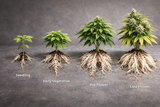
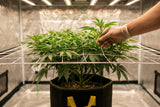
Quick answer: Cannabis canopy management is the practice of shaping how a plant grows above the soil so that light, air, and energy are distributed evenly across many productive tops instead of one dominant cola. It matters because the canopy is the plant's production engine: roots set the ceiling on water and nutrients, but the canopy decides how efficiently that supply gets converted into flower. A flat, evenly lit canopy puts more bud sites in strong, usable light, and that beats simply running a bigger light almost every time.
The catch is that most of your canopy structure is a design decision made early, during veg and the first weeks of flower, and it locks in permanently once flowering is underway. This guide covers the biology: why plants build canopies, why an even one wins on light physics and gas exchange, how stretch and apical dominance set the shape, and which canopy mistakes you simply cannot fix later.
Cannabis canopy management is the highest-leverage, lowest-cost lever most home growers ignore. You can spend more on a bigger light, richer nutrients, and better genetics, and still leave half your yield on the table because the plant is shaped wrong. The canopy is where light becomes biomass, and its shape decides how much of your input actually turns into flower. This article is the science behind that: not a how-to on any single technique, but the why underneath all of them. For the hands-on methods, we link out to the complete training guide, low-stress training, and the Screen of Green (SCROG) walkthrough as we go. If you are still learning how to grow cannabis in the first place, start there for the full workflow, then use this article as the reasoning behind the shaping steps.
What Is Cannabis Canopy Management?
Cannabis canopy management is the deliberate control of a plant's above-ground structure: how tall it gets, how its branches are spaced, how light reaches each growth site, and how energy is allocated across the plant. The canopy is not just a pile of leaves. It is a biological system for turning light into sugar, and its geometry decides how well that system runs.
Here is the mental model that makes everything else click. If roots determine a plant's potential, the canopy determines how efficiently that potential is expressed. Strong roots feeding a badly shaped canopy waste their supply. A well-built canopy on weak roots runs out of fuel. The two develop together, which is why we treat root development and canopy structure as one linked problem.

A well-managed canopy exposes more productive growth sites to light, keeps branch growth balanced, minimizes shaded and unproductive areas, and can hold flower weight without collapsing. A poorly managed one wastes light, grows unevenly, limits flower production, and builds structural weakness that shows up right when the buds get heavy. None of this is about making the plant look tidy. It is about biological efficiency: getting the most flower out of the light, water, and nutrients you are already paying for.
Why Plants Build Canopies (and Why That Instinct Wastes Light Indoors)
Canopy structure is not accidental. It is the result of millions of years of evolution responding to one pressure: competition for light. In a wild stand of plants, the ones that grow taller fastest and spread their leaves first intercept sunlight before their neighbors, outcompete the surrounding vegetation, and reproduce. That pressure shaped a fixed growth priority into the plant: vertical extension first, lateral branching second, leaf angle tuned for capture.

Indoors, that instinct backfires. Your grow light is not a distant sun that a plant has to race toward. It is a fixed panel pouring photons straight down onto a roughly flat plane. When the plant follows its nature and shoots one dominant top upward, it wins a race that no longer exists, and the prize is wasted light, uneven energy use, and structural stress. Cannabis canopy management is, at its core, retraining an outdoor survival strategy to run efficiently in an artificial box. You are not fighting the plant. You are updating its assumptions about where the light comes from.
Why an Even Canopy Beats Raw Wattage
This is the central idea, so it is worth stating plainly: for the money you have already spent, the shape of your canopy is a better buy than a bigger light. A grow light illuminates a plane. A flat canopy puts the maximum number of tops in that plane, all at a similar distance from the source, so they all receive similar intensity.
Be careful how you read the research here, because it gets quoted backwards constantly. In the most-cited indoor cannabis light trial, dry flower yield rose in a straight line with canopy-level light all the way up to 1,800 µmol/m²/s, climbing from 116 to 519 g/m² with no plateau anywhere in the range tested.1 More light did keep producing more bud. Anyone who tells you cannabis hits a hard light ceiling is not quoting that study.
What the same trial also found is the part that matters for canopy work: leaf-level photosynthesis saturated far below 1,800, so the leaf response turned out to be a poor predictor of what the whole plant did.1 Light does not stop paying. It stops paying at the individual leaf long before it stops paying at the plant, and the gap between those two points is made up almost entirely of leaves you have not put into the light yet. That is a canopy problem, not a fixture problem.

When the canopy is level, light reaches every productive growth point at similar intensity. That creates more uniform photosynthesis, balanced branch development, consistent flower size, and better overall yield efficiency. Instead of one top gorging on light while lower branches starve, the energy is distributed. More leaves operate near peak efficiency, more flowering sites develop fully, and less light spills past the plant as wasted heat. Canopy uniformity is how you raise the share of your light that ends up as flower. That is a different lever from raising the light itself, and a far cheaper one.
Light intensity and distance: the inverse-square problem
Light does not fall off gently as it moves away from its source. It follows the inverse-square law, so intensity drops sharply with distance: a leaf twice as far from the lamp gets roughly a quarter of the intensity, not half, and small height differences turn into large differences in usable energy.2

Distance is the half of this that growers already know about. It is also the smaller half. Long before the extra distance has done much damage, the canopy itself has taken the light: every leaf above a bud site intercepts its share first, so what reaches the interior falls away layer by layer rather than inch by inch.2

Subcanopy lighting trials make the same point from the other direction. Add light underneath a cannabis canopy, where the top leaves cannot reach it first, and the lower buds put on yield and cannabinoid content that the top fixture alone was never going to give them.3 Their problem was not that they sat too far from the lamp. It was that the plant above them had already spent the light.
One honest caveat: a wide LED panel is not a true point source, so over the short distances inside a tent the real falloff is gentler than a strict inverse square. That does not weaken the argument, it sharpens it. The less of the loss you can blame on distance, the more of it belongs to the canopy, and the canopy is the part you can redesign. This is why a tall, uneven plant underperforms even under a powerful light: it looks healthy up top while quietly failing below.
The source-sink relationship: energy follows light and hormones
Inside the plant, sugar moves according to a simple economy. Mature, well-lit leaves are sources: they produce more energy than they use. Growing tips, flowers, and old shaded leaves are sinks: they consume more than they make. Energy flows toward the sites getting the most light and the strongest hormonal signals, so well-lit branches accelerate while shaded ones fall behind.2

A shaded leaf is not neutral. It stays green, but it produces little usable energy and consumes more carbohydrate than it generates, so it becomes a drain rather than a contributor. A leaf does not cross that line the instant it loses the light, though. Leaves acclimate to the light they get, trimming their own running costs to stay solvent in dimmer conditions, so the leaf that actually costs you is the one sitting in deep and sustained shade, not the one that caught a passing shadow. Over time the plant deprioritizes it: slowing its growth, pulling resources upward, and eventually shedding it. That is not disease, it is accounting. A canopy full of shaded leaves is not a lush canopy, it is a sign that light is being wasted and energy is poorly routed. Managing the canopy is largely about keeping leaves on the source side of that ledger.
Leaf saturation versus whole-plant yield: the mismatch that matters
A single leaf does not photosynthesize faster forever. Each leaf has a saturation point, and past it, extra photons landing on that leaf return very little.4 The mistake, and it is an easy one to make, is to scale that up and conclude the plant carries the same ceiling. It does not. In the trial above, whole-plant yield was still climbing in a straight line at 1,800 µmol/m²/s while leaf-level photosynthesis had already flattened off well below it.1 A plant beats its own leaves because it has more than one layer of them, and because leaves acclimate to the light they actually receive.

That mismatch is the entire argument for canopy work. If a leaf is already full, the way to buy more photosynthesis is not a brighter photon on a leaf that cannot use it. It is another leaf in usable light. An uneven canopy has its tops sitting past saturation while the mid-canopy sits below its productive threshold, so the same fixture does less total work than it could. The goal of canopy management is not to expose leaves to more light, it is to expose more leaves to usable light.
The economics deserve the same honesty. The one published look at light intensity against profitability in cannabis found that the value of the extra yield still outran the extra electricity right through the range they tested, so nobody should tell you that turning the light up is a losing trade.5 Canopy shape is not a substitute for light. It is the cheaper lever, and the only one that is free once the fixture is bought: it changes how much of the light you are already paying for lands somewhere that can use it.
Canopy Density: The Gas-Exchange Problem Most Growers Miss
A canopy can be perfectly flat and still underperform if the density is wrong. Most growers obsess over height and ignore the other variable that matters just as much: how much leaf is packed into a given volume of space. Cannabis-specific canopy research is still thin here, so the physics below leans on established plant-canopy science, but the mechanism is well understood.
Airflow is usually filed under mold prevention. That is real, but it undersells it. Airflow changes how leaves actually function. Every leaf sits inside a thin film of still air called the boundary layer. In a dense, stagnant canopy that layer thickens, and when it does, carbon dioxide exchange slows so photosynthesis becomes less efficient, transpiration slows so leaves cool less effectively, water and nutrient movement through the plant drops, and trapped humidity destabilizes the microclimate. That is a hidden reason dense canopies underperform under strong light: the plant simply cannot move gases and water fast enough to use the light it is getting.

That is the mechanism at the scale of one leaf. Zoom out and the same problem repeats across the whole plant: a canopy packed tightly enough to stall the air is a canopy full of leaves each sitting inside its own thickened film.

Too dense versus too open
Density is the balance between leaf area, which is your photosynthetic surface, and open air space, which gives you light penetration, airflow, and drying. Get it wrong in either direction and you lose. A canopy that is too dense has plenty of leaf but not enough usable conditions for that leaf to work: you see strong tops over weak mid-canopy growth, persistent shade in the lower half, humidity pockets, and leaves overlapping instead of tiling into a clean layer. Those humidity pockets are not only a photosynthesis problem: once the plant is in flower they are the conditions bud rot needs. A canopy that is too open has the opposite problem: light punches through to the floor and the pot surface, you get fewer bud sites per square foot, and you waste photons on bare ground. Classic canopy science captured this decades ago: there is an optimal leaf area for maximum production under a given light level, and past it, adding more leaf stops helping.6 The best canopies land in the middle: enough leaf to capture the light, enough gaps for air to move and mid-canopy sites to stay fed.

Carbon dioxide distribution and canopy depth
Even if you never supplement carbon dioxide, canopy depth still governs how much of it reaches the interior. Deep inside a dense, poorly mixed canopy, air exchange is slow, carbon dioxide gets consumed faster than it is replenished, the boundary layer thickens, and the microclimate goes stagnant. That interior can become locally carbon-dioxide-limited while the room as a whole reads fine. It reinforces the core principle: a canopy is not only a light problem, it is a gas-exchange problem, and you cannot fix gas exchange with more nutrients. You fix it with structure, spacing, and airflow.

How Stretch Locks In Your Canopy Structure
Most of your final canopy is decided during vegetative growth and the stretch, the surge of vertical growth in roughly the first two to three weeks after the flip to flower. Stretch is not just the plant getting taller. It is the plant committing to decisions: how far apart the bud sites will be, how tall each branch becomes, how thick the structure needs to be, and which parts of the plant get to dominate. Once internode spacing is set, you cannot fix it later. You can only support it or limit the damage.

The biggest controllable drivers of internode spacing are light intensity at the growing tip, where strong light keeps nodes tight and weak light encourages stretch; canopy competition signals, where crowded plants stretch harder because they read it as a race; temperature swings, where large day-to-night differences increase stretch; and early canopy shape, where a top that dominates early tends to keep winning. This is exactly why canopy management is a design decision and not a reaction. If you let the plant build a tall, uneven architecture early, it usually keeps that pattern straight through flower. Enter the stretch with a level canopy and the stretch amplifies a good structure. Enter it with an uneven one and the stretch makes it worse. The window is short and the leverage is high.
Apical Dominance: The Rule Canopy Management Fights
Cannabis grows with apical dominance. The highest growing tip produces hormones, primarily auxins, that suppress the branches below it so the plant can prioritize the top. Energy gets directed upward, lower growth stays weak, and one main cola dominates. In the wild that is a winning move: it lets the plant reach light faster and outcompete its neighbors. Under a fixed overhead light, it is a liability, because it produces exactly the tall, uneven, self-shading shape you do not want.

Canopy management exists to counteract this tendency, and the most direct tool for it is topping to break apical dominance. Removing the dominant tip forces the plant to split growth into multiple lower shoots, which is the foundation of nearly every training method. You are not overriding the plant's biology. You are redirecting a hormone signal so the plant spreads its ambition across many tops instead of pouring it into one.
How You Actually Manage the Canopy
Training is the practice of changing plant structure on purpose so the canopy captures light more evenly. It works on two levers. The first is hormonal: interrupting apical dominance so the plant activates lower branches instead of feeding one leader. The second is light allocation: flattening the canopy so more branches sit in high-quality light, since the plant sends growth toward wherever the light is strongest. Left alone, the tallest top wins twice, more light and more hormone, and runs away with the plant. Training removes that double advantage.
When you train, real internal shifts follow even when little seems to happen on the surface. Hormone gradients rebalance and the plant starts feeding lateral growth. Source-sink priorities shift as more tips become sinks, so sugars and nutrients spread across more sites. Stems thicken where stress is applied, building stronger attachment points for later flower load. And the canopy microclimate improves as spacing and airflow get better. What training does not do is raise genetic potential. Genetics set the ceiling; canopy management just gets you closer to it.

Canopy styles: one plant, a few, or many
The best canopy shape depends on how many plants you are running. With many small plants you can fill a flat layer quickly with a Sea of Green. With a single plant and time to build, a Screen of Green spreads that one plant into a full flat canopy under a net. And with a few larger plants, you build the structure into each plant with training rather than a net. These are strategies for the same goal, one productive layer, chosen by plant count, space, and how much veg time you have.

The mechanics of each belong in their own guides, because this article is the why, not the how. For the step-by-step methods, start with LST to bend the branches, add mainlining or the manifold method for a symmetric base of equal colas, and read the full SCROG walkthrough if you are running one or two plants under a net. The tools that hold those bends without cutting into the stem are simple: LST clips like the BudClips for the early angles, and coated wire like the BudHuggers for pulling outer branches down level and anchoring them to the pot. A light pass of strategic defoliation to remove leaves that shade the layer below keeps the canopy you built breathing.
How to Evaluate a Good Canopy
Growers throw around "good structure" without defining it. Here are three checks you can actually run, no measurement project required.

The uniformity check. Stand back and look at the plant from the side. Is it one surface or several layers? A strong canopy has one primary productive layer, only minor variation in top height, and few deep shadow zones. A weak one has a few tops dominating, a second dead-zone layer below them, and a lot of leaf that never produces anything.
The light-distribution check. Are the tops thriving while the mid-canopy stalls? That is light being captured too unevenly. Your target is not maximum brightness at the very top, it is usable light across every productive site. If only the top eight inches (20 cm) of the plant is doing real work, the canopy is too tall or too dense.
The plant-behavior check. Balanced canopies grow in balance: similar branch vigor across tops, consistent leaf size, consistent bud development. When one side or one top keeps winning, it is usually not a nutrient issue, it is a structure and light-dominance issue, and the fix is structural, not another bottle.

What Canopy Mistakes Cannot Be Fixed
This is the part that separates canopy management from every other grow task: some of it is permanent. Treat canopy development as a design phase, not a correction phase, because once flowering begins, internode spacing is locked in, branch angles cannot be re-set, structural weaknesses stay, and light distribution cannot be fully corrected.

The mistakes you cannot undo later are excessive vertical growth, poor branch spacing, uneven canopy height, and weak structural support. You can prop up a floppy plant with stakes and netting, but you cannot go back and re-space the nodes or re-angle a hardened branch. Late intervention in flower usually just adds stress, costs yield, and slows bud development. Every technique in the training cluster exists to get the structure right before that window closes, because the plant spends the rest of the cycle compounding whatever shape it entered flower with, good or bad.
Roots and Canopy Develop Together
Canopy performance is inseparable from root performance, and it is worth ending the science here because it is the most common blind spot. Roots determine how much water can be supplied, how many nutrients can be absorbed, and how fast the plant recovers from stress. The canopy determines how efficiently that energy is used, where growth is directed, and how much biomass the plant can support. A strong canopy on weak roots runs out of fuel. Strong roots under a badly structured canopy waste their potential. The two have to develop in balance.

This is also why canopy training works best when roots are already well established, the environment is stable, and stress is minimized. Push structural changes on a plant with a weak root system or an unstable environment and you stack stresses that compound. If you want the full picture on the other half of this system, our deep dive on root development covers how the root zone sets the ceiling the canopy then works within.
Canopy Management Across the Plant Lifecycle
Timing decides how much a given action helps or hurts, so canopy work maps onto the grow in a predictable way.

In the seedling stage, do minimal canopy work. The priority is root establishment and a healthy structural foundation, not shaping. In the vegetative stage, do the primary canopy building. This is when recovery potential is highest and structural balance is established, so it is where topping, training, and spacing earn their keep. In early flower, the only adjustment left is tucking under a trellis net until the stretch ends around day 21 - no new bends, cuts or clips - and your focus shifts to light exposure as the stretch fills the canopy. In mid to late flower, make no structural changes at all: support the weight, protect the bud sites, and accept that the canopy shape is fixed. For a full week-by-week view of what the plant is doing once it flips, see the flowering stretch guide. The pattern is consistent: the earlier you act, the more the plant compounds the benefit, and the later you act, the more you are just managing damage.
Frequently Asked Questions
What is cannabis canopy management?
Cannabis canopy management is the deliberate shaping of a plant's above-ground structure so light, air, and energy reach many productive tops evenly instead of one dominant cola. It covers height, branch spacing, density, and training. Done well, it puts more bud sites in usable light and lets the plant convert the light it already receives into more flower.
Why does an even canopy produce better than a taller one?
A grow light illuminates a flat plane, so a level canopy places the most tops at a similar, strong light intensity. A tall plant sends one cola into the best light while shading everything below into a low-output dead zone. Spreading growth into one even layer keeps more leaves photosynthesizing efficiently, which is why shape beats raw wattage.
Does canopy structure actually increase yield?
Canopy structure does not raise a plant's genetic ceiling, but it strongly affects how close you get to it. The research is clear that cannabis yield keeps rising with the light the canopy actually intercepts, with no plateau found even at 1,800 µmol/m²/s, while an individual leaf saturates far below that. Because the plant outruns its own leaves by having more of them in usable light, a better canopy is how you turn the light, water, and nutrients you already pay for into flower instead of into shaded, unproductive growth.
What does the ideal cannabis canopy look like?
Flat or gently curved, with even branch height, minimal shading, and uniform spacing. Density should sit in the middle: enough leaf area to capture the light, enough open space for air to move and light to reach mid-canopy sites. The opposite, a tall central cola over weak lower growth with uneven node spacing, is the pattern to avoid.
Can you fix an uneven canopy during flowering?
Not really. Once flowering begins, internode spacing is locked, branch angles cannot be re-set, and light distribution cannot be fully corrected. You can support a floppy plant with stakes or netting, but you cannot re-space or re-angle hardened structure. This is why canopy management is a design phase done in veg and early stretch, not a repair job in bloom.
What is apical dominance and how does it affect the canopy?
Apical dominance is the plant's tendency to let its highest growing tip release auxin hormones that suppress the branches below it, so one main cola dominates and lower growth stays weak. Under a fixed overhead light that produces a tall, self-shading shape. Topping and training interrupt that signal so growth spreads across many even tops instead.
What causes stretch, and when does it set the canopy structure?
Stretch is the surge of vertical growth in roughly the first two to three weeks after the flip to flower. It sets internode spacing, branch height, and which tops dominate. Weak light at the tips, crowding, and large day-to-night temperature swings all increase it. Because spacing locks in once stretch ends, you build an even canopy before stretch, not after.
How dense should a cannabis canopy be?
Aim for the middle. Too dense and you get strong tops over a shaded, humid, stagnant interior where mid-canopy sites starve. Too open and light punches past the plant to the floor, wasting photons on bare ground. The target is enough leaf to capture the light with enough gaps for airflow, drying, and light penetration into the productive layer.
Does airflow affect the canopy beyond preventing mold?
Yes, and this is underrated. Every leaf sits in a thin boundary layer of still air. In a dense, stagnant canopy that layer thickens and slows carbon dioxide exchange, transpiration, and water movement, so each leaf produces less usable energy even under strong light. Good airflow thins the boundary layer and keeps leaves working, which is a photosynthesis benefit, not just a mold one.
What is the source-sink relationship in a cannabis plant?
Sources are mature, well-lit leaves that produce more energy than they use. Sinks are growing tips, flowers, and shaded old leaves that consume more than they make. Sugar flows toward the sites with the most light and strongest hormone signals, so well-lit branches speed up and shaded ones fall behind. Good canopy management keeps more leaves on the productive source side.
Is more light better, or is canopy shape more important?
Both work, but they are not the same purchase. More light does keep producing more bud: yield rose linearly to 1,800 µmol/m²/s in the best indoor trial available, and the extra yield was still worth more than the extra electricity. What saturates is the individual leaf, not the plant. So in an uneven canopy the tops sit past saturation while the mid-canopy stays starved, and a brighter fixture mostly feeds leaves that are already full. Fixing the shape costs nothing once the light is bought, which is why it is the lever to pull first.
How do roots affect canopy development?
Roots set the ceiling: they determine how much water and nutrient the plant can supply and how fast it recovers from stress. The canopy decides how efficiently that supply becomes flower. Strong roots under a poor canopy waste potential, and a strong canopy on weak roots runs out of fuel. The two must develop in balance, which is why training works best once roots are established.
What is the difference between SOG, SCROG, and training a few big plants?
All three build one flat productive layer, chosen by plant count and veg time. Sea of Green uses many small plants flipped early, each contributing a top or two. SCROG spreads one or two plants flat under a net over a longer veg. A few big plants build structure into each plant by hand. More plants means less training each; fewer plants means more training per plant.
When should I start managing my canopy?
Start in vegetative growth, once roots are established and the plant is growing vigorously. Veg is when recovery potential is highest and structure is set, so it is where topping, training, and spacing pay off. Structural training ends at the flip; the only thing that continues is tucking under a trellis net through the stretch, and that stops around week three of flower when the structure locks in.
Do autoflowers need different canopy management?
Yes. Autoflowers run on a fixed clock and start flowering on age, usually three to four weeks from sprout, so they cannot afford the recovery time a second cut costs. The rule for autos is one topping at most, taken only when you are removing very little plant material and the plant is visibly vigorous, with low-stress training doing the rest: gently bend and spread branches into a low even canopy. A slow or stressed auto should not be topped at all. Save the heavier structural work for photoperiods.
Next Steps in Your Grow
Canopy science only pays off when you act on it. The place to turn this into structure is the training cluster: start with topping to break apical dominance, layer in bending the branches out to spread the canopy, and follow the full training routine to tie it together. If you run one or two plants in limited height, the SCROG method enforces the flat canopy this article describes, and the same flattening logic scales up to big outdoor plants.
The gear that makes an even canopy easier to build is the gear that holds your bends: low stress training clips for the early angles, BudHuggers for pulling outer branches down level, and fabric pots like the BudPots whose grommets give you anchor points to tie down to - and not every pot's grommets survive that pull. You can get all three together in the BudTrainer bundle. And because the canopy is only half the system, round out the science with how roots set the ceiling every canopy works within.
References
- Rodriguez-Morrison, V., Llewellyn, D., & Zheng, Y. (2021). Cannabis Yield, Potency, and Leaf Photosynthesis Respond Differently to Increasing Light Levels in an Indoor Environment. Frontiers in Plant Science, 12, 646020. https://www.frontiersin.org/articles/10.3389/fpls.2021.646020/full
- Niinemets, U. (2007). Photosynthesis and resource distribution through plant canopies. Plant, Cell & Environment, 30(9), 1052-1071. https://onlinelibrary.wiley.com/doi/abs/10.1111/j.1365-3040.2007.01683.x
- Hawley, D., Graham, T., Stasiak, M., & Dixon, M. (2018). Improving Cannabis Bud Quality and Yield with Subcanopy Lighting. HortScience, 53(11), 1593-1599. https://journals.ashs.org/hortsci/view/journals/hortsci/53/11/article-p1593.xml
- Chandra, S., Lata, H., Khan, I. A., & ElSohly, M. A. (2008). Photosynthetic response of Cannabis sativa L. to variations in photosynthetic photon flux densities, temperature and CO2 conditions. Physiology and Molecular Biology of Plants, 14(4), 299-306. https://link.springer.com/article/10.1007/s12298-008-0027-x
- Eaves, J., Eaves, S., Morphy, C., & Murray, C. (2020). The relationship between light intensity, cannabis yields, and profitability. Agronomy Journal, 112(2), 1466-1470. https://acsess.onlinelibrary.wiley.com/doi/10.1002/agj2.20008
- Monsi, M., & Saeki, T. (2005). On the Factor Light in Plant Communities and its Importance for Matter Production. Annals of Botany, 95(3), 549-567. https://academic.oup.com/aob/article-abstract/95/3/549/322932

About the Author
Henrique Dias is the CEO and co-founder of BudTrainer. He is a mechanical engineer who also holds a graduate certificate in Commercial Cannabis Production from Niagara College in Ontario, Canada - the first college-level cannabis cultivation program in North America. Before founding BudTrainer, Henrique worked with Health Canada licensed cannabis producers, where he gained hands-on experience in cultivation, processing, and post-harvest management of cannabis at commercial scale. He started BudTrainer to bring that same level of craft to home growers through better-designed gardening tools and clear, science-backed education.
DISCLAIMER: Everything taught and sold by BudTrainer® is to be used strictly for legal purposes. We do not endorse the production of illegal substances and it is your duty to ensure that you are complying with the law. The words "hemp," "cannabis," "weed," and "marijuana" are used interchangeably to refer to the same plant (legal hemp with less than 0.3% THC) for the purposes of this lesson.