Quick answer: Cannabis roots are the plant's underground organ system for absorbing water and minerals, anchoring the plant, storing energy, and signaling growth. Cannabis grows a fibrous root system - many fine, branching roots rather than one thick taproot - and the health of that system sets a hard ceiling on everything above the soil. Leaf size, stem strength, stretch, and flower load are all limited by what the roots can supply. Most of the time, a struggling plant is not short on nutrients. Its root zone is short on oxygen. It is the same reason a damaged root zone fakes a nutrient deficiency on the leaves above it.
This guide is the biology, not a feeding chart: how the root system is built, where uptake actually happens, why root efficiency beats root size, and how oxygen, moisture, chemistry, and temperature decide whether roots thrive or fail. It also explains the mechanism behind the two problems growers misdiagnose most - root rot and overwatering - so you can read your root zone instead of guessing at it.

Cannabis roots are the most important part of the plant you never look at. Every visible outcome - how fast the plant grows, how big the leaves get, how well it handles training, how much flower it can carry - is constrained by what happens below the soil surface. Growers pour attention into light, nutrients, and training while the actual bottleneck sits in the pot, out of sight. This article fixes that. It covers how root systems form and function, and how the root-zone environment shapes root behavior from the moment the radicle emerges at germination through to late flower. For the hands-on methods - watering, container choice, and how to transplant cannabis - we link out as we go. Roots set the ceiling; the canopy decides how much of it you reach. Healthy roots are the foundation of growing healthy cannabis plants, so this is the groundwork the whole grow is built on.
What Cannabis Roots Actually Do
The root system is the plant's underground organ network, and it runs five jobs at once: water absorption, mineral nutrient uptake, physical anchoring, hormone signaling, and energy storage and exchange. Miss any one of them and the whole plant pays for it. Roots are not a passive drinking straw. They are an active, adaptive system that constantly rebuilds itself to chase oxygen, moisture, and nutrients through the medium.1
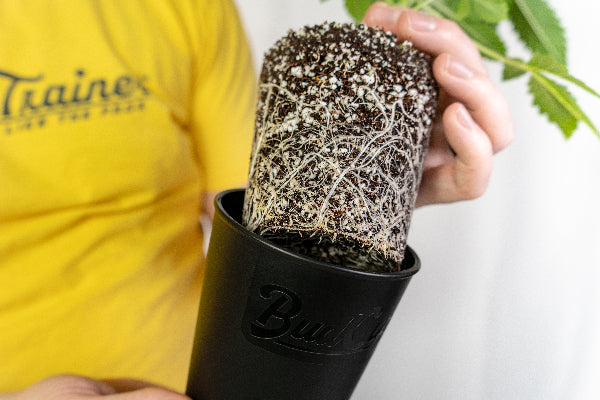
Cannabis develops a fibrous root system - a mass of many fine, branching roots rather than one dominant, thick taproot. That matters because the fibrous structure is built for surface area. The more the system branches into fine roots and root tips, the more interface it has with the water and nutrients around it. A big, ropey rootball is not the goal. A dense field of active fine roots is.

Here is the mental model for the whole article: roots set the potential, and the rest of the plant spends it. Two plants under identical light and identical nutrients can perform completely differently based on root architecture alone. The plant with more root tips, better distribution through the pot, and higher oxygen access will beat the plant with long circling roots, compacted zones, and poor aeration every time - same inputs, different result. The root system is the multiplier on everything else you do.
The Anatomy of a Cannabis Root System
Understanding the parts explains why certain practices work and others reliably fail. Each structure has a distinct job, and problems usually trace back to a specific part of the system.
The taproot (primary root)
The taproot, or radicle, is the first root to emerge. It pushes out of the seed shell during germination, establishes early anchoring, and starts the first water absorption. In cannabis it is quickly overtaken in function by the lateral roots - it is the seed's opening move, not the main event. To get that first root off to a strong start, see how to plant cannabis seeds.

Lateral roots
The side-branching roots that form the bulk of the root mass. Lateral roots do most of the real work - the majority of water and nutrient uptake happens here, not on the taproot. Branching density is the metric that matters: more laterals means more surface area means more uptake.

Root hairs
Root hairs are microscopic extensions of the root's epidermal cells, and they are the primary interface for absorption. They dramatically increase surface area, and they are where most water and mineral uptake actually occurs.2 They are also fragile and short-lived, often living days to weeks rather than months, which means the plant is constantly rebuilding its uptake surface. Anything that repeatedly damages root hairs - drybacks that go too hard, chronic saturation, harsh salt swings, rough transplant handling - cuts uptake even when the plant technically has plenty of root.

The rhizosphere and the root zone
The rhizosphere is the thin biological zone right around the roots where microbial activity, nutrient exchange, and root exudate interactions happen. It is one of the most biologically active regions in the medium, and it is highly sensitive to moisture imbalance, compaction, and chemical buildup. Disrupt it and nutrient availability drops even when the nutrients are physically present. The root zone is broader still: the entire environment the roots occupy, including the physical structure of the medium, oxygen availability, moisture distribution, and microbial populations. When we say "manage the roots," we mean manage this whole environment, not just the roots themselves.

Why Root Efficiency Beats Root Size
This is the single most useful reframe in root science, so it is worth stating plainly: the healthiest root systems are not defined by thickness. They are defined by the density of fine branching, the amount of white or tan healthy feeder root, and the constant production of new tips. Root size is a vanity metric. Root efficiency is the real one.3
Most growers picture "roots" as the thick, visible strands, but those structural roots do relatively little absorbing. Uptake happens at the active edge of the system - the newest root tips and the root hairs just behind them. The tip carries the meristem, the cell-division zone, and as it advances it constantly creates fresh surface area that explores new oxygen pockets, moisture films, and nutrient zones. A root system is a moving frontier, not a static sponge.
This explains a paradox every grower eventually hits: a plant can look intensely "rooty," with thick roots circling the pot, and still perform badly. The root mass is large, but it has stopped producing a dense field of healthy tips and hairs. It looks impressive and works poorly. When you evaluate roots, ignore the bulk and look for fine white branching and fresh tips.

How Cannabis Roots Grow and Absorb
Roots grow through apical elongation: new cells are produced at the root tip and expand outward. Growth is directional, and it chases four things - higher moisture, higher oxygen, accessible nutrient concentrations, and less physical resistance. Roots actively avoid compacted, anaerobic, or waterlogged zones. That single fact means your container design, watering habits, and media structure directly write the shape of the root system, because the roots are always growing toward the conditions those choices create.

▶ Watch the root-development video on YouTube

On the uptake side, roots absorb water mainly through osmosis, driven by the concentration gradient between the root interior and the surrounding medium. Nutrients enter through passive diffusion, active transport that costs the plant energy, and mycorrhizal exchange when fungi are present. Once absorbed, water and dissolved minerals move upward through the xylem. The nutrients stay in the plant while most of the water exits through the leaves as transpiration. The practical consequence is huge: most nutrient uptake is carried by water movement, so poor watering practices show up looking exactly like nutrient deficiencies. Before you add another bottle, look at how water is actually moving through the pot. The other end of that pull is the air around the leaves, which our guide to vapor pressure deficit covers.
Root Zone Chemistry: pH, EC, and Salt Stress
Root problems get misdiagnosed as nutrient deficiencies constantly, when the real issue is the chemistry of the thin water film around the roots. A root can only absorb a mineral that is dissolved in water, present in the right ionic form, and at a concentration that does not block water uptake. That last condition is the one most growers never think about.
pH is a nutrient-availability gate, not a number
pH controls which nutrients stay soluble and which precipitate out or become chemically locked. When pH drifts out of range, the plant shows deficiency symptoms even when you are feeding correctly, because the root physically cannot access what is present. Just as important, unstable pH is usually a symptom of a root-zone problem - salt buildup, inconsistent wetting, poor oxygen - rather than a standalone "pH problem." Chasing the number without fixing the root zone is a treadmill.

EC and osmotic pressure
EC is a proxy for dissolved salts. Push it too high and you raise the osmotic pressure of the solution, which means the plant has to work harder to pull water into the root against the gradient.4 When EC gets too high in the root zone, water uptake slows, transpiration slows, nutrient flow slows with it, and the leaves can droop even though the medium is visibly wet. The plant looks deficient because flow is restricted, not because nutrients are missing. This is exactly why feeding more rarely fixes a "deficiency" that is actually salt stress - you are adding to the problem.

Salts do not build up evenly
Salts accumulate where water repeatedly evaporates and dries first: near the top layer of the medium, at the outer edge of the rootball, and in zones that stay just moist enough but rarely get fully flushed. That is why a plant can be fine in one part of the pot and stressed in another, and why runoff EC that climbs over time is evidence of accumulation rather than proof the plant "likes it strong." Alkalinity in your water source drives a lot of this - hard water pushes pH upward over time and encourages buildup, while very soft or RO water swings fast unless the nutrient solution provides buffering. The failure mode to remember: in a salt-stressed root zone, the medium can be wet while the plant still cannot pull water efficiently, so growers misread it as underwatering and make it worse. The feeding side of this - what EC to actually run, and the half-strength habit that stops salts stacking up in the first place - is in our guide to how much to feed.

Oxygen: The Master Variable
If you take one thing from this article, take this: roots need oxygen to function, and most root failure is really oxygen failure. Unlike leaves, roots do not photosynthesize. They respire, consuming oxygen and releasing carbon dioxide, just like we do. When oxygen around the roots drops too low, root metabolism slows, nutrient uptake declines, pathogens gain the advantage, and root tissue starts to die back.5

Overwatering is an oxygen problem, not a water problem
Overwatering does not mean "too much water at once." It means the roots are not getting enough oxygen because water is occupying the air spaces in the medium. When soil or coco stays saturated, oxygen is pushed out, roots cannot respire, uptake slows, and harmful microbes thrive. The result is yellowing leaves, drooping even though the medium is wet, deficiency symptoms, and eventually root rot. Underwatering is the mirror image and less common: root hairs collapse, nutrient movement stops, turgor pressure drops, and growth slows to conserve energy. Both extremes are really about the balance of water and air in the pot over time. To keep that balance in a real pot, water by the weight of the pot rather than by the calendar.

Soil air versus dissolved oxygen
Roots do not just need oxygen, they need a delivery system for it. In soil or coco, oxygen arrives through air-filled pore space. After watering, some pores fill with water, then as the pot drains and dries they refill with air - that cycling is why healthy, self-draining root zones work. In water-based systems like DWC, oxygen arrives as dissolved oxygen in the solution, and if it drops, roots can suffocate while completely surrounded by water. The most dangerous container condition is chronic wetness without air exchange: the medium blocks pores, drainage is slow, oxygen diffusion is limited, and respiration demand rises as the root zone warms. A grower sees "wet soil" and assumes the plant is safe from drought while the root is quietly failing from low oxygen.
The wet-dry cycle
A healthy container root zone is not "wet" or "dry" - it cycles. Right after watering, roots have maximum access to dissolved nutrients in the water film, but while pores stay waterlogged, oxygen delivery is restricted. As the medium drains and slightly dries, oxygen returns to the pore spaces and respiration improves. That cycling keeps root hairs functional, encourages new branching toward zones that have both moisture and oxygen, and keeps beneficial microbes stable. This is why two growers who "water the same amount per week" get completely different results: what matters is not weekly volume, it is whether the root zone spends most of its time in a state that supports both respiration and uptake.

Root Zone Temperature
Root-zone temperature controls enzyme activity, and enzymes drive nearly every reaction involved in nutrient uptake and metabolism. In a cold garage or basement, getting the tent off the cold floor is the first fix. Those enzymes only work efficiently within a narrow band, so when the root zone falls outside it, nutrient conversion slows, absorption becomes inefficient, and deficiencies appear even with nutrients present. For an established plant, the target range for cannabis roots is roughly 18 to 22 degrees C (65 to 72 degrees F). Seedlings run warmer: our planting guide puts the seedling root zone at 75-79°F (24-26°C). Too cold and enzyme activity slows, uptake drops, and growth stalls. Too warm and respiration rises, oxygen availability falls, and stress and disease risk climb. Roots are more temperature-sensitive than leaves, and problems often show up below ground before you see anything above it - a cold windowsill or a hot black pot in direct sun can bottleneck an otherwise healthy plant.

Roots as a Signaling System
Roots are not just plumbing, they are an active signaling organ. They produce and regulate hormones - cytokinins that drive cell division and shoot growth, auxins that control root branching and directional growth, and stress hormones that respond to drought, compaction, and nutrient imbalance. Those signals reach up and shape the whole plant.

Root health controls shoot growth rate, because roots transport the carbohydrates and hormones that build above-ground tissue - limit root function and shoot growth slows regardless of light or genetics. It controls leaf size, because leaf expansion depends on turgor pressure, which depends on steady water uptake; stressed roots give you smaller leaves and less photosynthetic surface. It controls branching symmetry, because a balanced root system distributes hormones evenly, while poor root health produces uneven growth and weak side branches. And it sets a permanent ceiling on flowering: root development during early growth determines how much energy the plant can support later, and because roots stop expanding significantly once flowering begins, any limitation in root mass becomes a fixed constraint on the whole bloom. What you build below ground in veg is what you have to spend in flower.
The Living Root Zone: Exudates, Microbes, and Mycorrhizae
Roots do not only absorb, they also feed the soil. They release compounds called root exudates - sugars, amino acids, and organic acids - into the rhizosphere, and the plant spends real energy making them on purpose.6 Exudates recruit beneficial microbes, help mobilize minerals near the root surface, and influence which organisms dominate the root zone. Think of it as a marketplace: the plant supplies carbon, and microbes return mineral availability, protection, and competitive exclusion of pathogens.

This is why microbes are not a separate topic from root health - they are an output of it. When root conditions are stable, with oxygen, moisture, and temperature in range, the plant produces exudates consistently and the biology stays productive. When roots are stressed by waterlogging, cold, or salt, exudate patterns change, microbial balance weakens, and pathogens get an opening. A healthy microbial population acts as an extension of the root system, increasing effective surface area without the plant having to grow more root.

Mycorrhizae are an amplifier, not a fix
Mycorrhizae are beneficial fungi that form a symbiosis with roots: in exchange for sugars, the fungal network extends outward through the medium and acts like an expansion of the root system, reaching micro-pores and zones the roots do not efficiently penetrate. They are especially good at improving access to phosphorus, which moves poorly in many media, and to some micronutrients.7 But they do not override a bad root zone. In a medium that is chronically waterlogged, salt-stressed, oxygen-limited, or swinging in pH, the plant reduces exudate output and the symbiosis becomes less effective. Mycorrhizae amplify an already-functioning system - they are not a rescue for a failing one. Apply them before planting, cloning, or transplanting, when the roots are ready to partner: see applying mycorrhizae at planting and during a transplant.
Cannabis Root Rot: Why Low Oxygen Lets Pathogens Win
Root rot is rarely random. It is the end of a predictable chain, and once you see the chain you can stop it early. Oxygen drops in the root zone. Respiration slows and roots stop maintaining healthy tissue. Root hairs die first, so uptake falls even while the roots still look present. Opportunistic microbes colonise the stressed tissue. Rot spreads, and the plant can no longer move water reliably. Every one of the worst root pathogens thrives in the exact conditions roots hate - stagnant moisture, low oxygen, and warm saturated media.5

The reason root failure fools people is that it shows up above ground before they think to check the roots. The early signals are a droop that does not improve after you adjust watering, slow recovery after any stress, deficiency-looking symptoms that do not respond to feeding, and a plant drinking less even though temperature and light are steady. Read those as root-zone warnings, not nutrient requests. The fix is almost never another bottle - it is restoring oxygen: better drainage, a real wet-dry cycle, a self-draining container, and cooler, cleaner root-zone conditions so the plant can defend itself again.
Soil vs Coco vs Hydro: Same Biology, Different Failure Modes
Root biology stays the same across every medium. What changes is the environment around the roots, and that changes what "good root management" even means. You cannot evaluate roots without knowing the medium context.

In soil, structure and compaction dominate. Soil is buffered and biologically active, which is forgiving, but oxygen and moisture can go uneven fast if the texture is heavy or compaction builds, and corrections are slow to take. In coco, chemistry and drainage dominate. Coco behaves like a hydroponic medium with physical structure - high oxygen potential and fast growth when dialed in, but chemistry swings faster and salts build easily if feeding and drainage are not consistent. In DWC and hydro, oxygen and temperature dominate. Roots live in a high-moisture environment, so dissolved oxygen is the entire game - growth is explosive when oxygen is high and water temperature is stable, and failure is fast when either goes wrong. The principles are constant; only the failure modes move. A common way to add oxygen to any soil or coco mix is to cut in around 30 percent perlite for air-filled pore space.
How Your Container Shapes the Roots
A container is not just a place to hold soil. It is a root environment, and it controls where oxygen exists, how water moves, and whether roots branch or spiral. Four variables do most of the work: material, shape, drainage, and air exposure. Get them right and the plant builds a dense, efficient root system almost on its own.
Air pruning: why fabric builds denser roots
When a root tip reaches the edge of a breathable fabric pot, it hits a drier, oxygen-rich zone, dries back, and stops extending. That sounds like a problem, but it triggers a useful response: the plant branches new roots further back inside the medium, building a denser, more fibrous system instead of a long circling one. This is air pruning, and it is the main reason fabric containers outperform rigid plastic for root architecture. Fabric also increases oxygen exchange through the walls and drains faster, so the medium re-oxygenates sooner after each watering. Reinforced fabric pots like the BudPots are built around exactly this effect, and their grommets double as tie-down anchors when you start training. If you are weighing options, the fabric pot comparison breaks down what to look for.

Circling: what rigid plastic causes
In a sealed plastic pot, a root tip that hits the wall does not stop - the moist boundary redirects it, and it starts spiraling around the container edge. Circling roots look like a big root system but work poorly: fewer roots branch inward, fewer fresh tips form where uptake is strongest, and the moist outer wall traps water in exactly the zone roots pack into, raising the risk of low-oxygen pockets. It is an efficiency problem disguised as a healthy-looking rootball.

Shape: tall versus wide
Shape changes the geometry of root growth. Tall, deep pots encourage vertical rooting and give young plants strong anchoring and a deeper moisture buffer, but the bottom can hold a saturated, low-oxygen layer for too long. Wide, shorter pots promote lateral expansion, give more even oxygen access across the root zone, and tend to match a wide training style better because the plant can build a broad base. Shallow containers restrict branching and buffer little water, so they dry fast and punish watering swings. For most home grows building a trained plant, a wider footprint pairs well with the canopy you are trying to build.

Transplanting and Root Development
Transplanting means moving a plant into a larger container, but biologically it is far more than relocation. Done right, it resets root growth patterns, provides fresh space for expansion, prevents circling, and stimulates new root branching. It is a controlled disruption designed to improve long-term root efficiency - not just a way to give the plant more room. On transplant day, a root system that had filled its old container and started to slow and circle suddenly meets fresh media, higher oxygen, and room to branch outward, and uptake improves. Seedlings started in self-draining starter pots like the BudCups transplant cleanly because the young root ball is already healthy and intact.

Timing is everything. Transplant too early and the roots are underdeveloped, the plant struggles to anchor, and moisture retention gets inconsistent. Too late and the roots bind, growth slows, and shock increases. The ideal window is when the roots have filled the container, growth is active, and the plant is not stressed. Transplant shock happens when root damage exceeds what the plant can recover from quickly, and it usually traces back to tearing root hairs, exposing roots to air too long, moving into cold media, watering again before the new pot has dried back, or hitting the plant with a drastic environment change at the same time. Prevent it with correct container sizing (too large drowns the roots in excess moisture, too small restricts them), gentle handling because root hairs are fragile, one thorough soak followed by a real dry-back, and a stable environment. Water a transplant in by soaking the new pot once, then leave it until it has lost about half the weight the soak added, usually 4 to 7 days; after that, water only a ring near the pot wall for the next few waterings so the roots grow outward into the fresh medium. Done well, a transplant should cause little to no visible stress. For the full method, see how to transplant cannabis.

Root Development at Each Growth Stage
Roots do not develop at a constant rate - their priorities shift with the plant's life cycle, and knowing the pattern tells you where to focus. In the seedling stage, the plant is establishing rapid early root structure and is extremely sensitive to overwatering; root health here quietly sets the ceiling for everything that follows. In the vegetative stage, the root system expands fastest and fills the container, which is why veg is the window to build a strong, well-distributed root mass through good aeration, appropriate pot sizing, and timely transplanting. Once the plant enters flowering, root expansion slows dramatically and then largely stops - the plant shifts its energy to bud production and lives off the root system it already built. That is the whole reason root work is front-loaded: you cannot grow significant new root capacity in bloom, so the root system you carry into flower is the one you finish with.

This is also why roots and canopy have to develop in balance. Strong roots feeding a badly built canopy waste their supply, and a well-built canopy on weak roots runs out of fuel. If you want the other half of the system, our deep dive on canopy development covers how the canopy spends what the roots supply, and the flowering guide shows what the plant does once root growth hands off to bud production.
How to Read Your Roots: Healthy vs Failing
You do not need lab equipment to assess a root system - you need to know what to look for. Healthy cannabis roots are white to light tan, firm, and finely branched, with a fresh, earthy smell and visible fine feeder roots and tips. Failing roots are brown or gray, mushy or slimy, thinning into a sparse structure, and often carry a sour or swampy smell. Color and texture tell you more than sheer size does.

Because roots are out of sight, most diagnosis happens through the plant above ground. The tell that points at the root zone rather than a nutrient gap is a symptom that does not respond to feeding: a droop that persists after you correct watering, deficiency-looking discoloration that spreads oddly, stalled growth, and falling water uptake with steady conditions. When symptoms ignore the feeding chart, stop adding inputs and start fixing the root zone - oxygen, drainage, temperature, and salt. That single reflex, checking the root zone before reaching for another bottle, prevents most of the death spirals new growers fall into.

Frequently Asked Questions
What do cannabis roots do?
Cannabis roots handle five jobs: absorbing water, taking up mineral nutrients, anchoring the plant, signaling growth through hormones, and storing energy. They are an active, adaptive system that constantly rebuilds itself to chase oxygen, moisture, and nutrients. Because every above-ground outcome depends on what the roots can supply, the root system sets a hard ceiling on the whole plant's performance.
What does a healthy cannabis root system look like?
Healthy cannabis roots are white to light tan, firm, and finely branched, with plenty of fine feeder roots and a fresh, earthy smell. Health is about density of fine branching and fresh tips, not raw size. A thick rootball circling the pot can actually be inefficient. Brown, gray, mushy, or sour-smelling roots signal rot and low oxygen.
Do cannabis plants have a taproot?
Cannabis starts with a taproot - the radicle that emerges from the seed at germination - but it grows a fibrous root system overall. The taproot handles early anchoring and the first water uptake, then the lateral roots and root hairs take over almost all of the work. So the taproot matters early, but the fine branching lateral network is what feeds the plant for the rest of its life.
Why are my cannabis roots brown, and what causes root rot?
Brown, mushy roots usually mean root rot, and root rot is an oxygen-failure chain. Oxygen drops in a saturated root zone, root hairs die, uptake falls, and opportunistic pathogens colonise the weakened tissue. It is driven by chronic wetness, poor drainage, and warm, stagnant media, not by a single overwatering. The fix is restoring oxygen through drainage and a real wet-dry cycle, not more nutrients.
Is my cannabis plant overwatered or underwatered?
Check the medium. If the plant droops while the pot is still wet, it is almost always overwatered, meaning oxygen-starved, because water is filling the air spaces the roots need. If the plant droops and the medium is dry and light, it is underwatered. Overwatering is far more common. Persistent droop right after watering points to low oxygen in the root zone, not thirst.
What is the ideal root zone temperature for cannabis?
For an established plant, aim for roughly 18 to 22 degrees C (65 to 72 degrees F) in the root zone; seedlings run warmer, at 75-79°F (24-26°C). In that band, the enzymes that drive nutrient uptake work efficiently. Too cold and uptake and growth slow; too warm and respiration rises while oxygen availability falls, raising stress and disease risk. Roots are more temperature-sensitive than leaves, so a cold floor or a sun-baked black pot can bottleneck a healthy plant.
Why do fabric pots grow better roots than plastic ones?
Fabric pots air prune. When a root tip reaches the breathable, drier edge it stops extending, which triggers the plant to branch new roots further back and build a denser, more fibrous system. Fabric also breathes and drains faster, so the medium re-oxygenates sooner. Rigid plastic redirects root tips into circling spirals and traps moisture at the wall, which is less efficient and riskier for oxygen.
What is the rhizosphere?
The rhizosphere is the thin biologically active zone right around the roots where nutrient exchange, microbial activity, and root exudate interactions happen. It is one of the busiest regions in the medium and highly sensitive to moisture imbalance, compaction, and salt buildup. When it is disrupted, nutrient availability drops even if the nutrients are physically present in the pot, which is why root-zone conditions matter so much.
Do cannabis roots need oxygen?
Yes. Roots respire, consuming oxygen and releasing carbon dioxide, and they cannot photosynthesize like leaves. When oxygen around the roots drops too low, metabolism slows, nutrient uptake declines, tissue dies back, and pathogens gain the advantage. This is why aeration and drainage matter as much as moisture, and why most overwatering damage is really oxygen starvation rather than an excess of water itself.
Should I use mycorrhizae on cannabis?
Mycorrhizae can help by extending the root system and improving access to phosphorus and some micronutrients, and they are best applied before planting, cloning, or transplanting. But they are an amplifier, not a rescue. In a waterlogged, salt-stressed, or oxygen-starved root zone the plant reduces the exudates that feed the fungi, so the symbiosis underperforms. Fix the root zone first, then the mycorrhizae pay off.
Why are my cannabis roots circling the pot?
Circling happens in sealed rigid containers. When a root tip hits a moist plastic wall it gets redirected rather than stopped, so it spirals around the edge. The result looks like a big root system but works poorly, with fewer inward branches and fresh tips. Fabric pots prevent this by air pruning the tips at the breathable edge, which pushes the plant to branch inward instead.
When do cannabis roots stop growing?
Root expansion slows sharply once flowering begins and then largely stops, as the plant redirects energy into bud production. Most root building happens in the seedling and vegetative stages. That is why root work is front-loaded: the root system you carry into flower is essentially the one you finish with, so any limitation in root mass at that point becomes a fixed constraint on the bloom.
Does pH really affect nutrient uptake at the roots?
Yes. pH controls which nutrients stay dissolved and which precipitate or lock up, so when it drifts out of range the plant shows deficiency symptoms even when you are feeding correctly, because the root cannot access what is present. Just as important, unstable pH is usually a symptom of a deeper root-zone problem like salt buildup or poor oxygen, not a standalone issue to chase.
Can damaged cannabis roots recover?
Often yes, if you catch it early and fix the cause. Because roots constantly regrow fresh tips and hairs, a plant can rebuild its uptake surface once oxygen, drainage, temperature, and salt are back in range. Recovery depends on how much healthy tissue remains and on removing the stressor rather than adding inputs. Severe, widespread rot may be terminal, but mild root stress is frequently reversible.
Next Steps in Your Grow
Root science pays off when you turn it into root-zone decisions. Start the plant right with solid germination and careful planting, protect the young root ball through a clean transplant, and give the roots an environment that stays oxygenated. The single highest-leverage choice is the container: air-pruning fabric pots like the BudPots build a denser root system, and self-draining starter pots like the BudCups keep seedling roots oxygenated from day one. You can get the pots together with the training gear in the BudTrainer bundle.
Because roots are only half the system, round out the picture with the canopy development science that governs how the plant spends what the roots supply, and once your root system is established and the plant is growing vigorously, put it to work with the complete training guide. Strong roots are what let a plant take training without stalling - build the foundation first, then shape the plant.
References
Cannabis-specific root research is still thin, so the mechanisms here draw on established plant-root and horticultural science, which applies directly to how cannabis roots function.
- Lynch, J. (1995). Root Architecture and Plant Productivity. Plant Physiology, 109(1), 7-13. https://doi.org/10.1104/pp.109.1.7
- Gilroy, S., & Jones, D. L. (2000). Through form to function: root hair development and nutrient uptake. Trends in Plant Science, 5(2), 56-60. https://doi.org/10.1016/S1360-1385(99)01551-4
- Comas, L. H., Becker, S. R., Cruz, V. M. V., Byrne, P. F., & Dierig, D. A. (2013). Root traits contributing to plant productivity under drought. Frontiers in Plant Science, 4, 442. https://doi.org/10.3389/fpls.2013.00442
- Munns, R., & Tester, M. (2008). Mechanisms of salinity tolerance. Annual Review of Plant Biology, 59, 651-681. https://doi.org/10.1146/annurev.arplant.59.032607.092911
- Colmer, T. D., & Voesenek, L. A. C. J. (2009). Flooding tolerance: suites of plant traits in variable environments. Functional Plant Biology, 36(8), 665-681. https://doi.org/10.1071/FP09144
- Bais, H. P., Weir, T. L., Perry, L. G., Gilroy, S., & Vivanco, J. M. (2006). The role of root exudates in rhizosphere interactions with plants and other organisms. Annual Review of Plant Biology, 57, 233-266. https://doi.org/10.1146/annurev.arplant.57.032905.105159
- Smith, S. E., & Smith, F. A. (2011). Roles of arbuscular mycorrhizas in plant nutrition and growth: new paradigms from cellular to ecosystem scales. Annual Review of Plant Biology, 62, 227-250. https://doi.org/10.1146/annurev-arplant-042110-103846

About the Author
Henrique Dias is the CEO and co-founder of BudTrainer. He is a mechanical engineer who also holds a graduate certificate in Commercial Cannabis Production from Niagara College in Ontario, Canada - the first college-level cannabis cultivation program in North America. Before founding BudTrainer, Henrique worked with Health Canada licensed cannabis producers, where he gained hands-on experience in cultivation, processing, and post-harvest management of cannabis at commercial scale. He started BudTrainer to bring that same level of craft to home growers through better-designed gardening tools and clear, science-backed education.
DISCLAIMER: Everything taught and sold by BudTrainer® is to be used strictly for legal purposes. We do not endorse the production of illegal substances and it is your duty to ensure that you are complying with the law. The words "hemp," "cannabis," "weed," and "marijuana" are used interchangeably to refer to the same plant (legal hemp with less than 0.3% THC) for the purposes of this lesson.