


Low-stress training is the most common training method in commercial cannabis cultivation for one reason: it works on almost every plant, almost every time.
Cannabis naturally grows in a "Christmas tree" shape - tall and narrow, with one dominant cola at the top receiving the most light, and progressively smaller, shadier bud sites below. This is called apical dominance: the main growing tip produces hormones (auxins) that suppress lateral branch growth and direct the plant's energy upward toward a single point.
LST breaks apical dominance by bending the main stalk sideways. Once the top is no longer the highest point, the plant can no longer suppress its lateral branches, so all of them receive a surge of growth hormones and begin racing upward simultaneously. The result is a flat, even canopy with multiple bud sites at the same height, all receiving equal light. Instead of one dominant cola, you get many - all growing at the same rate, all the same size.
For indoor growers, this is particularly powerful. Grow lights lose 5 to 10 times their intensity for every foot of distance from the source. A bud site 3 feet from your light receives a fraction of what the top does. LST collapses that gap by bringing every bud site to the same height. To understand the full science behind how canopy development drives yield, read our article on Cannabis Canopy Development Science.
Tools and Materials
LST requires a small kit. The combination below is what we use across both our indoor R&D grows and our commercial validation work, and is the same kit recommended throughout the BudTrainer Method:
- LST clips for upper nodes where garden wire is too coarse
- A fabric pot with grommets to give you fixed, evenly spaced anchor points
- Garden wire for the main stalk and lower branches
- Fine-tip trimming scissors for the optional defoliation work in Stage 2

If you want to see how our LST clips compare to other clips on the market, our BudClips vs other LST clips comparison goes through the design tradeoffs in detail.
When to Start Low-Stress Training Cannabis
The short answer: start at the 5th node, typically 3 to 4 weeks after germination. The reasoning behind that specific timing matters because it explains why earlier or later both produce worse outcomes.
Young cannabis stems are flexible because their cells have not yet deposited large amounts of lignin - the structural polymer that makes plant tissue rigid. A 3-week-old seedling can bend to 90 degrees and hold the new position without snapping. The same plant 3 weeks later has stiffened into a woody trunk that resists bending and tends to crack when forced. The 5th node window is the sweet spot: the plant has enough biomass to handle a bend, and the main stalk is still pliable enough to take the angle without damage.
If you are still at the seedling stage, see our germination guide and planting guide first. Seedlings benefit from a starter cup environment before their first transplant into a fabric pot - our guide on using the BudCups walks through that early stage in detail.
Photoperiod vs Autoflower Start Timing
Photoperiod plants give you flexibility - they stay in veg until you change the light cycle, so a few extra days waiting for the 5th node will not cost you. Autoflowers transition to flowering on their internal clock, regardless of training stage, so starting earlier matters more. For autoflowers, begin at node 4 or 5, whichever appears first, and do not wait beyond it.
Visual indicators that your plant is ready:
- The 5th node is fully formed with two visible side shoots
- The main stalk is firm but still bends easily with light hand pressure
- Internodal spacing is short and tight (a sign of healthy light intensity)
- Leaves at lower nodes have started to overlap each other
If the main stalk feels stiff and you can hear or feel a crack threat when you flex it, you are too late - skip the Stage 1 main-stalk bend and move directly to Stage 2 branch training instead. The plant will still benefit from spread, just not as dramatically.

The 3 Stages of Cannabis LST
The BudTrainer LST Method has three stages. The first two shape your plant to optimize light exposure and airflow. The final stage gives your buds the structural support they need to grow into large, dense colas without falling over. Each stage targets a different problem, and skipping any of them leaves yield on the table.
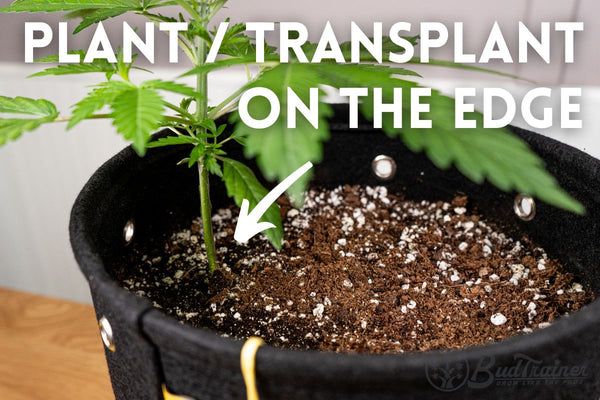
Tip: Plant on the Edge of Your Pot
Before starting Stage 1, there is one setup detail that makes a significant difference. Rather than planting or transplanting your seedling in the center of your pot, place it 1.5 inches from the edge, right next to one of the grommets. This gives your main stalk more room to travel as you bend it sideways across the pot, allowing you to grow a longer, thicker trunk and use your pot area much more effectively.
Stage 1: Training the Main Stalk
When: The 5th node appears (roughly 3 to 4 weeks from germination).
Stage 1 transforms your main stalk from a vertical trunk into a horizontal one. This increases your plant's effective canopy area and exposes the lower branches to direct light. It is the core move of LST: everything else builds on it.
Step 1. Bend and Anchor the Main Stalk
Cut a short piece of garden wire and attach one end to the grommet on the pot that is closest to your plant. Attach the other end around the base of the seedling, about 1 to 1.5 inches from the soil. This base anchor keeps the stalk from bending at ground level and snapping into the soil.


Once the base is secure, bend the seedling at roughly 90 degrees and tie the top of the plant to the opposite grommet on the pot. The two pieces of wire together - one at the base, one at the top - will hold the seedling in the horizontal position. If your wire does not reach the opposite grommet, push one end into the soil as an anchor instead.

After training, your plant will keep trying to grow upward over the next few days. To continue growing it sideways, move the wire up to the next node as the plant gets taller. Repeat this until the main stalk has traveled across the pot to the opposite side.

Step 2. Prune the 1st Node
After bending the main stalk, trim off both the leaves and growth sites at the 1st node. The 1st node sits closest to the soil and will never develop into a strong branch. Removing it redirects energy to all the remaining upper nodes, which now receive a surge of growth hormones thanks to the broken apical dominance.

Stage 2: Training Side Branches
When: 2 weeks after Stage 1. Repeat every 1 to 2 weeks throughout the vegetative stage.
Stage 2 is where you spread and manage the side branches that have shot up following Stage 1. It has three steps: a light defoliation, training the branches outward, and topping the main stalk (for photoperiod plants). You can repeat this stage every 1 to 2 weeks for as long as your plant is still in veg. For outdoor grows with several months of veg time, consistent weekly training here is one of the most effective ways to build an even, multi-cola canopy. See our outdoor grow guide for how this scales over a full season.

Step 1. Light Defoliation
By week 6 or later of veg, some of your leaves will be over 30 days old. At this age, they begin consuming nearly as much energy as they produce, and the older they get, the more they drain. Remove them now so your plant can redirect that energy to younger, more productive growth.
Removing main stalk leaves: The leaves on the first 3 nodes are the oldest. Even if they look big and healthy, remove them. Once those large old leaves are gone, the remaining younger leaves will often double in size within 1 to 2 days.

Removing shaded leaves and branches: Any leaf or branch sitting in the shade is a net drain on your plant - like a solar panel installed under a roof. It produces less than it consumes. Remove it now before it carries into the flowering stage where it would become larfy popcorn buds. For the deeper walkthrough of defoliation timing across all stages, see our full guide on how to defoliate cannabis.

Step 2. Training Side Branches
Once the plant is clear of old and shaded growth, bend the side branches outward using a combination of garden wire and LST clips.
Bottom nodes (older, longer branches): Cut a 4 to 6 inch piece of garden wire, attach one end to the grommet closest to the branch, and pull the branch down to your desired height. Loop the wire around the branch to create a hook - make the hook at least twice as wide as the branch to avoid strangling it as it grows. Secure the wire around the pot and adjust as needed. Spread all the bottom branches outward so they fan out from the center.

Top nodes (newer, shorter branches): The upper branches will be too small for garden wire hooks. Use LST clips instead. Clips clamp directly onto the branch and hold it bent outward without needing an anchor point on the pot, which makes them ideal for smaller growth that is still close to the main stalk. For the full clip-by-clip walkthrough, see How to Use the BudClips.

Top the Main Stalk
Once the main stalk reaches the far edge of your pot, it has nowhere left to travel and will start growing upward again. This is when you top it. The BudTrainer Method calls for two toppings during veg for photoperiod plants, and this is the first one. Topping here prevents the main stalk from becoming a tall central cola that throws the canopy off balance, and it sends an additional surge of energy to all the remaining side branches. The full procedure is in our topping guide.
The second topping happens 2 to 3 weeks later, after the new growth has matured into clear main branches of its own. Top each of those new main branches once, then return to LST to spread and balance the resulting canopy. This LST plus topping plus LST plus topping plus LST rhythm is the core of the BudTrainer Method during veg.
For autoflowers, skip topping entirely and stay with LST only. Autoflowers cannot afford the recovery time between cuts.

How to Fix a Broken Branch
Breaking a branch during training is a normal part of growing - it happens to experienced growers too. A broken branch will not ruin your grow. Cannabis is resilient and will redirect energy to the remaining branches. If the break is a partial snap with both sides still connected, wrap it immediately with plant tape, making sure both sides of the broken tissue are touching. Add extra tape if the branch is heavy for support.


After about a week, your plant will have healed and you can remove the tape. If the branch came off completely in two pieces, it cannot be saved - expose the remaining branch to as much light as possible and carry on. For the full repair walkthrough, see our article on how to fix a broken branch.

Stage 3: Bud Support During Flower
When: Days 21 to 25 of flowering (right after mid-flower defoliation).
Stage 3 is not about shaping anymore - it is about keeping your buds upright as they get heavy. Before starting Stage 3, complete your mid-flower defoliation (removing all lower leaves and shaded branches, also called lollipopping) between days 21 and 25 of flower. Then come back here for bud support.
Around weeks 3 to 4 of the cannabis flowering stages, your plant stops stretching and begins bulking up. As buds swell and become top-heavy, unsupported branches will start leaning and drooping. This reduces airflow around the buds and increases mold risk. You have two options for support.


Option 1. Garden Ties
The quickest way to support your buds is to tie opposite branches together so they hold each other up. Pick branches that are directly across from each other (180 degrees apart) and connect them with a piece of garden wire. Do not pull them toward each other; tie them as they naturally sit so the support is balanced. You can also run a single large loop of wire around all the branches at canopy height, like a tomato cage, and tie it to 3 or 4 branches to keep it from sliding down.

Option 2. Trellis Netting
A trellis net offers stronger and more comprehensive support but requires a fixed structure - the corner poles of a grow tent, or a wood or PVC frame outdoors. Once a net is in place, you cannot move the plant until harvest. We recommend using a net with 3-inch holes, which supports roughly one large cola per hole.
Unlike garden ties (which you add around week 3 of flower), you can install a trellis net at the very start of the flowering cycle and use it for both training and support. During the stretch phase, tuck each branch under the net as it grows 3 to 4 inches above the line - this bends it horizontal and spreads your canopy wider. Once the plant stops stretching at the end of week 3, stop tucking. From this point on, the net shifts from holding branches down to holding buds up as they swell.


Once the plant stops stretching, let the branches grow freely through the net. From here, it is all about maintaining your watering and feeding routine while the buds fatten up. As you approach harvest, trichomes will begin forming and the aromas from the terpenes will intensify. For what comes next, read our guides on pre-harvest defoliation, harvesting, and cannabis drying.

How to LST Autoflowers
LST is the best training method for autoflowers, full stop. Autoflowers transition to flowering based on their internal age clock, not the light cycle, which means they cannot recover from a stalled veg phase. Anything that costs them growing days costs them yield. Topping an autoflower forces a 5 to 10 day recovery period before growth resumes. Mainlining adds even more. LST, by contrast, never asks the plant to stop and heal, so every day stays productive.
Follow the same 3-stage process described above, with a few adjustments for the autoflower lifecycle.
Autoflower LST Adjustments
- Start earlier. Begin Stage 1 the moment node 4 or 5 appears, whichever comes first. Do not wait for the textbook 5th node if node 4 is already showing strength - autoflowers do not give you the buffer time photoperiods do.
- Bend more gradually. Take the main stalk to 45 degrees first, wait 24 hours, then bring it the rest of the way to 90 over the next 2 to 3 days. A stiff bend in one session is the most common cause of snapped main stems in autoflowers because their stalks lignify faster than photoperiods.
- Check ties daily. Autoflower growth rates accelerate quickly during weeks 3 to 5. A wire that is correctly placed today can be strangling the branch by tomorrow. Treat tie management as a daily task during this window, not weekly.
- Skip the top. Topping is not recommended for autoflowers. The recovery time eats too much of the fixed lifecycle. Stick to LST only.
- Stage 3 is unchanged. Bud support during flower works identically for autoflowers and photoperiods.
Autoflower LST Timing by Week
Use this as a rough calendar. Strain genetics will shift these windows by a few days in either direction, but the structure holds across most autoflower varieties:
| Week | Plant Stage | LST Action |
|---|---|---|
| Week 1 | Germination, seedling | None. Let the plant establish. |
| Week 2 to 3 | Node 4 to 5 forming | Start Stage 1. Bend main stalk gradually over 2 to 3 days. |
| Week 3 to 5 | Active veg, branches developing | Stage 2. Spread side branches, check ties daily. |
| Week 5 to 7 | Pre-flower, early stretch | Final Stage 2 spread. Tuck under trellis if using one. |
| Week 7 to 8 | Stretch ends, flowers form | Stop active training. Begin Stage 3 bud support. |
| Week 8 to 12 | Bud development, swelling | Maintain support. Watering and feeding routine only. |
Common Autoflower LST Mistakes
Three mistakes account for most failed autoflower LST attempts:
- Starting too late. Waiting for the 5th node to "fully develop" can cost you 3 to 5 days, which is 5 to 10 percent of an autoflower's productive lifecycle. Start at node 4 if it is there.
- Bending all at once. Autoflower stalks stiffen faster than photoperiods. A single aggressive bend that a photoperiod would absorb often snaps an autoflower.
- Continuing to train during stretch. Once the plant enters flower and the stretch begins, active bending is over. Forcing stems into new positions at this stage stresses the plant when it has no time to recover and risks snapping lignified flowering branches.
LST and Topping Work Better Together
The internet treats LST and topping as competing options. They are not. The BudTrainer Method uses both, and the more you combine them the better the canopy you build.
LST bends. Topping cuts. They solve different problems.
LST flattens the canopy and spreads bud sites across the same height. Topping multiplies the number of main growing points. Used together, you get the multiplied colas from topping AND the even canopy from LST. Used alone, each technique leaves yield on the table that the other would have caught.
The BudTrainer Method recommends two toppings and continuous LST through the vegetative stage for photoperiod plants. The first topping happens at Stage 2 when the main stalk reaches the edge of the pot. The second topping happens 2 to 3 weeks later on the new growth that has matured into clear main branches. Between and after each topping, LST keeps spreading and balancing the canopy.
Both techniques can and should be used from the very first grow. The "wait until you have experience before topping" advice you see everywhere is overstated. If you can identify node 5 and use clean scissors, you can top. The yield difference between trained and untrained plants is too large to leave on the table while you build confidence over several grows. The full topping walkthrough is in our topping guide.
The one exception is autoflowers. Autoflowers have a fixed lifecycle and cannot absorb the 5 to 10 day recovery that follows each topping. For autoflowers, LST is the complete training plan. For everything else, layer both.
LST vs High-Stress Training - The Full Comparison
LST is classified as low-stress because it does not cut or remove plant material during the training itself - it only bends and repositions branches. The plant experiences minimal disruption and continues growing at full speed throughout the process.
High-stress training (HST) techniques like topping, FIMing, mainlining, and manifolding all involve cutting or wounding the plant, which forces a recovery period of several days before growth resumes. HST can push yield potential further than LST alone in skilled hands, but it carries more risk and demands precise timing.
| Method | Recovery Time | Risk Level | Autoflower Safe |
|---|---|---|---|
| LST | None | Low | Yes (recommended) |
| Topping | 5 to 10 days | Medium | Not recommended |
| FIMing | 3 to 7 days | Medium | Not recommended |
| Mainlining | 2 to 3 weeks total | High | No |
The BudTrainer Method combines LST and topping from the first grow for photoperiod plants - two toppings during veg with continuous LST between and after each one. For autoflowers, LST alone is the complete training plan because the recovery time from cutting costs too much of the fixed lifecycle. Mainlining and manifolding are more advanced HST methods that growers can layer in once the LST and topping rhythm becomes second nature. For the deeper view of how to layer training methods, see our parent training guide.
Why Low-Stress Training Works (the Science)
LST works because of two distinct physiological mechanisms acting at the same time: hormonal redistribution from broken apical dominance, and improved light interception across the canopy. Both are well-documented in the broader plant science literature, even though cannabis-specific peer-reviewed work on training methods remains thin.
Apical Dominance and Auxin Flow
The plant hormone auxin is produced at the shoot apex (the topmost growing point) and travels downward through the stem. As it moves down, it suppresses the activation of lateral buds at lower nodes. This is the mechanism behind cannabis's natural Christmas-tree shape: the top suppresses everything below it, concentrating growth at a single point.1
Bending the main stalk sideways does not remove the apex, but it changes its relative position. Once the top is no longer the highest point in the canopy, several lateral buds compete for "highest position" status. Auxin distribution rebalances across the plant, lateral buds at multiple nodes simultaneously break dormancy, and what was one growing point becomes 6 to 10. This is why a single Stage 1 bend can transform plant architecture so dramatically in just a few days.2

Light Interception and the Inverse Square Law
Light intensity from a point source decreases with the square of the distance from that source. In practical terms, a bud site twice as far from a grow light receives roughly a quarter of the intensity. For a 600W LED at typical hanging height, intensity at the canopy top can be 800 to 1,000 PPFD (photosynthetic photon flux density), while a bud site one foot below the canopy might receive only 200 to 300 PPFD.3
An untrained plant therefore has a steep light gradient from top to bottom. Top buds develop densely; lower buds develop into airy "popcorn" with a fraction of the cannabinoid and terpene content. By creating a flat canopy where all bud sites are at roughly the same height, LST collapses that gradient. Every bud site receives within 10 to 20 percent of the same light intensity, and every bud site develops with comparable density.4
What the Cannabis Literature Says (and Does Not)
We need to be honest here: peer-reviewed cannabis-specific research on training methods is limited. Most of the literature on canopy management, light interception, and apical dominance comes from related horticultural crops (tomato, hemp fiber varieties, ornamentals) and from broader plant physiology. The 30 to 50 percent yield improvements that commercial growers cite for LST are operational data, not double-blind controlled studies.5
The underlying mechanisms - apical dominance, light interception, canopy architecture - are very well established. The applied cannabis numbers are based on grower experience and commercial production data, which is what we have to work with until cannabis research expands further. We default to commercial production practice because the people producing at scale have the strongest economic incentive to figure out what actually works.
Common LST Mistakes to Avoid
- Starting too late. Stems lignify quickly. If your main stalk feels stiff and resists bending, you are past the ideal window. Start at node 4 to 5, not later.
- Bending too aggressively in one session. Take the stalk to 45 degrees first, let it adjust for a day, then take it to 90. Forcing a cold stem to 90 degrees in one move is the most common cause of snapped branches.
- Tying too tight. Wire or ties that are snug now will strangle the branch as it grows thicker. Always create a hook at least twice the diameter of the branch and check it every 2 to 3 days during active veg.
- Not adjusting ties regularly. Plants grow fast. A wire that was positioned correctly 3 days ago may now be restricting growth. Check your anchor points every 2 to 3 days during veg and daily during the stretch phase.
- Letting one branch dominate. If one branch outgrows the others, bend it down further or clip it lower. The goal is a flat canopy - the moment one top rises higher than the rest, it reasserts apical dominance and starts suppressing the others.
- Training during the stretch phase. Aggressive bending after the plant has entered flower and is actively stretching can stress it at the wrong moment. Tuck branches under a trellis net during the stretch, but avoid forcing stems into new positions at this stage.
Frequently Asked Questions
When should I start LST on my cannabis plant?
Start when the 5th node appears, typically 3 to 4 weeks from germination. At this stage the main stalk is still flexible enough to bend to 90 degrees without snapping. Starting earlier gives you more training time in veg; starting after the stalk has lignified (become woody) makes bending much harder and increases the risk of breaking the main stem.
What does low stress training do?
LST breaks apical dominance by bending the main stalk sideways, which redistributes growth hormones (auxins) across the entire plant rather than concentrating them at a single apex. This activates multiple lateral branches simultaneously and creates a flat, even canopy where every bud site receives the same light intensity. The result is more bud sites, all developing at comparable density, instead of one dominant top cola and many underdeveloped lower buds.
Can you LST an autoflower?
Yes, and LST is the recommended training method for autoflowers because it requires no recovery period. Follow the same 3 stages, but start at node 4 or 5 (whichever appears first), bend gradually over 2 to 3 days rather than all at once, and check your ties daily during weeks 3 to 5 when growth accelerates. Skip topping for autoflowers since the recovery time eats too much of the fixed lifecycle.
Is LST better than topping?
Neither is better. They solve different problems and the BudTrainer Method uses both together. LST flattens the canopy and spreads bud sites; topping multiplies the number of main colas. Combining them produces more even bud sites than either technique alone. For photoperiod plants, we recommend two toppings during veg with continuous LST between and after each one. For autoflowers, use LST only - topping costs too much recovery time on a fixed lifecycle.
Does LST increase yield?
Yes. By breaking apical dominance and creating an even canopy, LST exposes all bud sites to the same light intensity rather than concentrating light on a single top cola. Commercial operations consistently report 30 to 50 percent yield improvements with LST compared to untrained plants in the same setup, which is why more than 95 percent of commercial cannabis producers use it as standard practice.
How often should I adjust my LST ties?
During active vegetative growth, check and adjust every 2 to 3 days. During the stretch phase of early flowering (days 1 to 21), check daily - plants grow fast enough that a wire snug today can be strangling the branch by tomorrow. For autoflowers in their rapid growth window (weeks 3 to 5), check daily as well. After the stretch ends and buds begin forming, stop repositioning branches and focus on support rather than training.
Can you LST during the flowering stage?
You can tuck branches under a trellis net during the first 3 weeks of flowering (the stretch phase) to widen the canopy. However, avoid aggressive bending of stems once the stretch ends and buds are forming - the stems have lignified and forcing them risks snapping. From day 21 to 25 onward, switch to bud support (Stage 3) rather than active training.
What is the best pot for LST?
A fabric pot with pre-installed grommets or anchor points is the most effective setup for LST. The grommets give you fixed, evenly spaced tie-down points around the pot, so you can anchor garden wire to hold branches in any position without drilling holes or improvising with clips. Fabric pots also improve root health and drainage compared to plastic, which supports faster overall growth.
What happens if I break a branch during LST?
If the break is partial and both sides are still connected, wrap it with plant tape immediately, bringing both sides of the broken tissue together and wrapping firmly. The branch will heal within about a week. If the branch came off completely, it cannot be saved, but the plant will redirect energy to the remaining branches and recover well. Breaking branches is a normal part of training and will not ruin your grow.
Do I need LST clips or can I use garden wire for everything?
Garden wire works for larger, longer branches on the lower nodes because you have room to create a hook and anchor it to the pot. LST clips are better for the upper nodes where branches are still small and close to the main stalk - clips clamp directly onto the branch without needing an anchor point, making them much faster to use on young growth. Using both tools together covers all parts of the plant.
How is LST different from ScrOG?
LST and ScrOG (Screen of Green) both aim to create an even canopy, but they work differently. LST uses ties and clips to hold individual branches in position. ScrOG uses a horizontal trellis net stretched above the plant - branches are tucked under the net as they grow through the holes, which holds them flat and fills the screen evenly. ScrOG is effectively LST with a net as the training tool, and is particularly effective for indoor grows where you want to fill a specific footprint.
When should I stop LST?
Active bending stops at the end of the stretch phase, around day 21 to 25 of flowering. By that point, stems have lignified and buds are forming, so forcing branches into new positions risks snapping them. After that, switch to Stage 3 bud support: tying opposite branches together, or letting branches grow freely through a trellis net while the buds swell. From this point until harvest, you are supporting weight, not changing shape.
Can I LST without LST clips?
Technically yes, using only garden wire and creative anchoring. Practically, the upper nodes of the plant are where clips dramatically speed up training: their branches are too short and too close to the main stalk for garden wire hooks to work cleanly. You can substitute soft ties, twist ties, or thin strips of soft fabric, but clips are the fastest tool we have found for that specific job. Garden wire on its own handles 60 to 70 percent of the work; clips handle the rest.
Will LST damage my cannabis plant?
When done correctly, no. LST does not cut or wound the plant, which is why it is classified as low-stress. The most common form of damage is a snapped branch from bending too aggressively in a single session, which is preventable by bending gradually over 2 to 3 days rather than all at once. Even when a snap happens, the plant usually recovers fully within a week if the break is repaired with plant tape promptly.
Next Steps
LST is the structural backbone of the BudTrainer Method. Once you have the 3 stages running smoothly, the next layers of the method build on top of it:
- Topping is the other half of the BudTrainer Method. For photoperiod plants, layer two toppings into your LST schedule from the very first grow.
- Defoliation in Stage 2 and again pre-flower removes the energy drains that even the best-trained canopy will accumulate.
- Harvesting, the complete drying guide, the cannabis trimming guide, and the curing guide walk you through the final lifecycle steps where careful work in veg and flower either pays off or quietly gets undone.
- If you want to push beyond the LST plus topping combination, see our guides on mainlining and manifolding for the more advanced high-stress techniques.
The toolkit we use across every grow at BudTrainer R&D is the same one outlined at the top of this article: a fabric pot with grommets, garden wire, and LST clips. If you want the complete bundle in one go, the BudTrainer Bundle packages everything together at a discount.
References
- Cline, M. G. (1997). Concepts and terminology of apical dominance. American Journal of Botany, 84(8), 1064-1069. https://bsapubs.onlinelibrary.wiley.com/doi/10.2307/2446149
- Domagalska, M. A., & Leyser, O. (2011). Signal integration in the control of shoot branching. Nature Reviews Molecular Cell Biology, 12(4), 211-221. https://www.nature.com/articles/nrm3088
- Chandra, S., Lata, H., Khan, I. A., & ElSohly, M. A. (2008). Photosynthetic response of Cannabis sativa L. to variations in photosynthetic photon flux densities, temperature and CO2 conditions. Physiology and Molecular Biology of Plants, 14(4), 299-306. https://link.springer.com/article/10.1007/s12298-008-0027-x
- Magagnini, G., Grassi, G., & Kotiranta, S. (2018). The effect of light spectrum on the morphology and cannabinoid content of Cannabis sativa L. Medical Cannabis and Cannabinoids, 1(1), 19-27. https://karger.com/mca/article/1/1/19/202028
- Caplan, D., Dixon, M., & Zheng, Y. (2017). Optimal rate of organic fertilizer during the vegetative-stage for cannabis grown in two coir-based substrates. HortScience, 52(9), 1307-1312. https://journals.ashs.org/hortsci/view/journals/hortsci/52/9/article-p1307.xml
- Folta, K. M., & Childers, K. S. (2008). Light as a growth regulator: Controlling plant biology with narrow-bandwidth solid-state lighting systems. HortScience, 43(7), 1957-1964. https://journals.ashs.org/hortsci/view/journals/hortsci/43/7/article-p1957.xml

About the Author
Henrique Dias is the CEO and co-founder of BudTrainer. He is a mechanical engineer who also holds a graduate certificate in Commercial Cannabis Production from Niagara College in Ontario, Canada - the first college-level cannabis cultivation program in North America. Before founding BudTrainer, Henrique worked with Health Canada licensed cannabis producers, where he gained hands-on experience in cultivation, processing, and post-harvest management of cannabis at commercial scale. He started BudTrainer to bring that same level of craft to home growers through better-designed gardening tools and clear, science-backed education.
DISCLAIMER: Everything taught and sold by BudTrainer® is to be used strictly for legal purposes. We do not endorse the production of illegal substances and it is your duty to ensure that you are complying with the law. The words "hemp," "cannabis," "weed," and "marijuana" are used interchangeably to refer to the same plant (legal hemp with less than 0.3% THC) for the purposes of this lesson.


