Most answers to curling leaves are a list of ten possible causes with no way to tell them apart: heat, light, overwatering, underwatering, nitrogen, pests, wind, pH. All possible, and no help when you are standing in front of your own plant. This guide starts with what you can see and measure in two minutes, and names a cause only once the symptom points to it. Where another of our guides owns the fix, we link to it rather than repeat it.
The Three Questions That Diagnose a Curl
Before you change anything, answer these in order. Each one takes less than a minute, and together they rule out most of the wrong answers.

Step 1 - Which way does the leaf curl?
Look at a curled leaf from the side. There are five shapes, and they mean different things:
- Folded up (tacoing or canoeing): each leaflet folds upward along its center vein, so the paler underside shows. This is a leaf defending itself from heat, strong light or dry air.
- Tips hooked down (the claw): the leaflets stay flat but their tips bend sharply down, and the leaf is usually a dark, glossy green. This points at a feed that is too rich in nitrogen.
- The whole leaf tipping down (drooping): the leaf bends down where its stalk (the petiole) meets the stem and hangs as one piece. This is almost always water: too much or too little.
- Twisted, puckered new growth: the newest leaves at the tips are small, crinkled and curled at odd angles. Something damaged them while they formed.
- Edges and tips curled up and hooked, with lime-yellow speckles: the leaves nearest the lamp are getting more light than they can use. This is light burn.
Step 2 - Which leaves are doing it?
Where the curl is on the plant matters as much as its shape. Curling only in the top leaves nearest the light points up, at the lamp and the air around it. Curling only in the newest growth at the tips points at mites, calcium or boron, or a chemical. Every leaf on the plant curling or drooping at once points down, at the roots and the pot. Curling only in the big old leaves at the bottom, especially late in flower, is usually the plant moving its nutrients out of leaves it no longer needs.

Step 3 - Lift the pot
This is the test that settles the most arguments, and it is the one people skip. Lift the pot, or tip it by a handle. If it is heavy and the medium is dark and damp a couple of inches down, the roots are wet. If it is light and the medium has pulled away from the wall, the roots are dry. Our watering guide explains how to learn your pot's weight, and the rule it sets is the one we use here: water when the pot has lost about half the weight it gained at its last watering.

A fabric pot with handles, like the BudPots, makes this a one-hand check you can do every day without reaching through the canopy.
Step 4 - Take the leaf's temperature
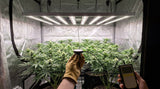
If the curl is at the top of the plant, point a cheap infrared thermometer at a curled leaf, then at the air beside it with a regular thermometer. A leaf that is drinking well stays close to the air temperature. Nelson and Bugbee found that well-watered leaves stayed within about 4°F (2°C) of the air under sunlight, high-pressure sodium and LED lighting alike, and that leaves short of water in still air ran as much as 14°F (8°C) above it under LED.4 The reading tells you where to look, and the heat or light section below explains how to read it.

Step 5 - Put the answers together
Put the three answers and the leaf reading together and the cause usually picks itself. The chart below is the whole guide on one page; the sections after it explain each branch.

| What you see | Where on the plant | The pot | Most likely cause | Go to |
|---|---|---|---|---|
| Leaflets folded up along the center vein | Top leaves nearest the light | Any | Heat, strong light or dry air | Leaves curling up |
| Edges and tips curled up and hooked, lime-yellow speckles | Top leaves, fading leaf by leaf down the plant | Any | Light burn | Light burn |
| Tips hooked down, leaf dark and glossy | Upper and middle leaves first | Normal | Too much nitrogen | The claw |
| Whole leaf tipping down, firm and thick | Whole plant | Heavy | Overwatering, roots short of oxygen | Leaves curling down |
| Whole plant wilting, leaves thin and papery | Whole plant | Light | Underwatering | Leaves curling down |
| Small, twisted, puckered new leaves | Growing tips only | Any | Mites, calcium or boron, ammonium-heavy feed, a chemical | Twisted new growth |
| Yellowing and limp, curling down | Lower fan leaves, late flower | Normal | Natural fade before harvest | Curling in flower |
What the Research Actually Says About Leaf Curl
Almost everything written about cannabis leaf curl is grower experience. The little research underneath it points somewhere different from the usual lists, and four findings are worth knowing.
Leaf rolling is a defense, not damage
Plants roll and fold their leaves on purpose. Asim Kadioglu and colleagues, reviewing the research on leaf rolling, describe it as a typical response to water shortage in crops like rice, maize, wheat and sorghum, also set off by salt, temperature, heavy metals, ultraviolet light, insects and disease. Rolling protects leaves from high light, and because it reduces the leaf area exposed and the water the leaf loses, it works as a way of avoiding drought.1 That research is on other crops, and no study we found has measured leaf folding in cannabis, but a tacoing cannabis leaf fits the pattern: it is shading itself and closing up against water loss, not breaking, and it usually opens again once the pressure is off.

A drooping leaf in a wet pot is a message from the roots
Why would leaves bend down in a pot full of water? Kent Bradford and Shang Fa Yang worked it out in tomatoes. Roots sitting in waterlogged soil make ACC, the compound plants turn into the hormone ethylene. The ACC rides the water stream up the stem to the leaves, becomes ethylene there, and the leaves bend down from the base of each leaf stalk, a movement botanists call epinasty. Bradford and Yang found ACC rising in the sap of flooded plants before the ethylene and the bend appeared, and feeding ACC into the stem of a healthy tomato bent its leaves the same way.2 No one has traced this signal in cannabis, but it fits what our watering guide describes: an overwatered leaf that is firm and full, not thirsty, tipping down as one piece in a heavy pot.

Most deficiencies do not curl leaves
Deficiency charts online often draw curled leaves for nutrients like potassium and magnesium. The one controlled trial on cannabis does not back that up. Paul Cockson, Brian Whipker and colleagues at North Carolina State grew the hemp cultivar T1 in sand, withheld one nutrient at a time for nine weeks and photographed every symptom as it developed. Calcium-short plants grew new leaves with irregular shapes and angles before the growing tips died. Boron-short plants grew new leaves that curled inward and down and sat at odd angles from the stalk. Copper-short plants, after nine weeks, grew new leaves whose margins curled slightly in and down. Of the other nine nutrients, eight produced yellowing, spotting or dead patches and molybdenum produced nothing visible; none of them curled a leaf.3 The practical rule: a nutrient curl shows up in the newest growth. Curl in the old leaves is rarely a deficiency, and feeding more will not fix it, which is why our deficiency guide diagnoses by where the symptom starts.

Too much nitrogen shows as dark green, and ammonium curls the tips
The claw is blamed on nitrogen everywhere, and the color part of that has measured support. Avia Saloner and Nirit Bernstein grew medical cannabis on five nitrogen levels from 30 to 320 mg/L (milligrams per liter of feed), and growth was best at 160 mg/L. At 320 mg/L the plants showed visible signs of overdose, smaller plants and organs and a dark-green color, and root growth was already restricted at 240 mg/L.5 They did not describe the claw itself: the dark color and the stunting are the measured part, and the hooked tips are grower observation that goes with them.
What did curl leaves in their work was the form of nitrogen. In a second trial on flowering plants, they held nitrogen at 200 mg/L and changed how much of it came as ammonium (NH4) instead of nitrate. With all of it as ammonium, the leaves at the growing tips turned curly with dead margins early in the trial, and the damage spread until the plants died. At 50% ammonium the leaves died back and wilted late in the trial, and 40% of the plants died. They recommend keeping ammonium at 30% of the nitrogen or less.6 It was one cultivar with five plants per treatment, so treat the cut-off as a guide, not a law. US fertilizer labels list ammoniacal and nitrate nitrogen separately, so the share is easy to check.

Leaves Curling Up: Heat, Light and Dry Air
Leaves folding up into tacos or canoes are the most common curl in a grow tent. They almost always start in the top leaves nearest the lamp while the leaves lower down lie flat, and that pattern means the problem is above the plant, not in the pot.

Heat or light? Read the leaf against the air
Tacoing can be heat or light or both, and the fix is different, so measure before you move anything. Take the leaf reading from Step 4 near the end of the lights-on period, when the tent is warmest:
- Hot leaf in cool air: the light is too close or too strong for the plant to keep up. Raise or dim the light over that spot.
- Hot leaf in hot air: the room is too hot. Cool the air first; moving the light will not fix a hot tent.
- Leaf at or below the air, curling anyway: neither. Look at the pot and the air's dryness.

As a working line, a top leaf more than about 4°F (2°C) warmer than the air beside it is running hot, the same line our foxtailing guide uses for heat at the tops. For the air itself, our indoor grow guide's targets are 71 to 82°F (22 to 28°C) in veg and 70 to 80°F (21 to 27°C) in flower with the lights on. If the air is the problem, the grow tent temperature guide walks through cooling a tent in order: measure the rise over the room, fix the exhaust, then cool the room itself. If the light is the problem, raise it 2 to 4 inches (5 to 10 cm) and read the leaf again the next day.

Dry air folds leaves too
A leaf loses water faster in dry air, and folding up is one way it slows that down. If your tent reads cool, the leaf reads normal and the top leaves still canoe, check the humidity. Very dry air, often in winter when a house is heated, pushes the plant to lose water faster than its roots can supply. Our VPD chart shows how temperature and humidity combine into how dry the air feels to the leaf, and our humidity guide covers raising it without misting the plants. Our VPD calculator tells you whether the air is drier than your stage wants.

Light burn: edges curled up and hooked
Light burn looks different from a heat taco once you know it. The leaves nearest the light pale toward lime yellow, small yellow spots gather toward the leaflet edges and tips, and those edges and tips curl up and hook over. It is worst on the top leaves and fades leaf by leaf down the plant. Our grow light distance guide owns light burn, and its fix order is the one to follow: deal with heat at the tops first, then raise the light 2 to 4 inches (5 to 10 cm), then dim a step.

Wind burn: a fan blowing straight in
A clip fan pointed straight at a plant from close range does the same job as dry air, only on one side. The leaves nearest the fan flip, flutter and fold up, and their tips can dry and crinkle, while the leaves on the far side stay flat. The tell is the direction: the damage faces the fan. Move the fan back or aim it across the canopy instead of into it. The leaves should move gently, not thrash.

Leaves pointing up is not a problem
Not every upward leaf is a curl. Healthy cannabis often lifts its whole leaves on their stalks toward the light, so the plant looks like it is raising its hands. Growers call it praying. The difference is in the leaflets: on a praying plant they stay flat, wide and glossy. On a stressed plant, the leaflets themselves fold. Praying leaves usually mean a plant that is drinking well under a light that is close to right.

The Claw: Leaf Tips Curling Down
The claw is a leaf whose leaflet tips hook sharply downward while the rest of the leaf stays flat and firm. It usually comes with an unnaturally dark, blue-green color and a waxy shine. It looks vigorous at a glance, which is why it fools people. The nutrient burn section of our deficiency guide owns this diagnosis: downward-clawing tips with a deep green sheen is nitrogen toxicity, not nitrogen deficiency.

Do not confuse the claw with nutrient burn, which often travels with it. Burn starts at the very tips as yellow, then crisp brown, and works inward, and the dead tips can curl under. A claw is green to the tip. One is too much nitrogen; the other is too much of everything.

What to do about a claw:
- Check your runoff EC (electrical conductivity, a measure of how much fertilizer is dissolved in the water). High runoff EC means you are overfeeding. Our deficiency guide covers the runoff test.
- Drop the feed to half strength, or feed plain pH-adjusted water for a watering or two, then come back lower than before.
- If you are in flower and still on a grow formula, switch. Our flowering guide keeps the grow feed through the stretch and moves to a bloom feed as the stretch slows, around weeks 2 to 3.
- Check the label for ammonium. If most of your nitrogen is ammonium, change formulas (see the research section above).
- Judge the fix by the new leaves. Clawed leaves stay clawed; the leaves that grow after the change should come in flat and a normal green.
Our nutrient guide sets how much to feed, including the start-at-half-strength rule that prevents most claws in the first place.
Leaves Curling Down: Overwatered, Underwatered or Root Trouble
When the whole leaf tips down from its stalk, and most of the plant does it at once, look at the pot before you look at anything else. Both overwatering and underwatering make a plant droop, which is why so many overwatered plants get watered again. The difference is in the pot's weight and the feel of the leaf.


On the left, an overwatered plant: the leaves are firm and thick, almost swollen, and curl down from the stalk with the whole leaf tipping as one piece. The pot is heavy and the medium is dark. On the right, an underwatered plant: the leaves are thin, papery and limp, the pot is light and the medium has shrunk from the wall. Our watering guide's comparison table covers the rest. The fastest tell after the pot lift is recovery: an underwatered plant stands back up within an hour or two of a drink, while an overwatered plant takes hours to days, and only once the pot dries back.
If the pot is heavy
Stop watering and let the pot dry back to the weight trigger. Do not give it nutrients, a pH correction or a root additive: the roots are not short of food, they are short of air, because water is filling the spaces in the medium that should hold oxygen (the droop signal above). Once the pot has lost about half the weight its last watering added, water normally, and pour less next time. A pot that stays heavy for many days is too big for the plant or does not drain; our soil guide covers mixes that hold enough air.
If it does not recover
A plant that keeps drooping in a wet pot after the pot has dried back, or droops in cool, aerated water in a hydro system, may have root rot. The leaves droop, lower leaves yellow, and growth stalls. Check the roots: rotten roots are brown, slimy and matted, and their outer layer slides off when pulled. Our root rot guide covers what to do next.

If the pot is light
Water it, slowly, until it drains, and watch: it should start lifting within an hour or two. Then learn the weight of the pot when it is wet and when it needs water, so the next watering comes before the droop. Repeated dry-outs cost more than the droop you can see; crispy edges on old leaves are the scar.
Drooping after a transplant
A droop for a day after a transplant is normal and needs nothing. Our transplanting guide's shock triage sets the line: a droop that lifts within 24 hours is normal, one that lasts past 24 hours means holding the light and humidity steady, and one still there after a week is not shock any more.

Twisted, Curled New Growth at the Tips
When the newest leaves at the tops of the shoots come in small, twisted, puckered and curled while the older leaves below are flat, the leaf did not change shape: it grew that way. Something damaged it while it was forming. There are four usual suspects.
Broad mites and russet mites
These are the pests growers most often blame on something else, because you cannot see them without strong magnification. Broad mites leave the newest leaves small, twisted, puckered and oddly glossy, and the growing tip stalls. Russet mites can turn leaves grayish or bronze and roll their edges upward. Whitney Cranshaw and colleagues, reviewing hemp pests, add a warning: that upward curl of the leaf edge appears in some cultivars only, and some cultivars curl like that with no mites at all.7 Check the newest leaves with at least 30x magnification before you spray anything. Our pest guide covers broad and russet mites and what to use against them.

Calcium, boron or copper
These nutrients do not move from old leaves to new ones, so when they run short, it is the new growth that suffers. In the Cockson trial, calcium-short tips grew distorted leaves at odd angles and then died, which makes the plant branch as if it had been topped; boron-short leaves curled in and down; copper-short leaves curled at the margins after nine weeks.3 Most of the time the cause is not an empty bottle but a pH that locks the nutrient out, so check the pH of your runoff first. The calcium section of our deficiency guide covers the fix.

An ammonium-heavy feed
In Saloner and Bernstein's trial, an all-ammonium feed curled the leaves at the growing tips within weeks.6 If you have just changed nutrients and the new growth started curling after the change, read the label for the share of nitrogen that comes as ammonium.
Viroid, chemicals and genetics
Three less common causes are worth knowing. Hop latent viroid, which spreads through cuttings and tools, can show on mother plants as nothing at all or as a mild leaf curl and mottling; our cloning guide covers it. Outdoors, drift from lawn and farm weedkillers that act like plant hormones can twist and cup new growth on plants near where they were sprayed. And some cultivars simply grow with a slight curl or wave in their leaves; if every plant of one strain does it from the start and grows well, it is the plant, not a problem.
Curling in Seedlings and Clones
Seedlings have tiny root systems and almost no reserves, so they curl faster and from smaller mistakes. The two most common causes are the same as in big plants, only quicker. Seedling leaves curling down in a cup of soaked mix are overwatered: the roots cannot breathe. Seedling leaves cupping up at the top of a small plant under a strong light are getting too much of it.

For a seedling, water less, not more, and let the cup dry back before the next watering. A self-draining starter pot like the BudCups helps, because you can push up its removable bottom plate and lift the whole root ball out of the top to look at the roots before you decide anything. For light, our planting guide sets seedlings at 200 to 400 PPFD for the first two weeks (PPFD is the amount of usable light landing on the plant each second), and the rule for too much light on a seedling is to dim the lamp rather than hang it higher.
Cuttings are different again. A fresh clone has no roots at all, so it droops for the first day or two while it loses water faster than its stem can pull it up. That is normal. Our cloning guide's day-by-day table shows what to expect.
Curling in Flower
Two kinds of curl show up in flower, and one of them is not a problem at all.
Late in flower, the big fan leaves lower and in the middle of the plant start to yellow, droop and curl a little down and inward. That is the plant moving nutrients out of leaves it no longer needs as it finishes. It is also why water use falls late in flower: growth has stopped and the older leaves are dying back. If the buds are swelling and the sugar leaves around them are still green, leave it alone. Feeding harder to green those leaves back up will not help the buds.

The other is heat at the tops. The top colas sit closest to the lamp, and in a warm tent the leaves around them fold up and bleach. That is the same heat-or-light question as in veg, with more at stake: stress at the tops in flower can also push out spiky new growth on the colas. Our foxtailing guide covers the fix order. And never bend a tall cola down in flower to get it away from the light: structural training finishes at the flip.
In the last week or two before the cut, a leaf curl is rarely worth changing anything for. Keep to the schedule in our harvesting guide.
Will Curled Leaves Uncurl?
Sometimes. A leaf that folded up from heat, strong light or dry air, or drooped from thirst, is still alive and working. Once the cause is gone it can flatten again, an underwatered leaf within an hour or two, a heat-folded one over the following day or so, as long as its edges did not dry out. A leaf with dry, crisp edges, burnt tips, a claw from overfeeding or twisted growth from mites or a deficiency will not go back. That tissue grew or died that way.
So judge the fix by the new growth, not by the old leaves. Give it about a week. If the leaves that come in after the change are flat, wide and a normal green, you fixed it, even if the old ones never recover. Do not pull curled leaves off in a hurry: they still make sugar for the plant, and removing them adds a second stress to the first.

Common Mistakes When Leaves Curl
- Feeding a curl. Most curls are water, heat or light. Adding nutrients to a plant that is overwatered or too hot makes it worse.
- Watering a droop without lifting the pot. A drooping plant in a heavy pot needs less water, not more.
- Moving the light when the room is the problem. A hot leaf in hot air needs the room cooled. Raising the light only costs you light.
- Dimming the whole tent for one hot spot. Fix the air at the tops and the light over that spot only, and keep the rest of the canopy on full light.
- Spraying for mites you have not seen. Twisted new growth can be calcium, boron, ammonium or genetics. Look at 30x first.
- Judging the fix by the old leaves. They may never uncurl. Watch the new growth.
- Changing three things at once. Change one, wait a few days, and watch the new leaves. Otherwise you will never know which change worked.
Frequently Asked Questions
Why are my cannabis leaves curling up?
Leaves that fold up along the center vein, like a taco or canoe, are protecting themselves from heat, strong light or dry air. It starts in the top leaves nearest the lamp. Point an infrared thermometer at a curled leaf: a leaf more than about 4°F (2°C) hotter than the air beside it points at the light, and hot air points at the room. Fix that first, not the feed.
Why are my cannabis leaves curling down?
It depends on what is curling. If only the leaflet tips hook down and the leaf is dark, glossy green, the feed is too rich in nitrogen. If the whole leaf tips down from its stalk, lift the pot: heavy means overwatered, light means underwatered. An overwatered plant does not recover until the pot dries back; an underwatered one stands up within an hour or two of a drink.
What does the cannabis claw mean?
The claw is a leaf whose leaflet tips hook sharply downward while the leaf stays flat, firm and unnaturally dark blue-green with a waxy shine. It points at too much nitrogen. Check your runoff EC, drop the feed to half strength, and check how much of your nitrogen comes as ammonium. Clawed leaves stay clawed, so judge the fix by the new leaves.
Is leaf curling caused by a nutrient deficiency?
Rarely. In Cockson and colleagues' controlled cannabis trial, only calcium, boron and copper deficiencies bent leaves, and only in the newest growth. Nitrogen, phosphorus, potassium, magnesium and the others yellowed or spotted leaves, or showed nothing, without curling them. If old leaves are curling, look at heat, light and water before you change the feed.
Can overwatering make cannabis leaves curl down?
Yes. Overwatered leaves feel firm and thick and tip down from the stalk as one piece, because the roots are short of oxygen, not water. In tomato, Bradford and Yang showed waterlogged roots send a signal up the stem that makes the leaves bend down. Stop watering, let the pot lose about half the weight its last watering added, then water normally.
How do I tell heat stress from light burn?
Heat stress folds the top leaves up along the center vein, and the air reads hot. Light burn pales the top leaves toward lime yellow with small yellow spots, and the leaflet edges and tips curl up and hook over, fading leaf by leaf down the plant. Take the leaf and air temperatures: a hot leaf in cool air points at the light.
Do curled cannabis leaves go back to normal?
Sometimes. A leaf folded by heat, strong light or dry air, or drooping from thirst, can flatten again once the cause is gone, as long as its edges did not dry out. Leaves with crisp edges, burnt tips, a claw or twisted growth will not. Judge the fix by the new growth over about a week, and do not strip the curled leaves.
Why are the new leaves on my cannabis plant twisted and curled?
New leaves that come in small, twisted and puckered were damaged while they formed. The usual causes are broad or russet mites, a calcium or boron problem, often from the wrong pH, or a feed heavy in ammonium. Look at the newest leaves at 30x magnification before spraying anything, then check your runoff pH and your nutrient label.
Why are my cannabis seedling leaves curling down?
Seedling leaves curling down in a cup of soaked mix are almost always overwatered. A seedling's roots are tiny and drink very little, so the mix stays wet and the roots run short of air. Let the cup dry back before you water again. A seedling cupping up under a strong lamp needs the light dimmed, not the lamp hung higher.
Is it normal for cannabis leaves to curl in late flower?
Yes. Late in flower the big fan leaves lower and in the middle of the plant yellow, droop and curl a little as the plant moves nutrients out of leaves it no longer needs. If the buds are still swelling and the sugar leaves are green, leave it alone. Feeding harder will not green those leaves back up or help the buds.
Can a fan make cannabis leaves curl?
Yes. A clip fan blowing straight into a plant from close range makes the nearest leaves flip, flutter and fold up, and their tips can dry and crinkle, while leaves on the far side stay flat. Move the fan back or aim it across the canopy instead of into it. The leaves should move gently, not thrash.
What does it mean when cannabis leaves point up?
Leaves lifted on their stalks toward the light, with flat, wide, glossy leaflets, are healthy. Growers call it praying, and it usually means the plant is drinking well and the light is close to right. It only becomes a problem when the leaflets themselves fold up along the center vein, which is the plant protecting itself from heat, light or dry air.
Can too much ammonium in the feed curl cannabis leaves?
Yes. In Saloner and Bernstein's trial on flowering cannabis, a feed with all its nitrogen as ammonium curled the leaves at the growing tips early on and later killed the plants, and 50% ammonium killed 40% of them. They advise keeping ammonium at 30% of the nitrogen or less. Fertilizer labels list ammoniacal and nitrate nitrogen separately.
Where to Go From Here
Most curling leaves come down to three habits: lift the pot before you water, take a leaf reading before you move the light, and judge every fix by the new growth. If you only take one thing from this guide, make it the pot lift.
References
- Kadioglu, A., Terzi, R., Saruhan, N., & Saglam, A. (2012). Current advances in the investigation of leaf rolling caused by biotic and abiotic stress factors. Plant Science, 182, 42-48. doi:10.1016/j.plantsci.2011.01.013
- Bradford, K. J., & Yang, S. F. (1980). Xylem transport of 1-aminocyclopropane-1-carboxylic acid, an ethylene precursor, in waterlogged tomato plants. Plant Physiology, 65(2), 322-326. doi:10.1104/pp.65.2.322
- Cockson, P., Landis, H., Smith, T., Hicks, K., & Whipker, B. E. (2019). Characterization of nutrient disorders of Cannabis sativa. Applied Sciences, 9(20), 4432. doi:10.3390/app9204432
- Nelson, J. A., & Bugbee, B. (2015). Analysis of environmental effects on leaf temperature under sunlight, high pressure sodium and light emitting diodes. PLoS ONE, 10(10), e0138930. doi:10.1371/journal.pone.0138930
- Saloner, A., & Bernstein, N. (2020). Response of medical cannabis (Cannabis sativa L.) to nitrogen supply under long photoperiod. Frontiers in Plant Science, 11, 572293. doi:10.3389/fpls.2020.572293
- Saloner, A., & Bernstein, N. (2022). Nitrogen source matters: High NH4/NO3 ratio reduces cannabinoids, terpenoids, and yield in medical cannabis. Frontiers in Plant Science, 13, 830224. doi:10.3389/fpls.2022.830224
- Cranshaw, W., Schreiner, M., Britt, K., Kuhar, T. P., McPartland, J., & Grant, J. (2019). Developing insect pest management systems for hemp in the United States: A work in progress. Journal of Integrated Pest Management, 10(1), 26. doi:10.1093/jipm/pmz023

About the Author
Henrique Dias is the CEO and co-founder of BudTrainer. He is a mechanical engineer who also holds a graduate certificate in Commercial Cannabis Production from Niagara College in Ontario, Canada - the first college-level cannabis cultivation program in North America. Before founding BudTrainer, Henrique worked with Health Canada licensed cannabis producers, where he gained hands-on experience in cultivation, processing, and post-harvest management of cannabis at commercial scale. He started BudTrainer to bring that same level of craft to home growers through better-designed gardening tools and clear, science-backed education.
DISCLAIMER: Everything taught and sold by BudTrainer® is to be used strictly for legal purposes. We do not endorse the production of illegal substances and it is your duty to ensure that you are complying with the law. The words "hemp," "cannabis," "weed," and "marijuana" are used interchangeably to refer to the same plant (legal hemp with less than 0.3% THC) for the purposes of this lesson.