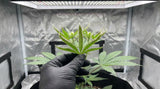
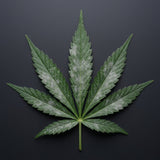
The internet answers brown spots with a color chart: rusty means calcium, olive means phosphorus, tan means potassium. The trouble is that color drifts with the cultivar, the light you look under and how old the spot is. Position does not drift. A phosphorus spot starts on the old leaves at the bottom because the plant moves phosphorus out of them; a light-burn spot starts at the top because that is where the light is strongest.
This guide reads a spot in three passes: where it is, what its edge and center look like through a loupe, and what changed in the week before it showed up. Each cause gets a short section and a link to the guide on this site that owns the fix, so the numbers stay the same everywhere. The one cause no other guide here covers, leaf septoria and the other fungal leaf spots, gets the long section.
The Short Answer: Brown Spots by Where They Are
Find the row that matches where the spots are on your plant first, and only then compare the look. Every row is explained further down.
| Where the spots are | What they look like | Most likely cause | First thing to do |
|---|---|---|---|
| Lowest, oldest fan leaves | Small olive-green spots that grow, sink and turn brown | Phosphorus shortage, usually from high pH or a cold root zone | Check the pH and the root-zone temperature |
| Lowest leaves, edges and teeth | Yellow edges that turn tan and crisp, starting at the teeth | Potassium shortage, often from salt buildup | Test the runoff EC |
| Lower leaves, between the veins | Yellow between green veins, then rust-brown patches | Magnesium shortage (an excess can also spot the oldest leaves) | Check the pH, then the feed |
| Lower leaves with yellow-ringed spots, plus damaged tips | Rust-brown spots in yellow rings near the edges; new growth twisted with brown edges | Calcium problem | Look at the growing tips, then the water and pH |
| Newest and middle leaves | Bright yellow netting with small tan flecks inside it | Manganese shortage, usually pH above 6.5 | Check the pH |
| Top leaves nearest the light | Small yellow spots, a few turned tan and crispy, fading leaf by leaf down the plant | Light burn | Measure the air at the tops, then raise or dim the light |
| Leaf tips all over the plant | Brown, crisp tips on dark, glossy green leaves | Nutrient burn | Test the runoff EC and feed lighter |
| Old fan leaves in the last weeks of flower | Yellowing from the bottom up, some leaves browning and drying | The normal late-flower fade | Nothing |
| Lower, inner leaves outdoors after wet weather | Brown to gray spots about a quarter inch (6 mm) across, bright yellow halos, black specks | Septoria leaf spot | Bag the worst leaves and keep the foliage dry |
| Anywhere, with dots, silver streaks or webbing | Pinprick dots or silvery patches with black specks | Spider mites or thrips | Check the leaf undersides with a loupe |
| Wherever a spray or mist dried | Dead spots in the shape of drops | A spray mixed too strong, or sprayed in heat or under the light | Mix at label rate and spray with the lights off |
How to Diagnose Brown Spots in Six Steps
A spot is the last thing in a chain. Something stopped a patch of leaf getting what it needed, or something attacked it, and the cells died. These six steps work backwards from the dead patch to the cause, and none of them needs more than a loupe, a marker, a pH pen and an EC pen (a meter that reads how much fertilizer salt is dissolved in water).
Step 1 - Find which leaves have the spots
Stand back and look at the whole plant before you look at any one leaf. Some nutrients can be pulled out of old leaves and sent to new growth; when they run short, the old leaves at the bottom go first. Others are locked into a leaf once it is built, so a shortage shows at the top, in the newest growth. Our deficiency guide's location-first rule puts nitrogen, phosphorus, potassium and magnesium in the first group, and calcium, iron, boron, sulfur, manganese, copper and zinc in the second.

- Lowest, oldest leaves: phosphorus, potassium, magnesium, or the normal fade at the end of flower.
- Newest leaves and growing tips: calcium, boron or manganese, or broad mites.
- Top leaves right under the light: light or heat.
- Lower, inner leaves of an outdoor plant after rain: a fungal leaf spot such as septoria.
- Everywhere at once: the roots, the pH, the watering or a spray.
Step 2 - Look at one spot through a loupe
A 30x pocket loupe is cheap and settles more arguments than any chart. Hold the leaf flat, start with the lens almost touching the spot, then draw the loupe slowly back until the spot is sharp. You are looking at three things: the edge, the center and the ring around it.

Tiny black dots like ground pepper inside a dead center mean a fungus is fruiting there, and on an outdoor plant that is usually septoria. A bright yellow halo around a spot points the same way. Raised orange powder that smears onto a fingertip is rust, a fungus too. Damage that starts at the leaf tips, edges and teeth and works inward points first to nutrient burn or a potassium shortage, both usually from salt buildup. Olive-green spots that sink and look wet are the phosphorus pattern. Bright yellow spots with no dark rim, on the top leaves, are light.

Step 3 - Turn the leaf over
Most pests live on the underside, and so does the rust fungus. Spider mites leave pinprick pale dots on the top of the leaf and sit underneath it, with round glassy eggs and specks of black waste. Thrips scrape silvery patches flecked with black specks. Rust shows as tiny raised orange pustules. If the underside is clean and the spots go right through the leaf, you can drop pests from the list.

Step 4 - Lift the pot, then check the pH and the runoff
Lift the pot before you touch a bottle. Droop plus a heavy pot is overwatering and droop plus a light pot is underwatering, the rule in our watering guide. Roots sitting in a pot that never dries cannot take up nutrients, and the plant shows deficiency spots in a root zone full of food.

Then measure. Check the pH of what you pour: 6.0 to 7.0 in soil, aiming for 6.5, and 5.5 to 6.5 in coco or hydro, aiming for 5.8 to 6.0, the ranges our nutrients guide sets. Then water until at least a fifth of what you poured runs out, catch it, and read its EC against the EC of what went in. Runoff far above the input means salts are building up, which points to nutrient burn or a potassium shortage; runoff far below it means the plant is hungry.
Step 5 - Think back over the last week
Spots usually show up days after the cause. Before you change anything, write down what changed in the week before: a light raised or lowered, a new feed or a dose of Cal-Mag, a spray, a hot spell, a new clone brought into the tent, a week of rain for an outdoor plant. The cause is usually on that list, and it saves you treating three things at once and never learning which one worked.
Step 6 - Mark one leaf and watch the new growth
Dead tissue stays dead, so the spotted leaves cannot tell you whether a fix worked. The leaves that grow after the fix can. Put a small dot of marker on the stalk of the youngest fully open leaf on the day you change something, and judge the result on the leaves that open above it over the next week or so. Our deficiency guide expects new growth to look better within 3 to 7 days once a pH problem is corrected. If new leaves come in clean, you found it. If they are still coming in spotted after two weeks, which our deficiency guide treats as a wrong diagnosis, go back to Step 1.

What the Research Says About Brown Spots
Two controlled trials have now grown cannabis with one nutrient left out at a time and photographed what happened, and plant pathologists have surveyed which leaf diseases turn up indoors and outdoors. Together they overturn a few things growers repeat.
In a vegetative plant, only phosphorus started as spots
Paul Cockson, Hunter Landis, Turner Smith, Kristin Hicks and Brian Whipker at North Carolina State rooted cuttings of a hemp cultivar called 'T1' in washed sand and fed each group a complete nutrient solution with one element left out, for up to nine weeks.1 Of the twelve elements they withheld, phosphorus was the only one whose first leaf symptom was spots: at seven weeks, irregular olive-green spots on the lower, older leaves, which grew, sank and looked almost wet, and in severe cases turned into large dead patches.
Several others killed tissue in other patterns. Potassium yellowed the edges of the old leaves, especially the saw teeth, and then left tan dead patches along them; it took nine weeks to show. Manganese made bright yellow netting on the upper and middle leaves with small tan dead flecks inside it. Zinc left tan dead patches along the edges of the newest leaves. Calcium, the nutrient most charts blame for rusty spots, made no spots at all in this trial: it stunted and twisted the growing tips at five weeks, the fastest of any element, and in the end killed them. Molybdenum showed nothing in nine weeks.

In flower, phosphorus, potassium and calcium all spotted the leaves
David Llewellyn, Scott Golem, Maxwell Jones and Youbin Zheng repeated the idea on a drug-type cultivar, 'Gelato 29', grown in 5 gallon (19 L) deep water culture buckets, with each shortage starting at the flip to 12/12 and running the 7.5 weeks to harvest.2 Three plants per treatment is a small trial, but it is the only one we found that withheld eight nutrients one at a time right through flower, and its pictures differ from the vegetative ones.
Phosphorus showed by week three as tiny pale spots on the lower fan leaves, which by week four had grown and started joining into larger dead patches; the plants made 63% less fresh flower than the fully fed controls (406 g against 1,110 g). Potassium produced dark brown dead streaks along the side veins of the larger sugar leaves around the buds, and light browning at the tips and teeth of the lower fan leaves, with 52% less flower. The calcium-short plants developed spots on their lower fan leaves from week three, each a brown dead center inside a yellow ring, crowded toward the edges and tips, with 44% less flower.

The authors flag that last one themselves. In the calcium treatment, sodium nitrate replaced the usual calcium nitrate, and the leaves still tested within or above the normal range for calcium, so they write that the treatment may have upset the plant's uptake of other nutrients. Read together, the two trials say that calcium trouble shows in the new growth, that it may also spot the lower leaves in flower, and that a rusty spot on its own does not prove calcium.
Leaf-spot fungi are an outdoor problem
Zamir Punja at Simon Fraser University sampled flower buds, and leaves already carrying powdery mildew, in three greenhouses and one indoor hydroponic facility in British Columbia and Alberta between 2015 and 2017. He found gray mold (Botrytis), Penicillium and Fusarium bud rots and powdery mildew, and reported no leaf-spot fungus, though spotted leaves were not what he sampled.3 A later molecular survey by Punja and colleagues again found powdery mildew and Botrytis to be the common pathogens on cannabis leaves and flowers.4 In his review of emerging diseases, Punja writes that hemp grown outdoors "can be severely affected by several leaf-spotting fungi".5
That matches where the leaf-spot research comes from: Kentucky, Tennessee and New York hemp fields in humid summers. It does not mean a tent is immune. When Mostafa Rahnama and the Kentucky group dropped Septoria spores onto greenhouse hemp, every plant was spotted ten days later.6 A tent can get septoria if spores ride in on an outdoor cutting or a gardener's sleeve and the leaves stay wet. It is not where most indoor brown spots come from.
Yellowing old leaves late in flower is normal
In the Guelph trial, the fully fed control plants had no symptoms for five weeks of flower. By week six their oldest, largest fan leaves had moderate yellowing, which got worse every week after, even though neither the nutrient solution nor the leaves were short of anything.2 The authors call this normal senescence in a maturing plant and warn growers to be "extra cautious when assessing foliar disorders in the latter stages of cannabis flowering". They add that flushing, withholding feed in the last weeks, may make deficiency symptoms look worse or speed the fade up. Our deficiency guide's section on the late-flower fade covers how to tell it from a real shortage.

Water drops are an unlikely cause of leaf spots
Gardeners have long warned against watering in the sun because drops act as tiny magnifying glasses. Ádám Egri, Ákos Horváth, György Kriska and Gábor Horváth tested it in the Hungarian summer.7 Glass spheres on maple leaves did burn them. Water drops on smooth, hairless ginkgo and maple leaves did not, from early morning into the early afternoon: a drop resting on a leaf flattens, its focus falls below the leaf, and the water cools the tissue it touches. The only leaf they managed to burn belonged to a floating fern whose water-repellent hairs hold round drops up off the surface, so the focus lands right on it.

Cannabis leaves carry short hairs and were not tested, so we cannot rule it out completely, but a grow light delivers far less light than the midday summer sun that failed to burn smooth leaves. The more likely culprit for spots that appear after spraying is what was dissolved in the water. Egri's group points to studies in which salty or chlorinated water and concentrated fertilizer and chemical solutions left sunburn-like brown patches by drawing water out of the leaf.
Brown Spots on the Lower Leaves
Spots that start at the bottom and climb are usually a mobile nutrient, the fade at the end of flower, or the roots. Each of these has a full section in another guide; this is the short version, enough to tell them apart.
Phosphorus: olive spots that sink and brown
Small, irregular olive-green spots on the oldest leaves, growing and sinking until they look wet, then dying back to rust-brown patches. Purple stems on their own are not the sign; both trials above found spots, the flowering one saw only moderate purpling of the leaf stalks, and the vegetative one reported none. Our deficiency guide treats phosphorus deficiency as a lockout story: the phosphorus is usually in the pot, but a pH above 7.0 or a cold root zone keeps the plant from taking it up. Fix the pH first, then keep the root zone above roughly 65°F (18°C), and add phosphorus only after both.

Potassium: dead edges and teeth
Yellowing that starts at the leaf edges, especially the saw teeth of the older leaves, then turns tan and crisp and works inward. In flower, watch the sugar leaves around the buds too: in the Guelph trial they showed dark brown streaks along their side veins. Our deficiency guide traces a potassium shortage to salt buildup, often in the pot of the grower who has been feeding most generously. Test the runoff, leach the salts out with plain pH-corrected water if it reads high, and come back with a lighter, balanced feed.

The flowering version looks like this: brown along the veins of the larger sugar leaves around the buds, light brown on the tips of the fans below.

Magnesium: yellow between the veins, then brown patches
The classic magnesium leaf yellows between green veins, a fishbone pattern, and later develops rust-brown dead patches. In flower, the Guelph trial saw the shortage hit the smaller, younger fan leaves hardest, so do not rule magnesium out because the bottom of the plant looks fine.2

Too much magnesium spots leaves too. In a vegetative trial by Dalit Morad and Nirit Bernstein at Israel's Volcani Institute, the best growth came at 35 to 70 mg of magnesium per liter, yet at 70 and 140 mg/L necrotic spots appeared on the old leaves at the bottom of the main stem.8 That is worth knowing before you add Cal-Mag on top of a full feed to fix a spot you have not diagnosed.
Calcium: yellow-ringed spots, and the tips tell you
Our deficiency guide explains why calcium shows up at both ends of the plant: it travels only in the water stream, so new growth runs short first, and so can a shaded lower leaf that moves little water. Lower down you get rust-brown spots on leaves that are otherwise green (in the Guelph trial each sat inside a yellow ring); at the top, stunted, twisted new growth with burnt edges. The tips are the more reliable half: spots below with damaged tips point to calcium, while spots with clean tips and a fishbone fade point to magnesium.

Calcium problems are most common with reverse-osmosis or very soft water and in coco that was not buffered. The Guelph caveat is also a reminder to keep sodium out of the feed: never fill a reservoir from a water-softener line, the rule in our hydroponics guide.
Spots plus a droop: check the roots
If the spots fit no single pattern, show up on old and new leaves at once, and the plant droops in a pot that always feels heavy, the problem is under the soil. Roots without air stop working and the plant shows a confusing mix of deficiency signs in a root zone full of nutrients. Let the pot dry back to the weight trigger in our watering guide before you water again; a fabric pot such as the BudPots dries faster than plastic. If the plant keeps wilting in a wet pot and the roots are brown and slimy, read our guide to cannabis root rot.

Brown Spots on New Growth and the Top of the Plant
Spots at the top come from immobile nutrients, which strand in the old leaves and leave the new growth short, or from whatever hangs above the canopy: the light and the heat it brings.
Manganese: yellow netting with tan flecks
Bright yellow netting between green veins on the newer and middle leaves, starting at the midrib of each leaflet and spreading out, with small tan dead flecks inside the yellow. Cockson's group saw it at six weeks.1 Manganese locks out above about pH 6.5, so check the pH before buying a micronutrient; the manganese section of our deficiency guide has the fix. It is one of the more forgiving problems: in neither trial did it significantly cut plant weight or flower yield.

Calcium and boron: dying tips and twisted new leaves
When calcium or boron runs short, the newest leaves come in small and twisted with dead brown edges, and the growing tip can die. Cockson's boron-short plants also wilted as their root tips died.1 The brown here is on misshapen leaves at the top of the plant, which separates it from the spots further down. Our leaf curling guide covers the twisted-growth side, including the broad mites that cause the same look.
Light burn: yellow spots that brown at the top
Light burn spots look a lot like phosphorus spots but come in yellow, not brown, on a leaf that is otherwise a healthy color. The few that die turn tan to brown and feel dry and crispy, never smooth. Leaflet edges and tips curl up and hook, and the damage is worst on the leaves nearest the light and fades leaf by leaf down the plant, never stopping at a straight line. Our grow light distance guide sets the fix order: check the air at the tops first, then raise the light 2 to 4 inches (5 to 10 cm), then dim it a step.

Brown tips everywhere: nutrient burn
Crisp brown tips on every leaflet, working inward along the edges, on leaves that are otherwise dark and glossy green, sometimes with the tips clawing down. That is a feed that is too strong. Our deficiency guide's nutrient burn section settles it with the runoff EC: high runoff means burn, low runoff means the plant is hungry.

Leaf Septoria and Other Leaf-Spot Diseases
Septoria leaf spot is a fungal disease, and the University of Kentucky's hemp team calls it the leaf spot most commonly reported on field hemp in that state.9 Growers call it leaf septoria; older literature calls it yellow leaf spot, although the spots themselves turn brown. The Kentucky isolates were named Septoria cannabis from how their spores and spore cases look under a microscope, because no reference sequences exist to compare them with.6
What leaf septoria looks like
Rahnama and colleagues describe it starting on the lower leaves and inside the canopy, about four to six weeks after transplanting outdoors. The spots begin small and irregular and quickly reach about 5 to 7.5 mm (a quarter inch) across, brown to gray, each with a prominent yellow halo. As they grow they become more irregular, often stopped by the leaf veins, their centers turn gray to white, and the halos spread outward until whole stretches of leaflet are yellow.6

The giveaway is in the center. Scattered black dots, the fungus's spore cases (pycnidia), become visible there; at 0.04 to 0.15 mm each they look like flakes of pepper, and Rahnama's photograph shows them through a hand lens. Kentucky's fact sheet adds that in wet weather the spores ooze out of them in curling tendrils.9 No nutrient problem makes black specks, though a patch that has been dead for weeks can grow a dark mold that lives on dead tissue, so judge a young spot.10

How septoria spreads, and why it climbs
Septoria survives the winter in infected plants and dead leaves. Under cool, dry conditions its spore cases stay alive in debris for up to nine months, but they last less than a month once buried in soil. Spores travel short distances in splashing rain and longer ones in wind-driven rain, and new spots appear 7 to 10 days after an infection. The wetter and more crowded the canopy, the shorter each cycle and the more spores it makes, which is why the disease starts on the low, inner leaves and climbs.9

Spores need water to splash and a wet leaf to land on, so anything that keeps soil off the leaves and the leaves dry slows it down.
Leaf septoria or calcium deficiency?
Growers mix these two up often, because both can leave brown spots ringed in yellow. Four checks separate them:
- Black specks. Septoria spots develop pepper-like specks in their centers under a loupe. A fresh calcium spot does not; any patch dead for weeks can grow dark mold, so check a young one.
- The growing tips. Calcium trouble damages the newest growth; septoria leaves the top of the plant clean until late.
- Where the plant lives. Septoria needs spores and wet leaves, so it belongs to outdoor plants after rain. A tent plant with spots and twisted tips points to calcium.
- How it moves. Septoria climbs from the lowest, innermost leaves upward and the spotted leaves yellow and drop within one to two weeks. A feed problem stops reaching new leaves once you fix the feed.

Does septoria hurt the harvest?
It usually looks worse than it is. Severe septoria can strip a plant of 50 to 90% of its leaves, with the spotted leaves yellowing and dropping within 7 to 14 days,6 and Kentucky's fact sheet says that in some years processors have rejected shipments because of it.9 But when Misbakhul Munir and the Kentucky team measured yield over two seasons at two sites, with Septoria, Bipolaris and Cercospora leaf spots together, plots inoculated with the three fungi and left unsprayed carried two to five times the leaf spot of uninoculated plots sprayed with a fungicide, and the yield results were mixed: no difference in flower weight in 2020, 23 and 24% less flower at the two sites in 2021, and no difference in CBD yield in either year.11 Their conclusion was that leaf spot diseases "may seldom warrant management" in that crop.

So do not panic and strip the plant, but do keep the disease off the upper leaves, which feed the buds. We found no report of septoria infecting cannabis flowers: every source we read describes leaves.

Other leaf spots you might meet outdoors
Septoria is not the only fungus on hemp leaves, and the others look different enough to tell apart.
Bipolaris leaf spot. Desiree Szarka and colleagues described light green specks that grew into round spots 1 to 2 mm across within two weeks, dark brown with a darker edge or light tan with none, scattered over young and old leaves alike rather than starting at the bottom.12 In the 2014 Kentucky field where they found it, losses reached 100% because the crop was discarded or failed its CBD target. Growers call it hemp leaf spot.

Cercospora leaf spot. Tan spots with raised dark brown to purplish borders, arriving late in the season as harvest approaches, in the Kentucky trials.11
Alternaria. The one leaf-spot fungus with an indoor record. Liam Buirs and Zamir Punja photographed Alternaria leaf blight on susceptible greenhouse cannabis genotypes beside tolerant ones.13 Alastair Roberts and Punja note that it is commonly recovered from the air of indoor facilities, and it caused lesions when they put it on wounded leaves,14 so a lab finding Alternaria on a spot does not by itself prove it caused it.
Rust. Most "rust spots" in grower talk are rust-colored dead tissue from a nutrient problem, but hemp does have a true rust fungus, Uredo kriegeriana, first confirmed in East Tennessee in August 2019 according to University of Tennessee Extension. It starts as yellow-orange spots on top of the leaf, and clusters of orange spores, visible to the naked eye, form on the underside.10 Rub one with a tissue: a rust pustule leaves orange powder behind, and a nutrient spot leaves nothing.

How to Treat Leaf Septoria and Other Fungal Leaf Spots
The evidence on treatments is thin, so the order below puts the cheap, certain steps first and the sprays last.
- Confirm it. A yellow halo, black specks under the loupe, spots that started on the lowest inner leaves, and a recent spell of wet weather. If you are in a tent with none of those, go back to the nutrient and light sections.
- Bag the worst leaves. Remove leaves that are mostly spotted or yellow, into a bag held under them, on a dry day when the foliage is dry. Disinfect your snips in 10% household bleach for 2 minutes and rinse, the rule from our cloning guide. Leave lightly spotted leaves working; they still feed the plant.
- Keep the leaves dry. Water the soil, not the plant, and water early in the day so anything you splash dries quickly. That is our practice, based on how the spores spread; no trial has tested it on cannabis. Never mist the leaves.
- Open the canopy. Kentucky's fact sheet recommends wider spacing and thinning.9 Clear the lowest, shaded growth that never makes good buds anyway, as our defoliation guide describes, and train plants wide in veg with LST clips like the BudClips so air moves through the middle.
- Cover bare soil. A layer of straw or other mulch under outdoor plants limits how far spores splash up from the ground, Kentucky's advice.9
- Spray only to protect, and only in the window. The only field trial we found that sprayed hemp against septoria used farm fungicides (azoxystrobin, plus isofetamid in the second year) that are not on Colorado's list of pesticides allowed on cannabis; no product a home grower can use has been field-tested against it. The details are in the next section.
- Clean up at the end. Bag spotted leaves and stems for the trash, or bury them, rather than leaving them on the surface: in cool, dry debris the spore cases can survive up to nine months, while buried they die within a month.9
- Change the cultivar next year. Schwartz and colleagues at Cornell screened about a hundred hemp entries over two seasons and found nine that stayed consistently low in disease; several were of Asian origin.15

What the spray trials found
Ed Dixon and the Kentucky group tested biological and organic fungicides against hemp pathogens on lab plates. A copper soap and a product based on the bacterium Bacillus mycoides stopped Septoria growing on the plate completely, and products based on Bacillus subtilis and Bacillus amyloliquefaciens slowed it.16 The authors say plainly that plate results do not translate into field efficacy. Kentucky's fact sheet adds that Bacillus products have also suppressed septoria in greenhouse tests, with no field data yet.9
The only field numbers for organic sprays come from Rufus Akinrinlola and Zachariah Hansen in Tennessee, on naturally occurring leaf spot, which the authors link mainly to Curvularia and Bipolaris in Tennessee rather than Septoria, in one season. Sprayed every ten days from the first spots, an insecticidal soap (potassium salts of fatty acids) cut leaf spot by 44%, a Bacillus amyloliquefaciens strain called F727 by 43% and a giant knotweed extract by 41%, while a different strain of the same bacterium, D747, did nothing measurable.17 The best organic sprays cut the disease by about 40%, and none came close to stopping it.

If you spray, use only a product registered for cannabis where you live, at the label rate. Colorado's list of pesticides allowed on cannabis, in the copy we saved on 2026-09-29, includes copper octanoate (Monterey Liquid Copper), Bacillus subtilis QST 713 (Serenade Garden, Cease), Bacillus amyloliquefaciens D747 (Double Nickel), Bacillus mycoides isolate J (LifeGard) and potassium salts of fatty acids; check your own state's or province's list. Follow the same window our powdery mildew guide sets for every spray: in veg, the whole plant; in weeks 1 to 4 of flower, leaves only, never the flowers, with the last spray on day 28; from week 5 to harvest, no sprays at all.

Spots From Pests, Sprays and the Wrong Mix
Not every dead patch is a nutrient or a fungus. These three causes leave their own marks, and two of them are easy to rule out with the loupe from Step 2.
Spider mites: pinprick dots that brown
Spider mites pierce leaf cells one at a time, leaving fine pale dots on the top of the leaf that bronze and brown as the leaf dies. Turn it over and you find the mites, their eggs and black specks of waste along the veins. Our spider mite guide has the 3-day spray schedule.

Thrips: silver streaks with black specks
Thrips scrape the leaf surface instead of piercing single cells, so whole areas go silvery, flecked with black specks of waste, which from a step back reads as spotting. The thrips section of our pest guide covers sticky cards and what to use.

Spray spots: what was in the bottle
Spots in the shape of drops, wherever a spray landed, usually trace back to the mix. At label rates the common powdery mildew sprays did no visible damage to flowering cannabis in a greenhouse trial: Buirs and Punja sprayed potassium bicarbonate at 3 g/L, a mineral oil at 10 mL/L and several other products on one cultivar and saw no damage from any of them.13 So a spray that spots leaves was probably mixed too strong or applied in the wrong conditions. Spray any oil with the lights fully off, and keep sulfur sprays to veg, never above 85°F (29°C) and never within two weeks of an oil spray, the rules our powdery mildew guide sets.
White spots are a different list
White spots that wipe off in a powdery smear are powdery mildew. Fine pale dots that stay put are spider mites, silvery patches are thrips, and a chalky ring that scrapes off is mineral residue from hard water or a spray. Our powdery mildew guide walks through the look-alikes one by one.

Brown Spots in Flower
In flower, start with timing. Old fan leaves yellowing and browning from the bottom up in the last two or three weeks is the fade, and needs nothing. Spots that appear in the first half of flower, on leaves that should still be green, are worth chasing: in the Guelph trial, every shortage except iron and manganese cut flower yield by 33 to 72%.2
Keep feeding on your normal schedule until a day or two before the cut, our rule from Scott Golem's commercial rooms, which no trial has tested, and do not flush to "clean up" a spotted plant: the Guelph authors warn that withholding feed can make deficiency signs look worse. Leaching a pot whose runoff reads high, as in the potassium section above, is a different job: it fixes salt buildup you measured. Keep sprays inside the window above. Spots are no reason to strip healthy fan leaves, since they are what is feeding the buds: take off only leaves that are mostly dead or carrying a fungus, and keep the planned flower cuts in our defoliation guide on their usual schedule. Spotted sugar leaves near the buds come off at the trim. Our flowering stage guide covers what is normal week by week.
Will Brown Spots Go Away?
No. The cells inside a brown spot are dead, and a leaf does not rebuild them. A spotted leaf will look the same or worse until it drops or you remove it, which is why every fix in this guide is judged on the new growth.
That does not mean the leaf is useless. A leaf with a few spots is still mostly green tissue making sugar for the plant. Remove a leaf when it is more dead than alive, when it carries a fungus that could spread, or when it is shading buds in flower. Leave the rest to work.
What Commercial Growers Do About Leaf Spots
Licensed indoor producers and outdoor hemp farms face different problems, and a home grower can borrow from both.

Indoors, the surveys above found powdery mildew and gray mold. Buirs and Punja's review of greenhouse disease management lists tolerant genotypes, pathogen-free stock plants, sanitation, careful irrigation, climate settings and routine scouting, with reduced-risk sprays as one tool among them. In Canada they list vaporized sulfur, a giant knotweed extract (Regalia Maxx), a mineral oil (Suffoil-X) and potassium bicarbonate (Milstop) as products registered against powdery mildew on cannabis, and they photographed tolerant and susceptible genotypes side by side, including for Alternaria leaf blight.13
Outdoors, Kentucky hemp farms deal with septoria, Bipolaris and Cercospora every humid summer. In Munir's trials, uninoculated plots sprayed with fungicide carried half the leaf spot or less of inoculated, unsprayed plots, and CBD yield did not differ,11 and breeders are now screening for resistant lines.15

What a home grower can copy costs almost nothing: a weekly ten-minute walk with a loupe, notes on what changed, clean cuttings from a source you trust, plants spaced so air moves between them, leaves kept dry, and a cultivar that spots every year retired for one that does not.
Common Mistakes With Brown Spots
Adding Cal-Mag at the first spot. Most spots are not calcium or magnesium, and too much magnesium spots leaves on its own. Diagnose first; our deficiency guide explains why "just add Cal-Mag" is usually the wrong first move.
Reading the color and ignoring the location. The same rusty spot means something different at the bottom of the plant, at the top under the light and on an outdoor plant after rain.
Flushing a spotted plant. Running plain water through a hungry plant removes what it needs, and in flower it can make the fade and any deficiency look worse.
Stripping every spotted leaf. A partly spotted leaf is still feeding the plant. Take the ones that are mostly dead or diseased.
Misting leaves to "help". Wet leaves are what septoria needs, and misting does nothing for a nutrient problem.
Spraying in late flower. From week 5 of flower nothing goes on the plant. A few spots on fan leaves near harvest are not worth residue on the buds.
Judging the fix by the old leaves. They will never recover. Watch the leaves that open after the change.
Blaming the water drops. Drops resting on a smooth leaf did not burn it even in full summer sun. Look at what was in the water instead.
Frequently Asked Questions
What causes brown spots on cannabis leaves?
Indoors, usually a nutrient problem, light or heat, the roots, a spray or pests; outdoors after wet weather, often a fungal leaf spot such as septoria. Where the spots are narrows it fastest: lowest leaves point to phosphorus, potassium or magnesium, newest growth to calcium, boron or manganese, top leaves under the lamp to light burn. Then look at one spot through a loupe for a yellow halo, black specks or orange powder.
Is it calcium deficiency or leaf septoria?
Look at the center of a spot with a loupe. Septoria spots develop tiny black specks, their spore cases, and usually sit inside a bright yellow halo on the lowest leaves of an outdoor plant after rain. A calcium problem leaves no specks, tends to crowd spots toward the leaf edges, and damages the newest growth at the top. A tent plant with spots and twisted tips points to calcium.
What does leaf septoria look like on cannabis?
It starts on the lower, inner leaves as small irregular spots that grow to about a quarter inch (5 to 7.5 mm), brown to gray with a bright yellow halo. As they grow, their centers turn gray to white and tiny black dots like pepper flakes appear in them. The halos merge, whole leaves yellow, and they drop within one to two weeks.
Does leaf septoria ruin the buds?
We found no report of septoria infecting cannabis flowers; every source describes leaves. It can strip a plant of most of its lower and middle leaves, and in Kentucky hemp trials heavy leaf spot cost about a quarter of the flower in one year of two while CBD yield did not change. Keep it off the upper leaves, which feed the buds, and keep the foliage dry.
Will brown spots on cannabis leaves go away?
No. The tissue inside a brown spot is dead and a leaf does not rebuild it, so a spotted leaf stays spotted until it drops or you remove it. That is why you judge any fix by the leaves that grow after it: mark the youngest open leaf on the day you change something, and if the new leaves above it come in clean over a week or so, the fix worked.
Should I cut off leaves with brown spots?
Only the ones that are mostly dead or yellow, or that carry a fungus such as septoria. A leaf with a few spots is still mostly green and still feeding the plant, so leave it working. When you do remove leaves for a fungus, do it on a dry day into a bag, and disinfect your snips in 10% household bleach for 2 minutes, then rinse.
Will Cal-Mag fix brown spots?
Only if the spots come from a calcium or magnesium shortage, and most do not. Check the pH and the runoff first, and look at the growing tips: damaged tips point to calcium, clean tips with a fishbone fade on old leaves point to magnesium. Too much magnesium spots leaves too: at 70 and 140 mg/L, Morad and Bernstein saw necrotic spots on the oldest leaves.
Does Serenade or a copper fungicide work on leaf septoria?
No field trial has tested them against septoria on cannabis; Kentucky's fact sheet says Bacillus products have suppressed it in lab and greenhouse tests, without giving numbers. On lab plates, a copper soap and a Bacillus mycoides product stopped the fungus completely, and products based on Bacillus subtilis, the bacterium in Serenade, slowed it. In a Tennessee field trial on other leaf spots, the best organic sprays cut the disease by about 40%. Use only products allowed where you live, and only in the spray window.
Can water drops burn cannabis leaves under a grow light?
Very unlikely. In outdoor tests by Egri and colleagues, water drops on smooth leaves did not burn them even in midsummer sun, because a drop resting on a leaf focuses light below it. Only a floating fern whose hairs hold drops up got burned. Cannabis was not tested, but a grow light is far weaker than summer sun. Spots after spraying usually come from what was in the water.
Why are my lower leaves getting brown spots in flower?
In the last two or three weeks, old fan leaves yellowing and browning from the bottom up is the normal fade: in a Guelph trial, fully fed plants did it from about week six. Earlier in flower, spots on the lower leaves are more likely a phosphorus or potassium shortage, which in that trial cut flower yield by 63% and 52%. Check the pH and runoff before you change the feed.
What are rust spots on cannabis leaves?
Usually rust-colored dead tissue from a nutrient problem rather than a fungus: phosphorus, potassium, magnesium and calcium can all leave rust-brown patches, so where the spots are tells you more than the color. Hemp does have a true rust fungus, confirmed in Tennessee in 2019, which forms tiny raised clusters of orange spores on the underside of the leaf. Rub one with a tissue: a rust pustule leaves orange powder behind, and a nutrient spot leaves nothing.
Can overwatering cause brown spots?
Yes, indirectly. Roots in a pot that never dries out run short of air and stop taking up nutrients, so the plant shows a confusing mix of deficiency spots in a root zone full of food, along with a droop and a heavy pot. Let the pot dry back to the weight trigger before watering again, and fix the watering before you add anything to the feed.
Can light burn cause brown spots?
It causes yellow spots first, on the top leaves nearest the light, on a leaf that is otherwise a healthy color. A few of them die and turn tan to brown, dry and crispy, and the leaflet tips curl up and hook. The damage fades leaf by leaf down the plant. Check the air at the tops first, then raise the light 2 to 4 inches (5 to 10 cm), then dim it.
Where to Go From Here
If your spots point to a nutrient, our cannabis deficiency chart has every element side by side and the fix for each. If they come with curled or twisted leaves, start with the leaf curling guide. If you are looking at bugs, our pest guide identifies them by where the damage is. And if your tent runs damp, our grow tent humidity guide shows how to bring it down.
References
- Cockson, P., Landis, H., Smith, T., Hicks, K., & Whipker, B. E. (2019). Characterization of nutrient disorders of Cannabis sativa. Applied Sciences, 9(20), 4432. doi:10.3390/app9204432
- Llewellyn, D., Golem, S., Jones, A. M. P., & Zheng, Y. (2023). Foliar symptomology, nutrient content, yield, and secondary metabolite variability of cannabis grown hydroponically with different single-element nutrient deficiencies. Plants, 12(3), 422. doi:10.3390/plants12030422
- Punja, Z. K. (2018). Flower and foliage-infecting pathogens of marijuana (Cannabis sativa L.) plants. Canadian Journal of Plant Pathology, 40(4), 514-527. doi:10.1080/07060661.2018.1535467
- Punja, Z. K., Kahl, D., Reade, R., Xiang, Y., Munz, J., & Nachappa, P. (2023). Challenges to Cannabis sativa production from pathogens and microbes: the role of molecular diagnostics and bioinformatics. International Journal of Molecular Sciences, 25(1), 14. doi:10.3390/ijms25010014
- Punja, Z. K. (2021). Emerging diseases of Cannabis sativa and sustainable management. Pest Management Science, 77(9), 3857-3870. doi:10.1002/ps.6307
- Rahnama, M., Szarka, D., Li, H., Dixon, E., Castlebury, L., & Ward Gauthier, N. A. (2021). Reemergence of Septoria leaf spot caused by Septoria cannabis on hemp in Kentucky. Plant Disease, 105(9), 2286-2289. doi:10.1094/PDIS-12-20-2620-SC
- Egri, Á., Horváth, Á., Kriska, G., & Horváth, G. (2010). Optics of sunlit water drops on leaves: conditions under which sunburn is possible. New Phytologist, 185(4), 979-987. doi:10.1111/j.1469-8137.2009.03150.x
- Morad, D., & Bernstein, N. (2023). Response of medical cannabis to magnesium (Mg) supply at the vegetative growth phase. Plants, 12(14), 2676. doi:10.3390/plants12142676
- Gauthier, N., Rahnama, M., & Leonberger, K. (2021). Septoria Leaf Spot of Field Hemp. University of Kentucky Cooperative Extension Service, Plant Pathology Fact Sheet PPFS-AG-H-01. PDF
- Hansen, Z., Bernard, E., Grant, J., Gwinn, K., Hale, F., Kelly, H., & Stewart, S. (2020). Hemp Disease and Pest Management. University of Tennessee Extension, W 916. doi:10.7290/utiapub/w916
- Munir, M., Smith, H., Valentine, T., Leonberger, K., Szarka, D., Dixon, E., Anthony, N., Ricciardi, M., Adedokun, T., Keene, T., Pearce, R., & Gauthier, N. (2024). Leaf spot disease development and its effect on yield of essential oil-producing hemp cultivars in Kentucky. Plant Disease, 108(6), 1621-1631. doi:10.1094/PDIS-11-23-2483-RE
- Szarka, D., Amsden, B., Beale, J., Dixon, E., Schardl, C. L., & Gauthier, N. (2020). First report of hemp leaf spot caused by a Bipolaris species on hemp (Cannabis sativa) in Kentucky. Plant Health Progress, 21(2), 82-84. doi:10.1094/PHP-01-20-0004-BR
- Buirs, L., & Punja, Z. K. (2024). Integrated management of pathogens and microbes in Cannabis sativa L. (cannabis) under greenhouse conditions. Plants, 13(6), 786. doi:10.3390/plants13060786
- Roberts, A. J., & Punja, Z. K. (2021). Pathogenicity of seedborne Alternaria and Stemphylium species and stem-infecting Neofusicoccum and Lasiodiplodia species to cannabis (Cannabis sativa L., marijuana) plants. Canadian Journal of Plant Pathology, 44(2), 250-269. doi:10.1080/07060661.2021.1988712
- Schwartz, J. A., Vignale, L., Gordon, T., Stansell, Z., Smart, L. B., & Smart, C. D. (2026). Screening of Cannabis sativa germplasm for susceptibility to Septoria leaf spot. Plant Disease, 110, 1750-1756. doi:10.1094/PDIS-07-25-1367-RE
- Dixon, E., Leonberger, K., Szarka, D., Amsden, B., Smith, H., Krause, M., & Gauthier, N. (2022). Prescreening of biological and biorational fungicides against common hemp pathogens using in vitro analyses. Plant Health Progress, 23(3), 250-255. doi:10.1094/PHP-12-21-0143-SC
- Akinrinlola, R., & Hansen, Z. (2021). Hemp Fungicide Efficacy Field Trial for Leaf Spot and Powdery Mildew. University of Tennessee Extension, W 995. doi:10.7290/utiapub/w995

About the Author
Henrique Dias is the CEO and co-founder of BudTrainer. He is a mechanical engineer who also holds a graduate certificate in Commercial Cannabis Production from Niagara College in Ontario, Canada - the first college-level cannabis cultivation program in North America. Before founding BudTrainer, Henrique worked with Health Canada licensed cannabis producers, where he gained hands-on experience in cultivation, processing, and post-harvest management of cannabis at commercial scale. He started BudTrainer to bring that same level of craft to home growers through better-designed gardening tools and clear, science-backed education.
DISCLAIMER: Everything taught and sold by BudTrainer® is to be used strictly for legal purposes. We do not endorse the production of illegal substances and it is your duty to ensure that you are complying with the law. The words "hemp," "cannabis," "weed," and "marijuana" are used interchangeably to refer to the same plant (legal hemp with less than 0.3% THC) for the purposes of this lesson.