Most grow tent temperature guides give you a target chart and a list of gadgets. The chart is fine. The gadgets are where people lose money: a bigger clip fan that only stirs hot air, an exhaust fan sized by a rule that ignores the light, a portable air conditioner bought on the big number on the box, a space heater wedged inside a fabric tent. None of them is tied to the thing that actually sets the temperature, which is a simple energy balance you can do on the back of an envelope.
This guide works the problem the way an engineer would. First the targets, by stage, quoted from the guides that own them. Then where the heat comes from, how to measure what your tent is actually doing, and the one rule that decides every fix. Then how to cool a tent in seven steps, how to size an air conditioner, what the research says temperature does to the plant, and how to keep a tent warm without starting a fire. If humidity is your problem rather than heat, our grow tent humidity guide is the companion to this one.
The Short Answer: Grow Tent Temperature by Stage
These are the targets, stage by stage, for the air at canopy height. Each row belongs to the guide that sets it, and we link to it rather than re-derive it.
| Stage | Lights on | Lights off | Set by |
|---|---|---|---|
| Seedlings and clones | 72-78°F (22-26°C) | Not below 65°F (18°C) | Planting guide |
| Vegetative growth | 71-82°F (22-28°C) | Within about 10°F (6°C) of the day | Indoor growing guide |
| Flower | 70-80°F (21-27°C), ideally 75-78°F (24-26°C) | 5 to 10°F (3 to 6°C) cooler | Flowering guide |
| Late flower | 65-75°F (18-24°C) | 5 to 10°F (3 to 6°C) cooler | Indoor and flowering guides |
| Drying room | 60-68°F (15-20°C), dark | Same, around the clock | Drying guide |
Two lines sit on either side of that table. Above 85°F (29°C) in flower, the plant's photosynthesis starts to fall off and heat drives terpenes off faster; our flowering guide names it as one of the four usual causes of airy buds. Below 65°F (18°C), bud density suffers and ripening drags. The leaves themselves cope with more heat than the buds: Suman Chandra and colleagues at the University of Mississippi found cannabis leaf photosynthesis peaked at 86°F (30°C) and put the practical optimum at 77-86°F (25-30°C).2 The bands above are set for the flowers, not for the leaves.

The one-line version: warm and steady for babies and veg, 75-78°F (24-26°C) with a cooler night in flower, a little cooler again at the end. The hard months are the ones where the room around the tent drifts out of that range, which is what the rest of this guide is about.
Where the Heat in Your Tent Comes From
Here is the fact every gadget list skips. In a closed tent, almost all of the heat arrived through the power cord.
Energy does not disappear. Every watt your grow light, fans, pump and dehumidifier draw from the wall ends up as heat somewhere in the room, and one watt running for an hour is 3.41 BTU (British thermal units, the unit air conditioners and heaters are rated in). Light is no exception. Your plants turn only a sliver of the light that lands on them into sugar; the rest either warms the leaf and the air around it or evaporates water out of the leaf. So a 480 W LED in a 4 ft by 4 ft (120 x 120 cm) tent is, as far as the air is concerned, a 480 W heater that also happens to grow cannabis.

That is also why an LED runs cooler than an old HPS (high pressure sodium) lamp. Not because LED light is somehow cold: at the same plug watts, the two make exactly the same heat. An LED runs cooler because it needs fewer watts for the same light. Paul Kusuma, Morgan Pattison and Bruce Bugbee reviewed independently tested horticultural fixtures in 2020 and found the best white-and-red LEDs, the kind most growers buy, delivering 2.5 to 2.8 micromoles of light per joule of electricity, against 1.72 for a 1,000 W double-ended HPS.3 Work it through and a good LED needs about 640 W to match that HPS lamp's light, which means about a third less heat in the tent for the same canopy.

There is a second, smaller difference: an HPS lamp throws more infrared straight at the leaves, so a leaf under HPS runs a little warmer than the air beside it, while a leaf under LED runs a little cooler. That is a leaf temperature question rather than an air temperature one, and our VPD guide covers leaf temperature in full.

Some of the heat leaves as water vapor
One complication works in your favor. When a plant transpires, the water that leaves its leaves takes energy with it: about 2.45 MJ for every kilogram evaporated, the latent heat the FAO's crop water guidelines use.4 A tent full of big, thirsty plants in mid flower, the stage our watering guide has them drinking every 1 to 3 days, turns a real share of the light into water vapor instead of warm air, and that share leaves through the exhaust as humidity. The same light over a few small plants, or over a late-flower canopy that has stopped drinking hard, shows up as more heat in the air. That is our reading of the physics rather than a cannabis measurement, but it explains a pattern most growers notice: the tent that ran fine in week 5 runs warm in week 9.

The vapor does not vanish either. It is your humidity problem, and if a dehumidifier pulls it back out of the air, the heat comes back out with it. That is why our humidity guide recommends drying the room rather than putting the dehumidifier inside the tent.
Measure It: The Three Readings That Tell You What to Fix
Every fix in this guide depends on knowing which of two problems you have: a room that is too warm, or a tent that runs too far above its room. One thermometer cannot tell them apart. Two can.
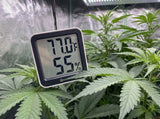
- The tent, at canopy height. Hang a digital thermometer-hygrometer at the height of the tallest tops, in the shade of the leaves, not in the light beam and not on the tent wall. Pick one with min-max memory, because the coldest moment of the day, just before the lights come on, happens while you sleep.
- The intake air. Put a second thermometer outside the tent, next to the vent or duct the tent breathes from. That is the floor your tent can never go below.
- The root zone, if the tent sits on a cold floor. A probe thermometer pushed into the pot tells you what the roots feel, which in a winter garage can be several degrees colder than the air.

The canopy reading is the one the targets in the table above refer to. In a tall tent the air near the light can be several degrees warmer than the air at the pots, so measure where the buds are.

An infrared thermometer pointed at a leaf adds a fourth reading, the leaf itself, which is how you tell heat stress from light stress at the tops. Our foxtailing guide uses it for exactly that: if a top leaf reads more than about 4°F (2°C) warmer than the air beside it, the tops are running hot.

Read the rise
With the lights on for at least an hour and the exhaust at its normal speed, subtract the intake temperature from the canopy temperature. That number is your rise. It tells you more about your setup than any spec sheet:
- Rise under 5°F (3°C) and the tent is still too hot: your exhaust is doing its job and the room is the problem. Go to cooling the room.
- Rise over 5°F (3°C): your exhaust is moving less air than the light needs. Fix the airflow first; it is cheaper than any air conditioner.
The rise also tells you how much air your fan is really moving, filter and ducting included. Real CFM is about 3.16 times your light's watts divided by the rise in °F. A 480 W light and a 12°F (7°C) rise means the fan is moving about 126 CFM, whatever the box says.

Root-zone readings matter most at the cold end. Our planting guide puts the seedling root zone at 75-79°F (24-26°C) and warns that a tray on cold tile or concrete runs 8-10°F (about 4-6°C) colder than the air above it. In a tent on a garage floor, the roots of a full-size plant feel the same pull, and our root science guide explains why root-zone temperature governs how fast roots take up water and nutrients.
The Rule That Decides Everything: A Fan Cannot Beat the Room
An exhaust fan swaps the warm air in your tent for air from the room. It cannot cool that air; it can only carry the light's heat away before it builds up. So the tent always ends up warmer than its intake, by an amount set by two numbers: how many watts go in, and how much air goes out.

The arithmetic is short. Air at room conditions carries about 1.08 BTU per hour for every cubic foot per minute (CFM) of airflow and every degree Fahrenheit it is warmed, which follows from the specific heat of air the FAO guidelines use (1.013 kJ per kilogram per °C) and a standard air density of about 1.2 kg per m³.4 Put the light's heat in, and:
Rise in °F = watts x 3.41 / (1.08 x real CFM), or about 3.16 x watts / CFM. In metric, rise in °C = watts / (0.33 x m³/h).

Two things fall out of that. First, the room sets a floor that no fan removes: in an 84°F (29°C) attic room, the best exhaust in the world gives you a tent a few degrees above 84°F (29°C). Second, airflow has diminishing returns. Doubling the fan halves the rise, so going from 100 to 200 CFM is a big win and going from 400 to 800 CFM barely registers.

The formula counts all the light's heat as warm air, which makes it a worst case: transpiring plants carry part of it out as water vapor, so real tents usually run a little under it. That is the right way to size equipment, because the worst case arrives with seedlings, with a small canopy, and in late flower when the plants drink less.
How to Cool a Grow Tent, Step by Step
Work through these in order. The first five cost little or nothing. Steps 6 and 7 are for tents the cheap fixes cannot hold.
Step 1 - Measure the room and the rise
Put one thermometer at canopy height and one at the tent's intake, let the lights run for an hour, and subtract. A rise over 5°F (3°C) means more airflow; a rise under 5°F (3°C) with the tent still hot means the room is the problem.
Do it on the hottest day you can, near the end of the lights-on period, when the tent has had all day to warm up. Write both numbers down: they decide which of the next steps are worth your money.
Step 2 - Size the exhaust for heat, not for air changes
Buy an inline exhaust fan that can move about 0.63 CFM (1.1 m³/h) of real airflow per watt of light, which holds the tent about 5°F (3°C) over its intake, and run it on a speed controller.
The rule most tent guides give is to exchange the tent's air once a minute: a 4 ft by 4 ft (120 x 120 cm) tent 80 inches (2 m) tall holds about 107 cubic feet, so the rule says 107 CFM. Put a 480 W LED in that tent and the formula above puts the canopy about 14°F (8°C) over the room. The rule sizes the fan for the air, and the problem is the heat. Run the numbers for every common tent size and the heat-based fan comes out two and a half to three times the air-change rule.

The figure on a fan's box is free-air airflow, measured with nothing attached. A carbon filter and a run of flexible duct cut the real flow, sometimes a lot. So buy a fan whose box rating sits comfortably above the yellow bar, and use a speed controller to turn it down to what you actually need. An inline fan and carbon filter in a 4 by 4 is often a 6 inch (150 mm) unit for this reason, even though a 4 inch (100 mm) fan easily clears the air-change rule.

A controller with a temperature probe, such as the AC Infinity Controller 69, can also raise the fan speed when the canopy warms up and lower it when it cools, which is worth having in a room whose temperature swings through the day.
Step 3 - Pull intake air from the coolest place you have
Open a passive intake low on the tent, on the side away from the exhaust, or duct the intake from the coolest air available, such as the floor of a basement or a cooler neighboring room.
Cool air sinks, so the bottom of any room is its coolest spot, and a basement floor can sit several degrees below the rest of the house. A duct running along the floor to a low port on the tent is the cheapest cooling upgrade there is: it lowers the floor the whole tent sits on. Give the intake an opening at least as large as the exhaust duct, or the fan works against a vacuum and moves less air.

One warning carries over from our humidity guide: outdoor or basement air that is cooler can also be wetter. In a humid summer, check the dew point, the temperature at which that air's water would start to condense, before you pull outside air into a flowering tent.
Step 4 - Move heat sources out of the tent
Hang a removable LED driver outside the tent, keep any dehumidifier in the room rather than in the tent, and remove anything plugged in that the tent does not need.
Many LED fixtures have a detachable driver, the box that converts wall power for the diodes. It wastes some of its power as heat, and outside the tent that heat goes to the room instead of the canopy. The same logic applies to a dehumidifier, which our humidity guide works out at close to 500 watts of heat for a unit pulling 20 pints (9.5 L) a day.

Step 5 - Run the lights during the coolest hours
Set the light timer so the lights-on period falls overnight, when the room is coolest, and the lights-off period lands on the hottest part of the day.
A plant does not know what time it is outside; it only knows when its lights are on. Flipping the schedule costs nothing and in summer can be worth more than any fan upgrade, because it moves your 480 W heater to the hours when the room is 5 or 10°F (3 or 6°C) cooler. It works the same for autoflowers and for photoperiod plants, as long as the dark period stays truly dark: our flowering guide covers light leaks.

Step 6 - Raise the light over a hot spot, but do not dim to cool
If one area of the canopy runs hot, raise the light or dim only over that spot, and treat dimming the whole tent as a last resort, because it costs yield.
This is the step people reach for first, and it is the most expensive one. In the University of Guelph trial run by Victoria Rodriguez-Morrison, David Llewellyn and Youbin Zheng, dry flower yield rose in a straight line as canopy light went from 120 to 1,800 µmol/m²/s (micromoles of light per square meter per second, the standard measure of light at the canopy), with no plateau anywhere a home grower will reach.5 Dim the whole tent by a quarter to cool it and you have given up roughly a quarter of the light that was growing your harvest. Our canopy science guide explains why spreading the light you have usually beats adding more.

Raising the light over a hot spot is a different matter. It is the fix our foxtailing guide puts after fixing the air at the tops: when the tallest colas run hot, the heat at the tops comes first, then the light over that spot only.

Step 7 - Cool the room with an air conditioner
When the room itself sits within about 5°F (3°C) of your target, put an air conditioner in the room, not in the tent, sized from every watt you plug in plus what the room already needs, and let the tent's intake draw the cooled air.
This is the one fix that lowers the floor in the formula. The next section covers how to size it and why the number on a portable unit's box needs a second look.
What about clip fans?
Small oscillating fans inside the tent do not cool the air at all; they add their own few watts to it. What they do is still worth doing: they break up the layer of hot, still air that collects right under the light, and they thin the boundary layer of air on each leaf so it can shed heat and water. Aim them across the canopy, not down onto it, and leave the cooling to the exhaust and the room.

What Size Air Conditioner for a Grow Tent?
This is the most searched question in the whole topic, and the answer is simpler than the forums make it. An air conditioner has to remove every watt you plug in, plus whatever heat the room already gets from the sun, the walls and the people in it.
Our rule: add up the plug watts of everything in and around the tent, multiply by 3.41, and add that to the room's own cooling need.
For the room's own need, ENERGY STAR's sizing chart for room air conditioners is the standard reference: 5,000 BTU per hour for 100 to 150 sq ft (9 to 14 m²), 6,000 for 150 to 250 sq ft (14 to 23 m²), 7,000 for 250 to 300 sq ft (23 to 28 m²), with 10% more for a very sunny room.6 The same chart tells you to add 4,000 BTU per hour if the room is a kitchen. Keep that number in mind, because a 4 ft by 4 ft (120 x 120 cm) tent with its dehumidifier comes to about 2,560, most of a kitchen.

| Setup | Plug watts | Heat added | In a 100-150 sq ft (9-14 m²) room |
|---|---|---|---|
| 2 x 4 ft (60 x 120 cm) tent, 240 W LED | About 280 W | About 960 BTU/h | About 6,000 BTU/h |
| 4 x 4 ft (120 x 120 cm) tent, 480 W LED | About 530 W | About 1,810 BTU/h | About 7,000 BTU/h |
| 4 x 4 ft tent plus a dehumidifier | About 750 W | About 2,560 BTU/h | About 7,500 BTU/h |
| 5 x 5 ft (150 x 150 cm) tent, 720 W LED | About 780 W | About 2,660 BTU/h | About 7,700 BTU/h |
Count the dehumidifier by its plug watts, about 220 W for the unit our humidity guide uses, not by the 500 watts of heat it releases. The difference is the heat of the water it condenses, and that water was evaporated by your light in the first place: the air conditioner is already removing it when you count the light. Count each watt once.
Portable air conditioners: read the SACC number
Since 2017, portable air conditioners in the US carry two cooling numbers, and the big one is not the one to size with. The older ASHRAE rating was measured at 80°F (27°C) room conditions and nothing else. The Department of Energy's test now produces a Seasonally Adjusted Cooling Capacity (SACC), which weights performance 20% against 95°F (35°C) outdoor air and 80% against 83°F (28°C), and counts two real losses the old number ignored: heat radiated back into the room from the warm exhaust duct, and, on a single-hose unit, the hot outdoor air that leaks in to replace the room air it blows outside.1

The difference is not small. LG's own listing for its LP1025WSSM portable unit gives 12,000 BTU per hour under the old ASHRAE method and 8,350 under SACC, 30% less, and LG notes the DOE figure can be up to 42% lower for the same product. Size with the SACC number against the totals above. A window unit has no hose to leak heat back into the room and pulls no outdoor air in behind it, so where a window allows one, it is usually the stronger choice for the money.

If it has to be a portable unit, a dual-hose model takes its cooling air from outside through one hose and returns it through the other, so it does not pull hot outdoor air into the room through every crack the way a single-hose unit does. A ductless mini-split is the permanent answer for a dedicated grow room, and the most efficient one.

Whatever you buy, put it in the room, not in the tent. An air conditioner's whole job is to move heat from one side of it to the other, and the hot side has to vent outside. Inside a tent, you are fighting its exhaust in a space a few feet across. In the room, the tent's intake simply draws the cooled air, exactly as Step 3 describes.
What the Research Says Temperature Does to Cannabis
Temperature research on cannabis is thin, and most of what grow guides say about it is borrowed from tomatoes. Two findings are solid enough to build on.
The first is Chandra's: cannabis leaves photosynthesize best around 77-86°F (25-30°C) and fall off above that.2 A leaf measurement is not a harvest measurement, which is why the flowering band sits a little lower, but it tells you a tent at 82°F (28°C) is not an emergency for the plant. It is the flowers that pay for heat, through airy buds and lost aroma.
The second is more useful, because it measured flowers. Gwonjeong Bok, Seungyong Hahm, Juhyung Shin and Jongseok Park at Chungnam National University grew hemp clones through seven weeks of flower under five day and night temperature pairs, all averaging 75°F (24°C), from a day 12°C cooler than the night to a day 12°C warmer.7 Flower biomass per plant was highest with no gap at all, 75°F (24°C) day and night, and 4.7 times lower when the night ran 12°C warmer than the day. Measured per square meter, the best yield and the most cannabinoids in the flowers came with the day 6°C (11°F) warmer than the night, 81°F (27°C) by day and 70°F (21°C) by night. Warmer nights than days produced the biggest plants and the poorest flowers.

One cultivar, a low-THC hemp in 1 liter pots in growth chambers, is a direction rather than a recipe. But it lines up with our flowering guide's 5 to 10°F (3 to 6°C) drop at lights-off, and it gives you one rule worth keeping in winter: whatever heats the tent at night must never hold it warmer than the day.
What heat stress looks like
The classic sign is at the top of the plant. The leaves nearest the light fold upward along their center vein into a canoe or taco shape, showing their paler undersides, and the tips and edges can yellow and dry. The leaves lower down, further from the heat, lie flat. Fix the air at the tops first, using the readings above.

Tacoing can also be light stress, which is why the leaf reading matters: a hot leaf in cool air points at the light, a hot leaf in hot air points at the room. Bleaching, where the tissue goes pale or white, is a light problem rather than a heat one, and our deficiency guide covers the look-alikes. Spiky, stacked growth on the top colas late in flower is foxtailing, and our foxtailing guide covers which kind you have.

How to Keep a Grow Tent Warm
In winter the problem flips, and it almost always shows up at lights-off. A tent has very little thermal mass: when the light switches off, its 480 W of heat switches off with it, and within minutes the tent falls to the temperature of the room. If your garage or basement sits at 55°F (13°C) overnight, so does your tent.
Start by checking whether you have a problem at all. If the room at night stays within your lights-off target, roughly 5 to 10°F (3 to 6°C) under your lights-on temperature and never below 65°F (18°C) for seedlings or in flower, the dark period needs nothing. If it falls further, work through these in order.
Run the lights through the coldest hours
The same timer trick that cools a summer tent warms a winter one. Put the lights-on period across the night, when the room is coldest, and let the tent go dark in the warmer daytime. Your light becomes your heater exactly when you need one.
Slow the exhaust at night, but do not stop it
At lights-off there is no light heat to carry away, so the exhaust only swaps warm tent air for cold room air. Turn it down. Do not turn it off: the hours after lights-off are the wettest hours of the day, and our humidity guide explains why the exhaust has to keep running through them. A controller that handles temperature and humidity together, slowing the fan when it is cold and speeding it up when the humidity climbs, does this for you.
Get the tent off a cold floor
A sheet of rigid foam insulation board under the tent stops a concrete floor from pulling heat out of the roots all night. Raise the pots too: fabric pots like our BudPots sitting on a slatted stand or a foam board stay warmer at the root zone than pots on bare concrete, and so do starter cups like BudCups on a heat mat with a thermostat for the first weeks.

Heat the room, not the tent
If you need a heater, the safest place for it is in the room, with the tent breathing the warmed air. An oil-filled radiator is the best type for the job: it has no exposed glowing element, it heats steadily, and it holds its warmth. The US Fire Administration's rule is to keep anything that can burn at least 3 feet (90 cm) from any heat source, and it notes that portable heater fires were only 3% of home heating fires from 2017 to 2019 but 41% of the fatal ones.8 A grow tent is a box of fabric, plastic and dry plant matter. In anything smaller than a 4 by 4, there is no way to give a heater 3 feet of clearance inside it.

If the heater has to go in the tent
Sometimes it does, in a room you cannot heat. Then use a heater built for the job: a PTC (ceramic) unit with a thermostat, tip-over and overheat cut-offs, standing on a hard, level surface clear of pots, walls and leaves, plugged straight into the wall rather than an extension cord. Grow tent heaters from Spider Farmer (530 W) and VIVOSUN (the AeroFlux, 700 W) are in the range most tents need, with a thermostat throttling them down.
To size one, use the same formula backwards. Heater watts = 1.08 x CFM x the gap in °F / 3.41, or about 0.32 x CFM x °F (in metric, 0.33 x m³/h x °C). With the exhaust slowed to 60 CFM at night, holding a tent 10°F (6°C) above a cold room takes about 190 W; 20°F (11°C) takes about 380 W. The fabric walls lose heat on top of that, which the formula does not count, so leave headroom and let the thermostat do the throttling.

Then set the thermostat below your lights-on temperature, never above it. A heater set to 80°F (27°C) in a tent that runs 77°F (25°C) with the lights on gives you exactly the warmer-night-than-day pattern that cost Bok and colleagues most of their flowers.

Common Grow Tent Temperature Mistakes
- Buying a bigger fan for a hot room. If the room is 84°F (29°C), the tent will be over 84°F (29°C) whatever the fan. Measure the rise first.
- Sizing the exhaust by air changes. One tent volume a minute leaves a typical LED tent 12 to 16°F (7 to 9°C) above its room in the worst case. Size by watts.
- Trusting the box CFM. A carbon filter and ducting cut it. Your measured rise tells you the real number.
- Buying a portable air conditioner on its ASHRAE rating. Read the SACC number, and prefer a dual-hose unit or a window unit.
- Putting the air conditioner or the dehumidifier inside the tent. Both move heat, they do not destroy it. Keep them in the room.
- Dimming the whole tent to cool it. It works, and it costs you yield in proportion. Cool the room instead.
- Measuring at the wrong height. A thermometer on the tent wall or at the pots reads cooler than the tops. Measure where the buds are.
- Turning the exhaust off at night to keep the heat in. You trade a cold problem for a humidity problem. Slow it, do not stop it.
- Setting a night heater above the day temperature. Warmer nights than days ruined the flowers in the one cannabis trial we found that tested it.
- A space heater inside a small tent. No room for 3 feet (90 cm) of clearance, and the tent is made of things that burn.
Which Fix Do You Need?
| What you measure | What it means | What to do |
|---|---|---|
| Tent hot, rise over 5°F (3°C) | Not enough real airflow for the light | Bigger or faster exhaust, bigger intake, driver outside the tent |
| Tent hot, rise under 5°F (3°C) | The room is too warm | Lights on at night, cooler intake air, then an air conditioner in the room |
| Only the tops hot | Hot layer under the light | Fans across the canopy, raise the light over that spot |
| Tent cold at lights-off only | The room is cold at night | Lights on at night, slower night exhaust, foam under the tent |
| Tent cold all day | The room is cold, period | Heat the room; a thermostat tent heater only if you cannot |
| Night warmer than day | Heater set too high, or a hot room at night | Thermostat below the lights-on temperature |
Frequently Asked Questions
What temperature should a grow tent be?
At canopy height: 72-78°F (22-26°C) for seedlings, 71-82°F (22-28°C) in veg, 70-80°F (21-27°C) in flower with 75-78°F (24-26°C) ideal, and 65-75°F (18-24°C) in late flower. At lights-off, let it fall 5 to 10°F (3 to 6°C) in flower, and never below 65°F (18°C) for seedlings.
What temperature is too hot for a grow tent?
Above 85°F (29°C) at the tops in flower, photosynthesis starts to fall off, heat drives terpenes off faster, and buds come out airier. The leaves cope with more, since cannabis leaf photosynthesis peaks near 86°F (30°C), but the flowering band is set for the buds. If the tops sit above 85°F (29°C), fix that before anything else.
What temperature is too cold for a grow tent?
Below 65°F (18°C) bud density suffers and ripening drags in flower, and seedlings should not drop below 65°F (18°C) with the lights off. Cannabis seedlings start to suffer below 50°F (10°C) and frost kills them. The usual cold problem is the dark period, when the light's heat switches off and the tent falls to room temperature.
How much hotter is a grow tent than the room?
By however much your exhaust allows. The rise in °F is about 3.16 times the light's watts divided by the real CFM your fan moves. A 480 W LED with 300 CFM of real airflow sits about 5°F (3°C) above the room; with 107 CFM, about 14°F (8°C). Transpiring plants carry some heat out as water vapor, so real tents run a little under that.
What size exhaust fan do I need for a 4x4 grow tent?
Size it for heat: about 0.63 CFM (1.1 m³/h) of real airflow per watt of light holds the tent 5°F (3°C) over its intake. For a 480 W LED that is about 300 CFM of real flow. A carbon filter and ducting cut the box rating, so most 4 by 4 growers end up with a 6 inch (150 mm) inline fan on a speed controller.
How do I lower the temperature in my grow tent without an AC?
Measure the room and the tent first. Then size the exhaust for your light's watts, pull intake air from the coolest spot you have, hang the LED driver outside the tent, keep any dehumidifier out of the tent, and run the lights at night when the room is coolest. If the room itself is within 5°F (3°C) of your target, only cooling the room will fix it.
What size air conditioner do I need for a grow tent?
Add up the plug watts of everything in and around the tent, multiply by 3.41 for BTU per hour, and add that to what the room already needs. A 4 by 4 tent with a 480 W LED adds about 1,800 BTU per hour; with a dehumidifier, about 2,560. In a 100-150 sq ft (9-14 m²) room, plan on about 7,000 to 7,500 BTU per hour.
Should I go by the SACC or the ASHRAE rating on a portable air conditioner?
The SACC rating. The Department of Energy's test behind it counts hot outdoor air, the heat that leaks back from the exhaust duct, and the outdoor air a single-hose unit pulls into the room. LG lists one of its portable units at 12,000 BTU per hour on the old ASHRAE method and 8,350 on SACC, 30% less.
Can I put an air conditioner inside my grow tent?
You can, but you should not. An air conditioner moves heat from one side of itself to the other, and the hot side has to vent outside. Put it in the room, let the tent's intake draw the cooled air, and the exhaust carries the light's heat out of the tent. The same goes for a dehumidifier.
Does an LED grow light produce less heat than an HPS?
Per watt, no: every watt becomes heat either way. But a good LED needs fewer watts for the same light. Kusuma, Pattison and Bugbee found the best tested white-and-red LED fixtures at 2.5 to 2.8 micromoles per joule against 1.72 for a 1,000 W double-ended HPS, so an LED matching that lamp's light makes about a third less heat.
Do clip fans cool a grow tent?
No. They add a few watts of heat of their own. What they do is break up the hot layer under the light and move air across each leaf so it sheds heat and water faster. Aim them across the canopy and leave the actual cooling to the exhaust fan and the room.
Should a grow tent be cooler at night?
Yes, a little. Our flowering guide recommends a drop of 5 to 10°F (3 to 6°C) at lights-off. In a hemp trial by Bok and colleagues, the most flower per square meter and the most cannabinoids came with the day 6°C (11°F) warmer than the night, and the worst flowers came when the night ran warmer than the day.
Are grow tent heaters like the Spider Farmer or VIVOSUN AeroFlux safe?
They are safer than a household space heater inside a tent, because they are PTC ceramic units with thermostats and cut-offs, at 530 W and 700 W. Stand one on a hard, level surface clear of pots, walls and leaves, plug it straight into the wall, and set it below your lights-on temperature. Heating the room around the tent is still the safer choice.
Is it OK to run grow lights at night?
Yes, and it is one of the best temperature fixes there is. The plant only knows when its lights are on, not what time it is outside. In summer, lights on overnight moves the heat to the coolest hours; in winter, it puts your light to work as a heater through the coldest ones. Keep the dark period truly dark.
Where to Go From Here
Temperature is half the climate. The other half is humidity, and our grow tent humidity guide works it through the same way, from the water you pour to the dehumidifier you buy. To bring the two together into one number per stage, use our VPD chart. And if you are setting up your first tent, our guide to growing weed indoors covers the whole setup, from the light to the exhaust.
References
- US Department of Energy. Uniform test method for measuring the energy consumption of portable air conditioners. Code of Federal Regulations, Title 10, Part 430, Subpart B, Appendix CC. https://www.ecfr.gov/current/title-10/chapter-II/subchapter-D/part-430/subpart-B/appendix-Appendix%20CC%20to%20Subpart%20B%20of%20Part%20430
- Chandra, S., Lata, H., Khan, I. A., & ElSohly, M. A. (2008). Photosynthetic response of Cannabis sativa L. to variations in photosynthetic photon flux densities, temperature and CO2 conditions. Physiology and Molecular Biology of Plants, 14(4), 299-306. https://doi.org/10.1007/s12298-008-0027-x
- Kusuma, P., Pattison, P. M., & Bugbee, B. (2020). From physics to fixtures to food: current and potential LED efficacy. Horticulture Research, 7, 56. https://doi.org/10.1038/s41438-020-0283-7
- Allen, R. G., Pereira, L. S., Raes, D., & Smith, M. (1998). Crop evapotranspiration: guidelines for computing crop water requirements. FAO Irrigation and Drainage Paper 56, Chapter 3. Food and Agriculture Organization of the United Nations. https://www.fao.org/4/x0490e/x0490e07.htm
- Rodriguez-Morrison, V., Llewellyn, D., & Zheng, Y. (2021). Cannabis yield, potency, and leaf photosynthesis respond differently to increasing light levels in an indoor environment. Frontiers in Plant Science, 12, 646020. https://doi.org/10.3389/fpls.2021.646020
- ENERGY STAR. Room air conditioners: sizing chart. US Environmental Protection Agency and US Department of Energy. https://www.energystar.gov/products/room_air_conditioners
- Bok, G., Hahm, S., Shin, J., & Park, J. (2023). Optimizing indoor hemp cultivation efficiency through differential day-night temperature treatment. Agronomy, 13(10), 2636. https://doi.org/10.3390/agronomy13102636
- US Fire Administration. Heating fire safety. Federal Emergency Management Agency. https://www.usfa.fema.gov/prevention/home-fires/prevent-fires/heating/

About the Author
Henrique Dias is the CEO and co-founder of BudTrainer. He is a mechanical engineer who also holds a graduate certificate in Commercial Cannabis Production from Niagara College in Ontario, Canada - the first college-level cannabis cultivation program in North America. Before founding BudTrainer, Henrique worked with Health Canada licensed cannabis producers, where he gained hands-on experience in cultivation, processing, and post-harvest management of cannabis at commercial scale. He started BudTrainer to bring that same level of craft to home growers through better-designed gardening tools and clear, science-backed education.
DISCLAIMER: Everything taught and sold by BudTrainer® is to be used strictly for legal purposes. We do not endorse the production of illegal substances and it is your duty to ensure that you are complying with the law. The words "hemp," "cannabis," "weed," and "marijuana" are used interchangeably to refer to the same plant (legal hemp with less than 0.3% THC) for the purposes of this lesson.