Most light schedule guides are a table: 18/6 here, 12/12 there, 18/6 or 20/4 or 24/0 for autoflowers, take your pick. The table is mostly right. What it does not tell you is why, and without the why you cannot answer the questions that actually come up. Can I give my plants more hours in veg? Does a little light in the night matter? Is 20/4 better for an autoflower? Why did my plants start growing leaves out of the buds?
This guide gives you the schedule for every stage first. Then it explains the two things a light schedule does, which settles most of those questions at once. Then it walks you through the flip to 12/12 step by step, what the research says about whether 12 hours is really the best flowering day, how to keep the dark period dark, how the sun does all of this for you outdoors, why autoflowers exist at all, and what to run one on. Light intensity and fixtures are a separate subject; this one is about the clock.
The Short Answer: Cannabis Light Schedule by Stage
The first number is hours of light, the second is hours of darkness, in every 24 hours. Where another of our guides owns the stage, it sets the number and we link to it.
| Stage | Light schedule | What the dark period does | Set by |
|---|---|---|---|
| Seedlings (photoperiod and autoflower) | 18/6 | Nothing it needs to; we keep 6 hours of dark | Planting guide |
| Clones while rooting | 18/6, at low intensity | Keeps them vegetative | Cloning guide |
| Vegetative growth (photoperiod) | 18/6 | Too short to trigger flowering | This guide |
| Mother plants | 18/6 | Holds them in veg indefinitely | Cloning guide |
| Flowering (photoperiod) | 12/12 | Long enough to start and hold flowering, if unbroken | Flowering guide |
| Autoflowers, seed to harvest | 18/6 (20/4 also works) | Does not control flowering at all | This guide |

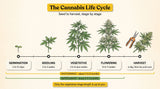
Our indoor growing guide carries the same schedules beside its temperature and humidity targets. Two rules sit underneath that table and decide every case it does not cover. A photoperiod plant flowers when the nights get long enough, and stays vegetative while they are short. An autoflower flowers on age, whatever the clock says. The rest of this guide is those two rules applied.
What a Light Schedule Actually Does: a Switch and a Dose
A few words first, because they come up all through this guide. A photoperiod plant is a normal cannabis plant whose flowering is controlled by day length; most seeds and every clone you buy are photoperiod unless the label says autoflower. An autoflower carries genetics that make it flower on age instead; our growth stages guide compares the two clocks. PPFD is how much usable light lands on the canopy each second, in micromoles per square meter per second; your light's maker publishes it, and a meter measures it. DLI, the daily light integral, is how much of that light the plant collects over a whole day, in moles per square meter per day.
Job one: the night is a switch
A photoperiod cannabis plant does not measure how long the day is. It measures how long the night is, and whether that night is unbroken. What matters for your timer is the threshold. Zhang, Anderson, Brym and Pearson put 27 hemp cultivars under 11 day lengths from 12 to 18 hours; the earliest-flowering of them needed days shorter than 13 hours 45 minutes to 14 hours, and others needed shorter still.3 Lisson, Mendham and Carberry found the same line, about 14 hours, in two fiber hemp cultivars two decades earlier.4 And in drug-type cannabis, Ahrens, Llewellyn and Zheng grew ten cultivars under six day lengths and every one of them started to flower at anything up to 14 hours.5
How the plant reads the night, in short. The sensor is phytochrome, a light-sensitive protein in the leaves. Light, red light above all, flips it into its active form; in the dark it slowly flips back. Only when the night is long enough for the active form to run down does the leaf send the signal to flower: a protein made from a gene called FLOWERING LOCUS T, or FT, which travels from the leaves to the growing tips and switches them from making leaves to making flowers. A short night, or a long night broken by light, never lets the active form run down, so the signal never goes out. Most of this machinery was worked out in other plants; cannabis researchers describe the flowering pathways as largely shared across flowering plants, and the cannabis version of the FT gene turns up again in the autoflower story below.6 Our flowering guide has the long version.

So 12/12 is not a magic number. It is a long night with a comfortable safety margin: 12 hours of dark against a threshold of roughly 10. That margin is why 12/12 works on every photoperiod cultivar you are likely to buy, and why it has been the standard for decades. The flip side is that the switch reads the night, not the total light. One hour of light in the middle of the night turns one long night into two short ones, and the plant reads short nights as summer. That is exactly what a light leak does, and it is why the dark period has to be dark (more on that below).
Job two: the hours are a dose
The other thing your schedule does is decide how much light the plant collects in a day, and that has nothing to do with flowering. It is simple arithmetic: DLI = PPFD x hours of light x 3,600 / 1,000,000. A light delivering 600 PPFD for 18 hours gives 38.9 moles per square meter per day. The same light for 20 hours gives 43.2, which is 11% more. The same light for 12 hours gives 25.9.

That means hours and intensity are interchangeable as far as growth goes, within the limits of your fixture. Twelve hours at 900 PPFD is the same daily dose as 18 hours at 600, or 24 hours at 450. It also explains why a flowering plant does not starve on two thirds of the hours of veg: growers run their lights harder in flower to make up for it. And it is why the yield research is framed in light per day. Rodriguez-Morrison, Llewellyn and Zheng flowered cannabis on 12/12 at canopy light from 120 to 1,800 PPFD, about 5 to 78 moles per day, and yield rose in a straight line the whole way, with no effect on potency.7 Our canopy science guide has that study in full.
Put the intensity ranges our other guides already use through the same arithmetic and you get a daily light target for each stage:

- Seedlings, first two weeks: 200 to 400 PPFD at 18/6 is 13 to 26 moles a day (the intensity is our planting guide's).
- Seedlings, weeks three and four: 400 to 600 PPFD at 18/6 is 26 to 39 moles a day.
- Flower: 600 to 900 PPFD at 12/12 is 26 to 39 moles a day (the intensity is our flowering guide's), and more light still pays.
No trial has set a daily light target for each stage of cannabis; these are our arithmetic on published intensity ranges, and we label them that way. The useful part is the shape: once a plant is past its first two weeks, the ranges our guides use land in the same band, about 26 to 39 moles a day, whether they are delivered over 18 hours or over 12. The schedule changes how you deliver the light, not how much the plant can use.
Light Schedule for Seedlings and Clones
Run seedlings on 18/6, photoperiod and autoflower alike. That is our planting guide's rule, reviewed by Scott Golem, and it keeps a daily dark period even for an autoflower, whose flowering does not depend on one. Some growers run autoflower seedlings at 20/4 or 24/0; we prefer 18/6, and the only controlled work on continuous light we found points the same way (see veg below).

We start seedlings in BudCups under the same 18/6 timer as the rest of the tent, so nothing changes for the seedling when it moves into its final pot.
A seedling's limit is intensity, not hours: 200 to 400 PPFD for the first two weeks. If your seedlings stretch tall and thin, the light is too weak or too far away, and adding hours will not fix it; our planting guide's section on lanky seedlings covers the fix. Its three fixes, in short: turn the light's intensity up, give the stem a loose support, and add gentle airflow.

Clones get 18/6 too, at much lower intensity. A cutting has no roots, so it cannot drink fast enough to keep up with strong light. Our cloning guide covers the trial behind that: cuttings rooted just as well at 50 PPFD as at 250, and the brighter light only made bigger clones. Keep the dome on and the light gentle, and do not bother with 24 hours.

Light Schedule for the Vegetative Stage
Keep photoperiod plants on 18/6 for as long as you want them to grow before flowering. Six hours of dark is far too short a night to trigger flowering, so the plant keeps building leaves and branches. There is no fixed length for veg. Our beginner's guide flips a photoperiod plant once it has filled about half the height you can give it, because the stretch adds half to double again.

Should you run 20/4 or 24/0 in veg?
You can. A photoperiod plant stays vegetative under any short night, and no night at all is the shortest night there is. The real question is whether the extra hours pay, and the dose rule answers most of it: 20/4 is 11% more light than 18/6 for 11% more electricity and heat, and turning the light up 11% does the same thing. What the extra hours also do is shrink or remove the dark period, and that is where the evidence turns against them. Šrajer Gajdošik and colleagues grew two hemp cultivars for five weeks at 16/8, 20/4 and 24/0 at about 250 PPFD. The 16/8 plants, the shortest day in the trial, had the most efficient photosynthetic response and the least damage to the membranes inside the leaf where photosynthesis happens; the longer days, 20/4 and 24/0, showed more of that damage.8 They did not measure yield, so this is a warning, not a verdict. In tomato, continuous light causes leaf injury outright, which Velez-Ramirez and colleagues traced to the plant's internal clock expecting a night that never comes.9
Our call: keep 18/6. If your fixture has headroom, get more light into veg by turning it up, not by taking the night away.
How much the light in veg matters later
Light in veg is not wasted on leaves you will later strip. Grover, Haiden and Berkowitz ran a clean test of it. They vegged hemp clones for four weeks either on 18/6 or on a "night break" schedule: 12 hours on, 5 off, 1 hour on, 6 off. The one-hour break kept the night-break plants vegetative just as well as 18/6 did. But it gave them 21.2 moles of light a day instead of 29.4, and when both groups were then flowered side by side under the same 12/12 light, the night-break plants made about 22% less flower, with the same cannabinoid content.1 Less light in veg became less flower at harvest. The authors also found the electricity it saved did not cover the lost crop.

Mother plants, kept only for cuttings, stay on 18/6 the same way and can be held in veg for years; our cloning guide covers whether you need one.
How to Switch to 12/12, Step by Step
The flip is one timer change. What makes it go well is everything around it: the timing, the tent, and the first week of nights.
Step 1 - Decide when to flip
Flip once the plant has filled about half the height you can give it, because the stretch will add half to double again in the first three weeks. Finish every cut before you flip: our topping guide finishes all topping at least 5 days before the switch, and structural training is done at the flip, with tucking under a trellis net as the one exception until the stretch ends around day 21 (our training guide covers the net).
Step 2 - Light-proof the tent before the first long night
Do the dark check before you flip, not after. Turn the grow light off with the room lights on, close yourself inside the tent for a few minutes so your eyes adjust, and look for any point of light: the door zipper, the corners, cable ports, vents, and any indicator light on a fan controller, power strip or timer inside the tent. Fix every one you find (see how to find and fix a leak below).
Step 3 - Set the timer: keep lights-on, move lights-off
Keep your lights-on time where it is and bring lights-off 6 hours earlier. If your lights came on at 6 am and went off at midnight, they now come on at 6 am and go off at 6 pm. The first night is simply 6 hours longer than the last. You do not need a gradual step-down or a day of darkness before the flip; the plant reads night length, and a long night is a long night. Pick your hours for temperature: run the lights during the coolest part of the day in summer and the coldest part of the night in winter.

Step 4 - Keep the dark dark from the first night
From the first long night on, do not open the tent during lights-off, and do not switch on a room light that shines into it. If you have to work in the dark, keep it brief and dim. Our flowering guide covers what is known about green work lights and why the safe rule does not change.
Step 5 - Count flowering from the flip
Flowering starts the day you flip, not the day you see pistils. Expect white pistils at the branch junctions within 7 to 14 days, and expect the plant to keep stretching for about three weeks. Write the flip date down; every week count in our week-by-week flowering guide runs from it.

Step 6 - Check the timer after any power cut
The most common way a 12/12 schedule fails is the timer losing its clock in a power cut and coming back on its default, or on 18/6, while you think it is flowering. After any outage, check the time on the timer and watch one full cycle. A digital timer with battery backup, or a smart plug that sets its clock from the internet, rides through outages better than a mechanical dial.

Is 12/12 Really Best? What the Research Actually Says
Here is the part most light schedule guides have not caught up with. If the switch only needs a night of about 10 hours and the dose rule says more hours means more light, then 12/12 might be leaving light on the table. A group at the University of Guelph tested exactly that.
First, Ahrens, Llewellyn and Zheng put ten drug-type cultivars under 12, 12.5, 13, 13.5, 14 and 15 hours of light. Every cultivar started to flower at every day length up to 14 hours, at most about 4 days later than at 12 hours. At 15 hours some cultivars started, but none of the flowers developed. The best yield signs sat between 12 and 13 hours, depending on the cultivar.5

Then they grew two high-THC cultivars, Incredible Milk and Gorilla Glue, all the way to harvest under 12 or 13 hours at the same intensity, 540 PPFD. Thirteen hours is only about 8% more light per day (25.7 moles against 23.8). The 13-hour plants yielded 1.35 times and 1.50 times as much flower, four to six times more than the extra light alone explains, and their major cannabinoid concentrations were the same or higher. Gorilla Glue started flowering on the same day under both schedules; Incredible Milk started about a day and a half later.2

Read the caveats before you change your timer. Both groups were harvested on the same day, when the 12-hour plants were ripe, and the 13-hour plants were ripening more slowly (their pistils browned and their trichomes ambered later), so in your own grow a 13-hour plant may want a few more days. It is two cultivars in small plots, and the authors say the gain may shrink in a full-size canopy. And there is a ceiling close above it. Peterswald and colleagues flowered three medical cultivars at 10, 12 and 14 hours: 14 hours raised CBD yield by 50 to 100% in the CBD cultivar, but in the high-THC Northern Lights a constant 14 hours cut THC concentration from about 12% to 7%.10

A different team, Sae-Tang and colleagues, tested the other end of flower. Switching to 18-hour days for the last 6 or 4 weeks sent plants back toward leafy growth and delayed them. Switching for only the last 2 weeks did no harm, and with strong white light at 600 PPFD it raised yield.11 That is one climate-chamber study; it is interesting, not a recipe.
What we recommend. Run 12/12 for your first grow and on any cultivar you have not flowered before: its 12-hour night has a margin no cultivar we know of fails. On a cultivar you have already flowered, 13/11 from the flip is a reasonable experiment, backed by the only controlled harvest trial there is. Watch for pistils by day 14. If they have not come, go back to 12/12, and plan on harvesting by the trichomes a few days later than you would have. Do not go to 14 hours on a THC cultivar.
Can You Run 12/12 From Seed?
Yes. A photoperiod seedling put straight onto 12/12 grows for a few weeks until it is old enough to respond, then flowers without ever having a real veg. The result is a small plant with one main cola and a few short side branches, finished weeks sooner than a vegged plant. It is a legitimate way to run a lot of small plants in a small space, or to sex and test a cultivar quickly. What it costs you is yield per plant and the chance to train: there is no time to top or spread the plant before the stretch, so it will be one main spear rather than a flat canopy. For one or two plants in a tent, vegging on 18/6 and training gets more out of the same light.

Light Leaks: Why the Dark Has to Be Dark
The night-break result above is the cleanest demonstration of why light leaks matter: one hour of light in the middle of the night was enough to keep plants out of flower entirely.1 That break was a full hour of grow light, far brighter than a sliver of light under a door. Nobody has measured how dim or how short a leak can be before cannabis notices, and we will not pretend otherwise. What we know is the direction, and what leaks look like when they get through.
A plant in flower that keeps getting light in its night can slide back toward vegetative growth, called re-veg: new leaves with one to three smooth, rounded blades growing out of the buds. Our flowering guide covers re-veg in its list of common flowering mistakes, and our foxtailing guide shows how to tell it from foxtails: if the new growth is leaves, it is re-veg; if it is flowers, it is not. Interrupted or inconsistent dark is also one of the common triggers for hermaphrodite flowers and "nanners", which can pollinate your buds.

How to find and fix a leak
Do the check from inside the tent, with the grow light off and the room lights on, and give your eyes a few minutes. The usual leaks, in the order we find them:
- The door zipper. Small gaps along the teeth or at the corners where two zippers meet. Fold the flap over and clip it, or tape the corners.
- Indicator lights inside the tent. Power strips, fan controllers, timers, smart plugs and dehumidifier displays. Cover each with a piece of black electrical tape, or move the device outside.
- Cable ports and vents. Cinch the drawstrings tight and close any vent flap you are not using. Make sure the duct and its port are light-tight.
- Pinholes in the fabric. Old tents wear through at the corners and seams. A patch of black tape on the outside fixes it.
- The room itself. A hallway light, a window, or a phone screen when you check on the plants at night. Leave the tent closed through lights-off.

Indicator lights are the leak almost everyone misses, because they are on all the time and you stop seeing them. A small orange or blue LED on a power strip inside the tent is lit for the whole night.

Outdoors: the Sun Sets Your Schedule
Outdoors, nobody sets a timer: the length of the day changes all year, and a photoperiod plant reads it the same way it reads your tent. At the spring equinox, around March 20, every place on Earth gets about 12 hours of day. North of the equator the days then lengthen until the longest day, around June 21: about 14 hours at 30°N, 15.4 at 43°N and 16.4 at 50°N. They shorten back through 12 hours at the fall equinox, around September 22, and keep shortening to the shortest day in December. At the equator the day stays at about 12 hours all year, so a photoperiod plant there starts to flower once it is old enough to respond, whatever the month. South of the equator the whole calendar flips: the longest day is in December and the outdoor harvest comes roughly six months after the northern one, around late March to early May.

A northern season fits that curve. Start seeds indoors from late March to mid-April, move the plants out from mid to late May once frost has passed, and they vegetate through the longest days of the year. Planting out too early has a second cost besides frost: in early April at 43°N the day is only about 13 hours, short enough that a photoperiod plant can start to flower, then slip back into leafy growth once the days pass 14 hours around the start of May. Our outdoor growing guide covers the timing in full.

Then the season turns. A photoperiod plant vegetates through the long days of early summer and starts to flower as the days shorten past its threshold, around 14 hours of daylight for most cultivars, which is the line Zhang and Lisson both found in hemp.34 Where you live decides when that happens. At 30°N, around Houston, the day never gets much past 14 hours, so plants are on the edge of flowering all summer. At 43°N, around Toronto and Boston, the day falls below 14 hours in mid-August. At 50°N, around Vancouver and Winnipeg, it is late August, and from there the days shorten fast.

That is why an outdoor photoperiod plant is harvested between late September and early November, depending on your region and cultivar, and why a late-flowering cultivar can run out of season in the north. Our outdoor growing guide covers choosing between photoperiod and autoflower for your latitude. Twilight also counts: the plant can sense dim light before sunrise and after sunset, so its effective day is a little longer than the sunrise-to-sunset numbers in these charts.

The outdoor version of a light leak is a streetlight or a security floodlight shining on your plants all night. Nobody has measured how much a streetlight delays cannabis, and it is far dimmer than the night break in the trial above, so we cannot tell you it will stop your plants from flowering. It is also the one leak you can avoid for free: put the pots where no lamp reaches them, or ask whether the floodlight needs to run all night. Autoflowers outdoors ignore all of this and finish on their own clock.

Why Autoflowers Exist: a Second Way to Switch On Flowering
Almost all cannabis is photoperiod. The autoflowering trait came into modern seed lines from wild and weedy populations of high-latitude Eurasia, usually called Cannabis ruderalis and most often placed in Siberia. Toth, Stack, Carlson and Smart describe the trait as bred in from those high-latitude populations, and note that the most recent genomic studies do not support ruderalis as a separate species, so "autoflower populations from the far north" is the more accurate name.6

The reason it pays off up north is in the calendar. At 55°N the longest day runs past 17 hours, and the day does not fall below 14 hours until the end of August. A photoperiod plant there spends the whole summer vegetating, starts to flower in late August, and needs 8 to 11 weeks more, which takes it to late October or mid-November. A short northern season can end in frost first. A plant that flowers on age, a few weeks after it sprouts, is finished in August. Dowling and colleagues make the same point about hemp: losing day-length sensitivity is what let the crop spread to higher latitudes.12

What changed inside the plant is now partly known, and it is not one thing. Toth's group mapped the trait in hemp to a region of chromosome 1 they named Autoflower1. Breeders have long treated it as recessive, which means a plant needs two copies, one from each parent, to autoflower.6 Leckie and colleagues traced a loss of day-length sensitivity in their cannabis lines to a single broken splice site in CsPRR37, a gene of the plant's internal daily clock (a preprint, not yet peer-reviewed).13 And Dowling and colleagues found a second route in Finola, a hemp autoflower: a duplicated, changed copy of the cannabis FT gene, the flower-now signal itself, with one copy more active than normal.12 In plain terms, an autoflower either has a broken night-length clock or makes the flowering signal without waiting for long nights. The trait arose at least twice.

Where the carbon-to-nitrogen ratio fits. In horticulture and cannabis production courses, autoflowering is often taught through the carbon-to-nitrogen (C:N) ratio: as a young plant builds up carbohydrates from photosynthesis relative to the nitrogen it takes in, it reaches a point of internal readiness and shifts from making leaves to making flowers. It is one of the oldest ideas in horticulture, going back to Kraus and Kraybill's 1918 work on tomato,14 and it matches what growers see: an autoflower switches at a fairly steady age, once it has built enough plant. Modern plant biology keeps the core of it. Sugar status helps time flowering: in Arabidopsis, the lab plant most of this was worked out in, a sugar signal called trehalose-6-phosphate is needed for flowering on time (Wahl and colleagues),15 and nitrogen supply moves flowering earlier or later depending on the amount (Weber and Burow).16 What the cannabis genetics add is why an autoflower can act on that readiness at all: the day-length gate that holds a photoperiod plant back is broken or bypassed. Nobody has yet measured the C:N ratio of an autoflower at the moment it starts to flower, so treat the two as working together: the plant's internal state says when it is ready, and the genes are why the length of the night no longer gets a vote.
And places where it is close to 12/12 all year? Toth and colleagues suggest the trait could also have evolved at very low latitudes, where day length barely changes through the year. That idea has not been tested. The same paper notes that in the tropics most nights are already longer than the critical night, so ordinary photoperiod plants flower there without any help.6 The far-north origin is the explanation researchers give.
Autoflower Light Schedule: 18/6, 20/4 or 24/0?
An autoflower does not use the night to decide when to flower; it flowers on age. Schilling and colleagues showed it plainly with Finola, a day-neutral hemp: it flowered in about 21 to 25 days, with no significant difference between 8, 12, 16 and 24 hours of light.17 So for an autoflower, the schedule is only ever a dose question, and putting one on 12/12 does nothing except cut its light by a third.
That leaves 18/6, 20/4 and 24/0. We recommend 18/6 from seed to harvest. 20/4 works too: it gives 11% more light for 11% more electricity and heat, which is worth it only if your tent stays cool and your fixture has no headroom to turn up. We do not recommend 24/0. In the hemp study above, the shortest day tested, 16/8, gave the most efficient photosynthesis and the least leaf-membrane damage; 20/4 and 24/0 both showed more damage.8 No trial has compared autoflower yield across these schedules, so anyone who tells you 20/4 yields more than 18/6, or that 24/0 is best, is telling you their grow, not a measurement. One schedule for the whole life of the plant is the simple, safe choice.

Because an autoflower's clock is fixed, every day of light counts; there is no extending veg to make up for a slow start. That is why our planting guide keeps autoflower seedlings on the same 18/6 as photoperiods, and why an autoflower gets one transplant, from the starter cup straight into its final pot. We grow ours in BudPots fabric pots sized for the whole run, so the plant never loses days to a second move.

When to Run the Lights: Picking Your Hours
The schedule fixes how many hours, not which ones. Choose the hours around temperature and noise. In summer, run the lights through the night and the early morning, when the room is coolest, so the light's heat lands on the coolest part of the day; in winter, do the same so the light helps heat the tent. Our grow tent temperature guide covers this in detail. Two things change when the lights go off whatever hours you pick: the tent cools, and the humidity reading climbs, which our grow tent humidity guide explains how to handle.

Whatever hours you choose, keep them. Moving lights-on by an hour now and then is fine. Shifting the schedule by several hours in one go during flower gives the plant one long or one short night; a short one is a light leak by another name.
Common Light Schedule Mistakes
- Running a photoperiod on 18/6 and waiting for flowers. A photoperiod plant does not flower until the nights get long. If you bought feminized photoperiod seeds thinking they were autoflowers, flip to 12/12. Our seeds guide explains the difference.
- Putting an autoflower on 12/12. It flowers on age anyway, so 12/12 just cuts its light by a third.
- Light leaks during flower. Zippers, indicator lights, vents and room lights. Do the dark check before the flip.
- Not checking the timer after a power cut. A timer that resets to its default can put a flowering tent back on a long day without you noticing.
- Adding hours to fix weak light. A stretched seedling needs more intensity, not a longer day. Extra hours add the same light a brighter setting would, and take away the night.
- Going to 24/0 in veg or with autoflowers. It gives more light, but in the only controlled work we found, longer days brought more damage inside the leaf than 16/8, and turning the light up does the same job.
- Counting flowering from the first pistils. Week one of flower is the week you flipped, and the harvest window is read from the trichomes, not the calendar.
Frequently Asked Questions
What is the best light schedule for cannabis?
18 hours of light and 6 of dark (18/6) for seedlings, clones and vegetative growth, then 12 hours of light and 12 of unbroken darkness (12/12) to flower a photoperiod plant. Autoflowers stay on 18/6 from seed to harvest. The 12-hour night is what starts flowering; the hours of light mostly decide how much light the plant collects in a day.
How many hours of light do seedlings need?
18 hours of light and 6 of dark, for photoperiod and autoflower seedlings alike. What seedlings are short of is usually intensity, not hours: about 200 to 400 PPFD for the first two weeks. If a seedling stretches tall and thin, the light is too weak or too far away, and a longer day will not fix it.
Is 18/6 or 20/4 better for autoflowers?
Both work. 20/4 gives about 11% more light for 11% more electricity and heat, which you could also get by turning the light up. We run 18/6 from seed to harvest. No trial has compared autoflower yield on the two schedules, and in hemp a 16/8 day gave more efficient photosynthesis and less leaf-membrane damage than 20/4.
Can I run my autoflower on 24/0?
You can, but we do not recommend it. It gives a third more light than 18/6, yet in a hemp study continuous light damaged the membranes inside the leaf more than a 16/8 day did, and in tomato continuous light causes leaf injury. Get extra light by turning the fixture up and keep a dark period.
Do autoflowers need 12/12 to flower?
No. An autoflower flowers on age, not on night length, so it starts flowering on its own a few weeks after germination under any schedule. Putting it on 12/12 does not make it flower sooner; it only cuts its daily light by a third, which costs yield.
When should I switch to 12/12?
When the plant has filled about half the height you can give it, because it will grow by half to double again during the stretch in the first three weeks of flower. Finish all topping at least 5 days before you switch, and light-proof the tent before the first long night.
Do I need to give my plants 24 hours of darkness before switching to 12/12?
No. The plant reads night length, so the first 12-hour night already counts. Keep your lights-on time and move lights-off 6 hours earlier; the first night is simply 6 hours longer than the last. A day of darkness first has no evidence behind it, and it costs a day of light.
Is 13/11 better than 12/12 for flowering?
Possibly, for some cultivars. Ahrens, Llewellyn and Zheng harvested 35 to 50% more flower from two high-THC cultivars under 13-hour days, with the same or higher THC, but the 13-hour plants ripened a little more slowly. We recommend 12/12 for a first grow and an unknown cultivar, and 13/11 only as an experiment on a cultivar you have flowered before.
Can a light leak ruin my harvest?
It can. In a trial, one hour of light in the middle of the night kept plants from flowering at all. A leak in flower can cause re-veg, new rounded leaves growing out of the buds, and it is one of the common triggers of hermaphrodite flowers. How dim a leak cannabis ignores has never been measured, so keep the dark completely dark.
Can I open my grow tent during the dark period?
Avoid it in flower. If you must, keep it brief and dim, and do not switch on a bright room light that shines in. Some growers use green work lights on the reasoning that plants make little use of green light, but no cannabis trial has tested that, so the safe rule is a closed tent until lights-on.
Can I use a Kasa smart plug as a grow light timer?
Yes, for an LED that draws less than the plug's rating, which on a TP-Link Kasa plug is printed on the plug and in its listing. A smart plug sets its clock from the internet, so it recovers from a power cut better than a mechanical dial timer. Check that its schedule runs on the plug itself, and watch one full cycle after any outage.
How long should I veg before switching to 12/12?
There is no fixed number of weeks. Veg until the plant fills about half the height you can give it, since the stretch adds half to double again. For many indoor grows that is 3 to 8 weeks of veg, depending on your tent height, your cultivar and how much you train.
Why do autoflowers flower without a light change?
Because the switch that waits for long nights is broken or bypassed in them. Researchers have traced it to a gene region called Autoflower1, a broken clock gene called CsPRR37, and in one hemp line a changed, more active copy of the FT flowering gene. The trait came from far-northern populations, where waiting for long nights would leave no time to finish before autumn.
Do autoflowers flower because of their carbon-to-nitrogen ratio?
That is how autoflowering is often taught: as the young plant builds up carbohydrates relative to nitrogen, it reaches internal readiness and starts to flower, and sugar status does help time flowering in plants generally. The cannabis genetics explain the other half: in an autoflower the day-length gate is broken or bypassed, so it can act on that readiness without waiting for long nights. No study has yet measured an autoflower's C:N ratio at the switch.
Can I put a photoperiod plant outside in April?
Usually not in the north. In early April at 43°N the day is only about 13 hours, short enough that a photoperiod plant can start to flower and then slip back into leafy growth as the days lengthen. Start seeds indoors from late March to mid-April and move plants out from mid to late May, after frost.
Do outdoor plants need a light schedule?
No, the sun sets it. A photoperiod plant outdoors starts to flower as the days shorten past roughly 14 hours of daylight, which is mid-August around Toronto and Boston and late August further north, and is harvested between late September and early November depending on region and cultivar.
References
- Grover, E. F., Haiden, S. R., & Berkowitz, G. A. (2025). Examining the "night break" method in Cannabis sativa horticulture: vegetative daily light integral affects yield of extractable biomass in C. sativa. Plants, 14(19), 3095. https://doi.org/10.3390/plants14193095
- Ahrens, A., Llewellyn, D., & Zheng, Y. (2024). Longer photoperiod substantially increases indoor-grown cannabis' yield and quality: a study of two high-THC cultivars grown under 12 h vs. 13 h days. Plants, 13(3), 433. https://doi.org/10.3390/plants13030433
- Zhang, M., Anderson, S. L., Brym, Z. T., & Pearson, B. J. (2021). Photoperiodic flowering response of essential oil, grain, and fiber hemp (Cannabis sativa L.) cultivars. Frontiers in Plant Science, 12, 694153. https://doi.org/10.3389/fpls.2021.694153
- Lisson, S. N., Mendham, N. J., & Carberry, P. S. (2000). Development of a hemp (Cannabis sativa L.) simulation model 2. The flowering response of two hemp cultivars to photoperiod. Australian Journal of Experimental Agriculture, 40(3), 413-417. https://doi.org/10.1071/EA99059
- Ahrens, A., Llewellyn, D., & Zheng, Y. (2023). Is twelve hours really the optimum photoperiod for promoting flowering in indoor-grown cultivars of Cannabis sativa? Plants, 12(14), 2605. https://doi.org/10.3390/plants12142605
- Toth, J. A., Stack, G. M., Carlson, C. H., & Smart, L. B. (2022). Identification and mapping of major-effect flowering time loci Autoflower1 and Early1 in Cannabis sativa L. Frontiers in Plant Science, 13, 991680. https://doi.org/10.3389/fpls.2022.991680
- Rodriguez-Morrison, V., Llewellyn, D., & Zheng, Y. (2021). Cannabis yield, potency, and leaf photosynthesis respond differently to increasing light levels in an indoor environment. Frontiers in Plant Science, 12, 646020. https://doi.org/10.3389/fpls.2021.646020
- Šrajer Gajdošik, M., Vicić, A., Gvozdić, V., Galić, V., Begović, L., & Mlinarić, S. (2022). Effect of prolonged photoperiod on light-dependent photosynthetic reactions in cannabis. International Journal of Molecular Sciences, 23(17), 9702. https://doi.org/10.3390/ijms23179702
- Velez-Ramirez, A. I., Dünner-Planella, G., Vreugdenhil, D., Millenaar, F. F., & van Ieperen, W. (2017). On the induction of injury in tomato under continuous light: circadian asynchrony as the main triggering factor. Functional Plant Biology, 44(6), 597-611. https://doi.org/10.1071/FP16285
- Peterswald, T. J., Mieog, J. C., Azman Halimi, R., Magner, N. J., Trebilco, A., Kretzschmar, T., & Purdy, S. J. (2023). Moving away from 12:12; the effect of different photoperiods on biomass yield and cannabinoids in medicinal cannabis. Plants, 12(5), 1061. https://doi.org/10.3390/plants12051061
- Sae-Tang, W., Heuvelink, E., Kappers, I. F., Contreras-Avilés, W., Bernal Cortes, D., Groen, H., Marin Gomez, J., Nicole, C. C. S., & Marcelis, L. F. M. (2025). Long-days during the last two weeks before harvest applied to short-day medicinal cannabis can improve inflorescence yield. Industrial Crops and Products, 233, 121442. https://doi.org/10.1016/j.indcrop.2025.121442
- Dowling, C. A., Shi, J., Toth, J. A., Quade, M. A., Smart, L. B., McCabe, P. F., Schilling, S., & Melzer, R. (2024). A FLOWERING LOCUS T ortholog is associated with photoperiod-insensitive flowering in hemp (Cannabis sativa L.). The Plant Journal, 119(1), 383-403. https://doi.org/10.1111/tpj.16769
- Leckie, K. M., Sawler, J., Kapos, P., Mackenzie, J. O., Giles, I., Baynes, K., Lo, J., Celedon, J. M., & Baute, G. J. (2023). Loss of daylength sensitivity by splice site mutation in Cannabis. bioRxiv (preprint, not peer-reviewed). https://doi.org/10.1101/2023.03.10.532103
- Kraus, E. J., & Kraybill, H. R. (1918). Vegetation and reproduction with special reference to the tomato. Oregon Agricultural College Experiment Station. https://doi.org/10.5962/bhl.title.36802
- Wahl, V., Ponnu, J., Schlereth, A., Arrivault, S., Langenecker, T., Franke, A., Feil, R., Lunn, J. E., Stitt, M., & Schmid, M. (2013). Regulation of flowering by trehalose-6-phosphate signaling in Arabidopsis thaliana. Science, 339(6120), 704-707. https://doi.org/10.1126/science.1230406
- Weber, K., & Burow, M. (2018). Nitrogen - essential macronutrient and signal controlling flowering time. Physiologia Plantarum, 162(2), 251-260. https://doi.org/10.1111/ppl.12664
- Schilling, S., Melzer, R., Dowling, C. A., Shi, J., Muldoon, S., & McCabe, P. F. (2023). A protocol for rapid generation cycling (speed breeding) of hemp (Cannabis sativa) for research and agriculture. The Plant Journal, 113(3), 437-445. https://doi.org/10.1111/tpj.16051

About the Author
Henrique Dias is the CEO and co-founder of BudTrainer. He is a mechanical engineer who also holds a graduate certificate in Commercial Cannabis Production from Niagara College in Ontario, Canada - the first college-level cannabis cultivation program in North America. Before founding BudTrainer, Henrique worked with Health Canada licensed cannabis producers, where he gained hands-on experience in cultivation, processing, and post-harvest management of cannabis at commercial scale. He started BudTrainer to bring that same level of craft to home growers through better-designed gardening tools and clear, science-backed education.
DISCLAIMER: Everything taught and sold by BudTrainer® is to be used strictly for legal purposes. We do not endorse the production of illegal substances and it is your duty to ensure that you are complying with the law. The words "hemp," "cannabis," "weed," and "marijuana" are used interchangeably to refer to the same plant (legal hemp with less than 0.3% THC) for the purposes of this lesson.