Most pest guides for cannabis are a picture gallery of twenty bugs with a spray under each one. That is backward. You do not usually see the bug first. You see a leaf that looks wrong, and the useful question is which part of the plant it is on, because each pest lives in its own place: on the newest growth, on the undersides, in the top inch of the soil, on the roots or inside the buds. Once you know the place, you are down to one or two suspects, and a loupe or a sticky card settles it.
This guide gives you that map, the eight pests that do nearly all the damage in a home grow, a ten-minute weekly check that finds them early, a seven-step plan to get rid of them, what you can and cannot spray at each stage, which predator eats which pest, the bugs that are not pests at all, and when a bud has to go in the bin. Spider mites, the most common of them, have their own full guide, and we link to it rather than repeat it.
The Pests That Actually Matter
Here is the short list, with where to look for each one. The first column is the one to memorize.
| Pest | Where you find it | What the damage looks like | Indoors or outdoors |
|---|---|---|---|
| Spider mites | Leaf undersides, then webbing on tops | Pale pinprick dots on top of the leaf, fine webbing later | Mostly indoors |
| Broad mites and hemp russet mites | The newest growth at the tips | Twisted, glossy, curled new leaves; gray or bronze older leaves; stalled tips | Both |
| Aphids | Leaf undersides, stems, later inside buds | Sticky shiny leaves, white shed skins, black sooty mold, curled leaves | Both |
| Root aphids | On the roots, below the soil line | A plant that slowly declines with nothing on its leaves | Indoors |
| Thrips | Leaf tops and undersides | Silvery streaks and patches flecked with black specks | Both |
| Fungus gnats | The soil surface, larvae in the top of the mix | Small black flies around the pots; weak seedlings and clones | Indoors |
| Whiteflies | Leaf undersides | A white cloud when you shake a branch; sticky leaves below | Mostly indoors |
| Caterpillars (corn earworm, budworms) | Inside the buds | A brown, hollow patch in a cola, dark crumbs like pepper, then gray mold | Outdoors |

Two things on that map are not pests at all, and they fool a lot of growers. Yellowing or spotting that follows the age of the leaves, with no insects and no specks, is almost always a feeding or pH problem; our deficiency guide reads those by location too. And a gray-white powder that smudges off with a finger is powdery mildew, a fungus, not an insect.
What the Research Says: A Short Pest List and a Shorter Spray List
The most complete count comes from John McPartland, whose 1996 review in the Journal of the International Hemp Association opened with the line that nearly 300 insect pests have been described on hemp and marijuana, "but very few cause economic crop losses."1 He sorted the damaging ones by where the crop grows. On marijuana, he wrote, the predominant pests are insects with piercing and sucking mouthparts: aphids, whiteflies, leafhoppers and mealybugs, plus the mites. His indoor list for flowers and leaves is spider mites, aphids, whiteflies, thrips and leafhoppers. His outdoor list adds flea beetles, borers, budworms, leafminers and stink bugs. Fungus gnats he filed as a minor root pest.
Twenty-three years later, Whitney Cranshaw and colleagues reviewed the pests of the new US hemp crop and came to much the same place.2 They call the two-spotted spider mite a key pest of cannabis wherever there is an indoor or greenhouse phase of production. They name broad mite as a pest of indoor cannabis in the United States and the sweetpotato whitefly as "a serious pest on indoor grown marijuana." In the field, they rank hemp russet mite and the cannabis aphid as the two most damaging of the sap-sucking pests, and the corn earworm as the pest with the greatest potential to injure the crop.

The spray side is where most guides go wrong. What you can put on a plant that will be dried and smoked is set by your state or province, not by what works on tomatoes. Colorado publishes its list openly, so we downloaded it: on 29 September 2026 the Colorado Department of Agriculture's cannabis list held 351 products. It carried 19 azadirachtin (neem) products, 12 products made from the fungus Beauveria bassiana, 8 made from the caterpillar bacterium Bt kurstaki, and 7 insecticidal soaps. It carried no product containing spinosad, the active ingredient in Captain Jack's Deadbug Brew, and none containing Bti, the gnat-killing bacterium in Mosquito Bits and Mosquito Dunks.

The one caterpillar product that is on the list has a problem of its own. Kadie Britt and 22 co-authors from across the US hemp research community reviewed what works on the corn earworm and found that sprayable Bt products "have largely been rendered ineffective" against it, because earworm populations have been bred resistant by years of Bt corn and cotton.3 Two products that do work on earworm in other crops, chlorantraniliprole and spinosad, are not approved for hemp. So the honest summary is this: indoors, most of your pest control is scouting, removing, soap, oil, fungus-based sprays and predators, and outdoors, the worst pest has almost nothing you can spray on it once it is inside a bud.
How to Identify Cannabis Pests by Where the Damage Is
Work through the plant in this order: the newest growth, the tops of the leaves, the undersides, the buds, the soil surface, and finally the roots. Each pest below is filed under the place it gives itself away.
Spider mites: dots on top, the mites underneath
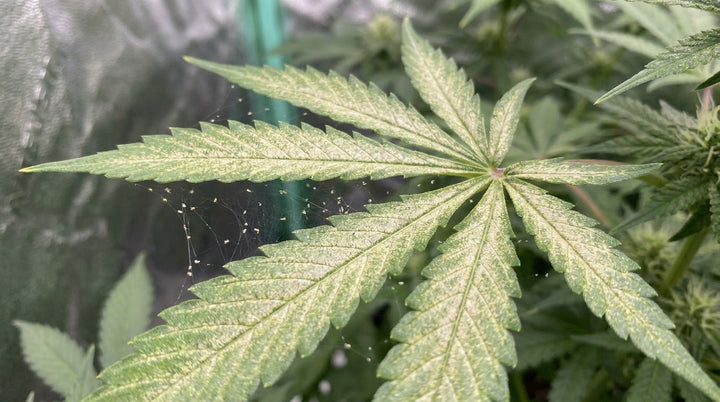
Spider mites are tiny sap-sucking mites, not insects, and they are the most common pest in indoor cannabis. The tell is a leaf covered in pale pinprick dots on its upper surface, with the mites themselves, their round eggs and later fine webbing on the underside. They breed fast, and they are famous for shrugging off any single spray. Our spider mite guide covers them in full, including the every-3-days spray schedule that actually clears them.

Broad mites and hemp russet mites: twisted new growth, nothing to see
These two are the pests growers most often blame on something else, because you cannot see them. Both are far smaller than spider mites. Cranshaw's review notes that hemp russet mites only become visible at extreme numbers, and then only as "a fine powdery material" on the leaf.2 Adrianna Szczepaniec and colleagues at Colorado State, testing sprays against it, describe a mite that feeds mainly on new growth and often exceeds a thousand mites on a single leaf.4
What you see is the damage. Broad mites leave the newest leaves at the tips small, twisted, puckered and oddly glossy, as if they were wet, and the growing tip stalls. Russet mites turn heavily infested leaves grayish or bronze, sometimes roll the leaf edges upward, and, once they reach the flowers, cut bud size and resin.2 Cranshaw adds a warning: that upward curl is not universal, and some cultivars curl like that with no mites at all.

If new growth looks twisted and glassy, check the pH and feed first, then go looking with the strongest magnification you have, at least 30x, on the newest leaves. If a 10x lens shows nothing, that is not a clean bill of health. In Szczepaniec's greenhouse trial, every product tested cut russet mite numbers within 10 days of the first spray, including rosemary oil and mineral oil, both of which have products on Colorado's cannabis list; outdoors, rosemary oil was one of only three that gave strong control.4
Aphids: sticky leaves, white skins, and ants
Aphids are soft, pear-shaped insects smaller than a sesame seed, 1.5 to 2 mm long, pale green, yellow or cream, with two tiny tailpipes at the back. They cluster on the undersides of leaves and along stems, and they breed without mating, so a colony builds quickly. The cannabis aphid, Phorodon cannabis, is a specialist on this plant. The signs are easier to spot than the aphids: white, empty shed skins scattered on the leaves, which look like tiny grains of rice, and a shiny, sticky coating called honeydew, the sugary waste aphids drip onto the leaves below them.

Honeydew is the bigger problem. McPartland notes that it feeds a black sooty mold that coats the leaves,1 and outdoors it draws ants, which farm aphids and defend them from predators. Cranshaw's review found that the cannabis aphid moves into maturing flowers and stays there through harvest, producing "abundant amounts of honeydew," and that aphids and their eggs end up in harvested flower.2

The best evidence for treating them on cannabis is recent. Daniel Lopez Restrepo and Igor Kovalchuk at the University of Lethbridge sprayed cannabis aphids with spores of two insect-killing fungi, Beauveria bassiana and Metarhizium anisopliae, and both killed every aphid within 10 days in the lab. In their greenhouse, Beauveria held aphid numbers near zero for nine weeks across three cultivars, and unlike the conventional insecticide they compared it with, it did not lower the plants' cannabinoid or terpene content.5 Beauveria is sold to home growers as BotaniGard and Mycotrol, and both are on Colorado's list.
Root aphids: a slow plant with nothing on the leaves
Root aphids are the reason a plant can decline for weeks while every leaf looks clean. The species in indoor cannabis is usually the rice root aphid. Whitney Cranshaw and Suzanne Wainwright-Evans found it on indoor cannabis in at least eight US states, living "almost entirely" on the roots, in soil, coco, rockwool and aeroponic systems alike.6 It produces no unique symptom: just a general decline and slower growth, sometimes with discolored lower leaves. That is exactly why it gets treated as a feeding problem for a month.
Their paper gives the one clue that points at the roots. The first sign most growers notice is dead winged aphids stuck on the hairs of the upper leaf surface, adults that flew up from the soil and got trapped. Yellow sticky cards catch them too.6 If you see small dead winged insects glued to your leaves and the plant is sulking, slide it out of its pot and look at the roots. Root aphids are small, round and dark olive to brown, 1.5 to 2 mm across, often packed in groups on the roots and at the base of the stem just under the soil line.
Move fast when you find them. The same paper cites a lab measurement, made on another crop, of the rice root aphid population doubling every 1.61 days at 77°F (25°C).6 Run that forward and 10 aphids become about 4,000 in two weeks if nothing checks them. They spread from older plants to new ones and through reused pots of soil that still hold live roots, which is one more reason our soil guide says never to reuse a mix after a serious pest problem.

Thrips: silver streaks and black specks
Thrips are slender insects, 1 to 1.5 mm long and shaped like a splinter, pale yellow to brown, that run or fly off when disturbed. They scrape the surface of the leaf and suck out what leaks, so instead of the separate dots spider mites leave, whole areas of the leaf go silvery, flecked with tiny black specks of their waste. McPartland noted they were becoming a problem in modern greenhouses using rockwool and hydroponics.1 Adults show up well on sticky cards, which is the easiest way to confirm them.

Fungus gnats: flies at the soil and a watering problem
Fungus gnats are the small, dark flies that walk on the soil and lift off when you water. They look like tiny mosquitoes, 2 to 3 mm long, no bigger than a grain of perlite, with long legs and clear wings, and they fly badly, so they stay near the pots. The adults do no harm. Their larvae do: translucent, legless worms about a quarter inch (6 mm) long with a shiny black head, living in the top of the mix.

Raymond Cloyd at Kansas State University reviewed what is known about them in greenhouses. The larvae eat mainly decaying plant material and fungi, but they also feed on healthy roots and tunnel into stems, and they spread root-rotting organisms such as Pythium and Fusarium; the adults carry spores of Botrytis, the gray mold behind bud rot.7 An established plant shrugs off a few larvae. A seedling or a fresh clone with a small root system does not.
The cause is almost always water. Cloyd's review ties big gnat populations to standing water and algae on the growing medium, and recommends well-drained mixes and not overwatering.7 A pot that never dries at the surface is a nursery. Water by the pot's weight, as our watering guide explains, letting the pot lose about half the weight it gained at its last watering before you water again, and the top of the mix dries between waterings and the cycle breaks.

To check for larvae, lay a thin slice of raw potato face down on the soil for a day or two, then flip it. Larvae come up to feed on it. It is a quick way to tell whether the flies you see are breeding in your pots.

Whiteflies: a white cloud when you shake a branch
Whiteflies are tiny moth-like insects, 1 to 1.5 mm long, with powdery white wings that rest on the undersides of leaves and rise in a small cloud when you move a branch. Their young are flat, pale, oval scales stuck to the underside of the leaf that barely look alive. Like aphids, they drip honeydew, so the leaves below them get sticky and can go black with sooty mold. Cranshaw's team observed the sweetpotato whitefly as a serious pest on indoor cannabis, though they had not seen whiteflies developing in hemp fields.2

Caterpillars and budworms: a brown tunnel in a bud
Outdoors, this is the pest that ruins harvests. The corn earworm, also called the cotton bollworm or tomato fruitworm, lays eggs on the plant in late summer, and its caterpillars, as Britt's review puts it, "feed little on foliage and concentrate feeding on flower buds."3 They tunnel into a cola, leave dark droppings called frass that look like coarse black pepper, and the wound they make lets mold in: the review notes that feeding wounds "predispose buds to rot, particularly in humid climates."

By the time you see a caterpillar, the bud is usually damaged. What you look for is the first sign: a single brown or dead-looking patch in an otherwise healthy cola, or frass on the buds and the leaves under them. Pull the bud gently open and you will usually find the tunnel. Britt's team surveyed 18 hemp fields across five states and found an average peak of 7.2 larvae per 30 buds, against a damage threshold they put at 2.5 per 30 buds.3 A backyard plant does not need a formal count, but it does need someone looking inside the colas every few days from mid flower on.
Bugs That Are Not Pests: Springtails, Soil Mites and the Good Guys
Not everything that moves in a grow is eating your plant. Some of the most alarming finds are harmless, and a few are on your side. Spraying them wastes a week and, in the case of predators, kills your free help. These are the ones growers most often mistake for pests.
| What you see | What it is | What to do |
|---|---|---|
| Tiny pale gray or white specks on wet soil or floating on runoff water, that jump when disturbed | Springtails | Nothing. Let the pot dry back more between waterings if there are a lot |
| Tiny round tan or white mites walking through the soil, never on the leaves | Soil mites, common in organic and living soils | Nothing. Check the leaf undersides to be sure they are not spider mites |
| A dark, spiky, alligator-shaped insect with orange spots on a leaf or stem | A lady beetle larva, eating aphids | Leave it, and look for the aphids it found |
| A fast, shiny, pear-shaped orange or tan mite among slower spider mites | A predatory mite | Leave it, and hold off on sprays that would kill it |
| A small spider or a thin web with a spider in it | A spider, which eats flying pests | Leave it. Spider mite webbing is a fine sheet over leaves and buds with many moving dots in it, not one spider |
Springtails cause the most false alarms. Whitney Cranshaw's Colorado State University fact sheet describes them as pinhead-sized, around 1.5 mm long, wingless, usually gray or pale, and able to jump with a forked spring folded under the body, which is why they are sometimes called "jumping dirt." They live wherever there is moisture and organic matter and feed on fungi, algae, decaying plant matter and bacteria. In potted plants, the fact sheet says, they are most often noticed just after watering, when they come up from the saturated soil to the surface, sometimes floating on pooled water in a raft, and they "do very little, if any, damage."8

The way to tell springtails from the pests they get confused with is where they are and how they move. Springtails are on the soil or the runoff water and they jump. Fungus gnat larvae are in the soil, are much longer, and have a black head. Root aphids sit still on the roots. Spider mites are on the leaves. A lot of springtails tells you one useful thing, the same thing fungus gnats do: the pot is staying too wet. Cranshaw's advice is to let the soil dry down a bit more between waterings, and they fade.8
How to Scout: A Ten-Minute Weekly Check
Every pest above is cheap to deal with at ten and expensive at ten thousand. The weekly check is what keeps you at ten. Do it on the same day every week, from the first week of veg to harvest, and before any new plant comes into the room.

- Read your sticky cards. Hang one yellow sticky card just above the canopy in every tent, and stand another in a pot just above the soil. Look at them first, before you touch a plant: they tell you what is flying. Swap them when they get too crowded to read.
- Check the newest growth. Look at the tip of every main branch for twisted, glossy or stalled new leaves.
- Turn over ten leaves. Pick leaves from the top, middle and bottom of each plant and look at the undersides with a 10x to 30x loupe, for mites, eggs, aphids and whitefly scales.
- Tap a branch over white paper. Specks that walk are mites or insects. Specks that sit still are dust.
- Look at the soil and the leaf surfaces. Flies at the soil, sticky leaves, silver streaks, and dead winged insects stuck to leaves each point to a different pest from the list above.
- From mid flower, look inside the biggest colas. Outdoors, look every few days for brown patches and frass.

Card color matters more than most guides admit. Yellow cards catch fungus gnats, whiteflies, winged aphids and thrips. For thrips, Robert van Tol and colleagues in the Netherlands found that the glue changes the answer: with clear glue, western flower thrips preferred yellow cards, but a whitish glue cut their attraction to yellow by 58% and raised it to blue by 65% in a wind tunnel, and the same shift held in two greenhouses.9 If you have thrips, add a blue card beside the yellow one and see which fills faster.

How to Get Rid of Pests on Cannabis, Step by Step
The steps are the same for every pest. What changes is the product in Step 5 and the predator in Step 6, both covered in the tables below.
Step 1 - Identify the pest by where the damage is
Use the map and the list above to get down to one or two suspects before you buy or spray anything. A spray for the wrong pest is a week lost, and some products that work on insects do nothing to mites.
Step 2 - Confirm it with a loupe, a sticky card or the roots
See the pest itself: mites and aphids under a loupe, flying pests on a card, gnat larvae under a potato slice, root aphids on the roots. If a plant is declining and every leaf is clean, check the roots before you change the feed.
Step 3 - Isolate the plant and check your stage
Move a badly infested plant away from the others if you can. Then check where you are in the grow, because it decides what you may spray. In veg you can spray the whole plant. In weeks 1 to 4 of flower, spray leaves only, never the flowers, and make the last spray on day 28. From week 5 of flower to harvest, spray nothing. That is the same window our powdery mildew guide uses, so one calendar covers both.

Step 4 - Remove what you can by hand
Strip and bag the worst leaves, pick caterpillars out of buds, wipe aphid colonies off stems, and knock whiteflies and aphids off with a strong spray of plain water before you treat. Bag leaves inside the tent and carry the bag straight outside, so you do not shake pests across the room. In flower, remove any bud a caterpillar has tunneled into.

Step 5 - Treat with a product on your state's list, on the pest's schedule
Use only products your state or province allows on cannabis, and follow the label rate. Spray the undersides as well as the tops, with the lights off, since most of these pests live underneath. One spray never clears an infestation, because eggs survive it: repeat on the pest's cycle, every 3 days for 12 days for spider mites, and alternate two products that work in different ways so the survivors do not breed resistance.

Step 6 - Add predators once numbers are down
Beneficial insects, mites and nematodes are the one tool you can keep using through late flower. Release them after a knockdown spray, not before, and check that nothing you sprayed in the last few days will harm them. The predator for each pest is in the table below.
Step 7 - Recheck weekly and keep the cards up
Go back to the weekly check. A clean week is not the end: one missed egg batch restarts the whole thing. Keep the cards up until harvest, and treat any new find as Step 1 again.

What to Use on Each Pest
This table puts the first move, the products and the predator for each pest in one place. Product names are examples of what is sold with that active ingredient in the United States; check each one against your own state's or province's list before you buy.
| Pest | First move | Sprays to consider (veg, early flower) | Predator or biological |
|---|---|---|---|
| Spider mites | Remove the worst leaves, start the 3-day schedule | Insecticidal soap, Burkholderia (Venerate), azadirachtin in veg | Phytoseiulus persimilis predatory mites |
| Broad and russet mites | Confirm at 30x or stronger on the newest leaves | Rosemary oil or mineral (horticultural) oil, insecticidal soap | Ask your supplier for a predator sold for broad or russet mites |
| Aphids | Wipe or wash off colonies, control ants outdoors | Insecticidal soap, Beauveria bassiana (BotaniGard, Mycotrol), azadirachtin | Lady beetles, lacewing larvae, aphid parasite wasps |
| Root aphids | Check the roots of every plant, never reuse that soil | Beauveria bassiana as a root drench, where the label allows it | Insect-killing fungi, per Cranshaw and Wainwright-Evans |
| Thrips | Yellow and blue cards, remove silvered leaves | Insecticidal soap, Beauveria bassiana, azadirachtin | Predatory mites sold for thrips |
| Fungus gnats | Let the pot dry back between waterings | None needed on the leaves; cards for the adults | Stratiolaelaps scimitus soil mites, Steinernema feltiae nematodes, the rove beetle Dalotia coriaria |
| Whiteflies | Vacuum or wash adults off, yellow cards | Insecticidal soap, Beauveria bassiana, azadirachtin | Predatory mites or parasite wasps sold for whiteflies |
| Caterpillars | Pick them out, remove tunneled buds | Bt kurstaki, before they are inside the buds; largely ineffective on corn earworm | Birds and wasps outdoors; hand-picking |
Some things belong on nobody's list for this plant. Abamectin (Avid) and bifenazate (Floramite) are synthetic miticides that are not allowed on cannabis, and our spider mite guide explains why. Spinosad, however natural its origin, was not on Colorado's list when we checked, and Britt's review says it is not approved for hemp.3 Neem oil and other oils go on leaves in veg only, never on flowers. And a product that a forum swears by but that no regulator has listed for cannabis is a guess with your harvest attached.
Beneficial Insects: Which Predator for Which Pest
Predators are the only pest control that keeps working after the spray window closes, and indoors, in a closed tent, they stay where you put them. Beneficial insects, mites and nematodes are living organisms rather than pesticides, so they do not appear on pesticide lists at all. Buy them from a supplier that ships live, release them the day they arrive, and match the predator to the pest.

For aphids, lady beetles and their alligator-shaped larvae are the familiar ones, and lacewing larvae and tiny parasite wasps that lay their eggs inside aphids do the same job in a tent. For spider mites, Phytoseiulus persimilis is the specialist, released against a count as our spider mite guide explains. For fungus gnats, Cloyd's review lists three that work in the soil: the predatory soil mite Stratiolaelaps scimitus (sold under its old name, Hypoaspis miles), the nematode Steinernema feltiae, and the rove beetle Dalotia coriaria.7 The same review found that a layer of sand or diatomaceous earth on the soil did nothing to stop adult gnats emerging, so skip that trick.

In the United States, ARBICO Organics, Nature's Good Guys, Tip Top Bio-Control and Buglogical sell predators to home growers; in Canada, Koppert does. Ask them which predator they recommend for your pest and your room temperature, since several of these work best in a set range.

Pests in Flower: What You Can Still Do, and When to Bin a Bud
Pests found in the first four weeks of flower get the same plan as veg, with leaf-only sprays that stop on day 28. From week 5 on, the plan changes: no sprays at all, only hand removal, bagged leaves, predators and scouting every few days. If a late infestation is spreading and the trichomes are close to the window in our harvesting guide, take the plant. A few days of ripening is not worth losing the colas.
On the buds themselves, here is what we do. Nobody has measured the health effects of smoking flower that had insects in it, so these are our rules, not a study's.
- A bud with a caterpillar tunnel or frass in it goes in the bin. Remove it and look closely at the buds around it. If you see any gray fuzz, our bud rot guide takes over: the whole bud and the buds touching it go.
- A bud with an aphid colony or sticky honeydew inside goes in the bin. The aphids, their skins and their eggs stay in the flower through drying, as Cranshaw's review found.2
- A bud with spider mite webbing through it goes in the bin, as our spider mite guide explains.
- Damage on fan leaves alone does not ruin the harvest. Silvered, stippled or sticky fan leaves get trimmed off. Check the buds under a loupe during the trim, and dry them as normal.
None of those buds get washed back into the harvest or made into extract. And do not dry an infested harvest in the room where your next crop is growing.
How to Keep Pests Out of Your Grow
Almost every indoor infestation walked in. Pests do not appear from nowhere in a sealed tent; they arrive on a new plant, on your clothes, on a pet, or in a bag of soil. These habits keep them out, in order of how much they matter.
- Quarantine every new plant for 14 days. Keep new clones and plants in a separate room from your tent for 14 days and check them with a loupe on day 0, day 7 and day 14, as our cloning guide and our mildew guide both advise. Clones are the most common way pests arrive, and nursery pots like BudCups let you slide out and check a young plant's root ball without harming it.
- Visit your grow first, not last. If you have been in a garden or someone else's grow room, change your clothes before you open your tent. Keep pets and houseplants out of the grow room.
- Keep the cards up and scout every week. The ten-minute check above, from seedling to harvest.
- Water by weight. A pot that dries back between waterings starves fungus gnats and keeps roots healthy.
- Keep the canopy open. You cannot scout or spray what you cannot reach. A plant trained flat in veg with its lower growth cleared lets you see every underside. Low-stress training with BudClips spreads the branches out, our training guide covers the whole routine, and our defoliation guide covers the clearing.
- Use fresh soil for every grow unless you know the last one was clean. Root aphids and gnat larvae ride along in reused mix.
- Clean the tent between grows. Empty it, wipe the walls, floor and fixtures, and wash or replace anything the last crop touched.


Outdoors you cannot seal the room, so scouting does the work. Walk the plants weekly and look under the leaves, and from mid flower look inside the colas every few days for caterpillar damage. Our outdoor growing guide covers picking a site and a cultivar that suit your climate.

Frequently Asked Questions
What are the most common pests on cannabis?
Indoors, spider mites, broad and russet mites, aphids, whiteflies, thrips, fungus gnats and root aphids. Outdoors, add caterpillars such as the corn earworm, which Colorado State researchers rank as the pest with the greatest potential to damage the crop. Nearly 300 insects have been recorded on cannabis, but very few of them cause real losses.
What are the tiny black bugs on my weed plants?
If they fly around the pots and walk on the soil, they are almost certainly fungus gnats, which breed in soil that stays wet. If they are on the leaves and the leaves have silver streaks, they may be thrips. Dead winged insects stuck to the tops of the leaves of a slow-growing plant can be root aphids, so check the roots.
What are the small white bugs on my cannabis leaves?
Tiny white moth-like insects that fly up when you shake a branch are whiteflies. Small white flecks that do not move are often shed aphid skins, a sign of an aphid colony nearby. Pale, slow-moving specks on the undersides can be spider mites or young aphids. Look with a 10x to 30x loupe to tell them apart.
How do I get rid of bugs on my weed plants naturally?
Identify the pest first, remove the worst leaves and any insects you can by hand, then treat with a product your state allows on cannabis, such as insecticidal soap, a Beauveria bassiana spray or, in veg only, azadirachtin or neem. Repeat on the pest's cycle, then release predators that eat that pest. Sprays stop on day 28 of flower.
Is Captain Jack's Deadbug Brew safe for cannabis?
Its active ingredient is spinosad, and when we checked Colorado's list of pesticides allowed on cannabis on 29 September 2026, it held no spinosad product at all. A national review of hemp pests also lists spinosad as not approved for hemp. We do not recommend it. Use a product your own state or province lists for cannabis.
Can I use neem oil on my cannabis plants?
In veg, yes, and azadirachtin, the active compound in neem, is on Colorado's cannabis list in 19 products. Never spray neem oil or any other oil on flowers: what is sprayed on a bud stays in it and ends up in the smoke. Stop all sprays on day 28 of flower, and spray leaves only after the flip.
How do I get rid of fungus gnats in my weed plants?
Fix the watering first. Let the pot lose about half the weight it gained at its last watering before you water again, so the top of the mix dries out between waterings. Add yellow sticky cards for the adults, and soil predators such as Stratiolaelaps scimitus mites or Steinernema feltiae nematodes for the larvae. A layer of sand on the soil does not stop them.
What do root aphids look like on cannabis?
Small, round, soft-bodied aphids, dark olive to brown, packed in groups on the roots and at the base of the stem just below the soil. Above ground, the plant just declines slowly with no clear symptom. The clue most growers notice first is dead winged aphids stuck to the hairs on the upper surface of the leaves.
How do I get rid of caterpillars on my weed plants?
Look inside the colas every few days from mid flower for brown patches and dark crumbs of frass, pick out every caterpillar you find, and remove any bud it has tunneled into. Bt kurstaki only works on caterpillars that eat it before they are inside a bud, and a national review found it has largely stopped working on the corn earworm.
Are springtails bad for cannabis plants?
No. Springtails are pinhead-sized pale specks that jump on wet soil or float on runoff water. They feed on fungi, algae and decaying matter, and a Colorado State University fact sheet says they do very little, if any, damage to potted plants. Large numbers mean the pot is staying too wet, so let it dry back more between waterings.
Can you smoke weed that had bugs on it?
Buds are fine if the damage was only on the fan leaves; trim those off and dry as normal. We bin any bud with a caterpillar tunnel or frass inside, an aphid colony or sticky honeydew, or spider mite webbing through it, and never wash those buds back into the harvest. No study has measured the effects of smoking insect-contaminated flower.
Do sticky traps get rid of pests?
No, they find them. Sticky cards catch flying adults such as fungus gnats, whiteflies, winged aphids and thrips, which tells you what is in the room and whether it is growing. They do not touch mites, larvae or anything that stays on the leaves. Use them as your early warning, alongside the weekly leaf check.
Can pests come in on clones?
Yes, and clones are the most common way pests reach an indoor grow. Keep every new clone or plant in a separate room for 14 days and check the leaves, both sides, with a loupe on day 0, day 7 and day 14 before it goes near your tent. Check its roots when you transplant it, too.
What is the hardest pest to get rid of on cannabis?
Spider mites, broad mites and root aphids, for different reasons. Spider mites breed resistance to any product you lean on. Broad and russet mites are invisible without strong magnification, so they spread before anyone notices. Root aphids live where you cannot see them and look like a feeding problem. All three reward a weekly check.
Where to Go From Here
If you found spider mites, go straight to the spider mite plan. If the problem turned out to be a white powder, it is a fungus, and our mildew guide has the plan. If the leaves are yellowing or spotted with no pests at all, start with the deficiency guide, and if the problem is watering, our watering guide has the weight method. For a clean start next grow, our indoor growing guide sets up a tent that pests find hard to live in.
References
- McPartland, J. M. (1996). Cannabis pests. Journal of the International Hemp Association, 3(2), 49, 52-55. http://www.internationalhempassociation.org/jiha/iha03201.html (archived copy)
- Cranshaw, W., Schreiner, M., Britt, K., Kuhar, T. P., McPartland, J., & Grant, J. (2019). Developing insect pest management systems for hemp in the United States: A work in progress. Journal of Integrated Pest Management, 10(1), 26. https://doi.org/10.1093/jipm/pmz023
- Britt, K. E., Kuhar, T. P., Cranshaw, W., McCullough, C. T., Taylor, S. V., Arends, B. R., Burrack, H., Pulkoski, M., Owens, D., Tolosa, T. A., Zebelo, S., Kesheimer, K., Ajayi, O. S., Samuel-Foo, M., Davis, J. A., Arey, N., Doughty, H., Jones, J., Bolt, M., Fritz, B. J., Grant, J., Cosner, J., & Schreiner, M. (2021). Pest management needs and limitations for corn earworm (Lepidoptera: Noctuidae), an emergent key pest of hemp in the United States. Journal of Integrated Pest Management, 12(1), 34. https://doi.org/10.1093/jipm/pmab030
- Szczepaniec, A., Lathrop-Melting, A., Janecek, T., Nachappa, P., Cranshaw, W., Alnajjar, G., & Axtell, A. (2024). Suppression of hemp russet mite, Aculops cannabicola (Acari: Eriophyidae), in industrial hemp in greenhouse and field. Environmental Entomology, 53(1), 18-25. https://doi.org/10.1093/ee/nvad052
- Lopez Restrepo, D., & Kovalchuk, I. (2025). Entomopathogenic fungi effectively control Phorodon cannabis aphid population in Cannabis sativa plants. Plants, 14(6), 931. https://doi.org/10.3390/plants14060931
- Cranshaw, W., & Wainwright-Evans, S. (2020). Cannabis sativa as a host of rice root aphid (Hemiptera: Aphididae) in North America. Journal of Integrated Pest Management, 11(1), 15. https://doi.org/10.1093/jipm/pmaa008
- Cloyd, R. A. (2015). Ecology of fungus gnats (Bradysia spp.) in greenhouse production systems associated with disease-interactions and alternative management strategies. Insects, 6(2), 325-332. https://doi.org/10.3390/insects6020325
- Cranshaw, W. (2007, reviewed 2025). Springtails (Fact Sheet 5.602). Colorado State University Extension. https://extension.colostate.edu/resource/springtails/
- van Tol, R. W. H. M., Tom, J., Roher, M., Schreurs, A., & van Dooremalen, C. (2021). Haze of glue determines preference of western flower thrips (Frankliniella occidentalis) for yellow or blue traps. Scientific Reports, 11, 6557. https://doi.org/10.1038/s41598-021-86105-5

About the Author
Henrique Dias is the CEO and co-founder of BudTrainer. He is a mechanical engineer who also holds a graduate certificate in Commercial Cannabis Production from Niagara College in Ontario, Canada - the first college-level cannabis cultivation program in North America. Before founding BudTrainer, Henrique worked with Health Canada licensed cannabis producers, where he gained hands-on experience in cultivation, processing, and post-harvest management of cannabis at commercial scale. He started BudTrainer to bring that same level of craft to home growers through better-designed gardening tools and clear, science-backed education.
DISCLAIMER: Everything taught and sold by BudTrainer® is to be used strictly for legal purposes. We do not endorse the production of illegal substances and it is your duty to ensure that you are complying with the law. The words "hemp," "cannabis," "weed," and "marijuana" are used interchangeably to refer to the same plant (legal hemp with less than 0.3% THC) for the purposes of this lesson.