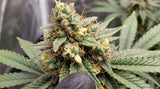
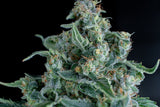
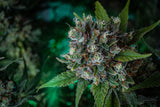
Purple buds photograph beautifully, so the internet is full of ways to force the color: ice water on the roots, cold nights, a few days of darkness, starving the plant of phosphorus, pushing the pH around. The cannabis research we found points to genetics first. A plant without the genes stays green whatever you do to it, and a plant with them colors up on its own, more or less depending on temperature and light.
Purple on a plant you are growing is usually not a sign that something is wrong, and the section on purple leaves and stems below shows how to tell the harmless kinds from the one that needs attention.
What Makes Weed Purple
The purple, red and pink in cannabis come from anthocyanins (say an-tho-SY-a-nins), water-soluble pigments that plants store in the sap of their cells. Chlorophyll makes a leaf green. A plant that makes anthocyanins as well lays red to purple on top of the green, and where the green fades, the purple takes over.
Laura Bassolino and colleagues at CREA, Italy's agricultural research council, identified which anthocyanins cannabis makes, in hemp lines grown in a field in Bologna. The main one, present in every sample where they found anthocyanins, was cyanidin-3-rutinoside (also called keracyanin), with smaller amounts of cyanidin-3-glucoside and two peonidin pigments.1 Kristina Gagalova and colleagues, most of them at the University of British Columbia, found the same leading pigment in four drug-type cultivars (grown for flower) from a licensed producer, and found no delphinidin pigments at all, the branch of the family that turns many flowers blue.2 That is why cannabis runs from pink through red to deep plum and never to true blue, whatever a strain name promises.
The amounts can be large. In one purple hemp line, Bassolino measured about 1,187 mg of anthocyanins per 100 g of fresh purple leaf against 3 mg in a green leaf from the same line, and 360 mg against 5 mg in purple and green flowers.1 Those purple leaves held far more of the pigment than black currants, the richest fruit source of it in the food database the authors checked.

Where the purple shows
Anthocyanins can show up almost anywhere on the plant. Bassolino found them in leaf stems (petioles), main stems, fan leaves, and in both female and male flowers.1 On a bud, the color sits in the bracts, the small teardrop-shaped pods that stack up into the bud (most growers call them calyxes), and in the sugar leaves, the small resin-dusted leaves that poke out between them. The diagram below names the parts we refer to in the rest of this guide.

The color is not always where you want it. Some plants turn their sugar leaves a dark purple-brown while the bracts stay pale green under the frost, which is what the plants in our own tent below did. Others color the whole bud, bracts and all, and some color only their leaves and stems and leave the buds green, which the genetics section explains.

When the whole bud does color, it usually reads as a dusky plum showing through the white frost of the trichomes, mixed with green. Bright, even, neon purple in a photo is often a filter, a colored grow light or a heavy hand with the saturation slider.

Red pistils are not purple weed
The thin hairs sticking out of a bud are pistils, the part of the female flower that catches pollen. They start white and turn orange, red or brown as the flower ages. That is normal maturing: Zamir Punja and Janesse Holmes describe the pistils browning and reddening around weeks 5 and 6 of flower in the cultivars they followed, and red or purple pistils and bracts in some strains where pigment was a feature of the cultivar.4 Rusty pistils on a green bud are a supporting harvest cue at most, and our harvesting guide explains why the trichomes decide.

Purple Is in the Genes
The strongest evidence that purple is genetic is also the simplest: plants grown side by side do not match. Gagalova's team studied four drug-type cultivars raised by a licensed producer in British Columbia, under the same LED lights and, in veg, at 72 to 75°F (22 to 24°C). Three turned red and purple in their leaves and leaf stems. The fourth, Willow-alpha, showed no red or purple at all, even in its leaf stems, and held the least anthocyanin of the four. The genes of the anthocyanin pathway ran far more strongly in the three colored plants than in the green one.2

Breeding shows the same thing from the other side. Sean Kim and colleagues in Shelby Ellison's lab at the University of Wisconsin-Madison started with a CBD autoflower (a plant that flowers on its own clock, whatever the day length) and self-pollinated it for three generations until every plant turned purple, leaves and flowers, about three weeks into flower, even in warm conditions of 77 to 86°F (25 to 30°C).3 Heat can tone the color down, as the research section below shows. It did not stop it in a line bred for it.
Where the trait sits
Two separate groups have mapped purple in cannabis, and they landed in the same place. Carter Prillaman's master's thesis in the same Wisconsin lab scored 355 plants from a cross between two CBD cultivars and found a region on chromosome 6 that explained about two thirds of the variation in flower color. The region holds a gene called CsMYB78, from a family of switch genes that turn anthocyanin production on in many plants, though when Prillaman added an extra, always-on copy of it to cannabis plants in the lab, they did not turn visibly purple, while plants given a related gene, CsMYB33, did.5 A patent filed by the cannabis breeding company Puregene, which scored 3,220 plants on their dried, trimmed top buds, points to an overlapping stretch of the same chromosome and names the same gene among its candidates.6 Neither document has been through peer review, so treat the details as a strong lead that still needs confirming.
The patent also describes purple as dominant: one copy of the purple version of the gene (one allele, in genetics terms) can be enough to show the color, though plants carrying one copy were less purple than plants carrying two.6
Purple leaves, green buds
Prillaman's plants mapped leaf and stem color to a different chromosome than flower color, chromosome 1.5 If that holds up, it explains something every grower has seen: a plant with dark purple leaves and plain green buds, and the reverse. Our own outdoor plant below, grown in a 15 gallon (57 L) BudPot, colored its fan leaves deep purple from top to bottom early in flower, while its young buds were still pale green.

So if purple buds are what you are after, judge a cultivar by photos of its finished buds, not its leaves. A plant that colors only its fan leaves gives you a striking plant in the garden and a pile of purple trim at harvest, and the buds you jar look like anyone else's.

Why seeds from a purple plant do not all come out purple
Most cannabis seeds come from crossing two different parents, so sisters from one seed pack carry different combinations of genes. In the patent's two test families, each bred from a purple parent crossed with a green one and then self-pollinated (second-generation families, called F2 by breeders), 101 plants scored purple and 41 green, and 83 purple against 30 green: roughly seven in ten purple.6 A seed pack sold as purple can still give you a green plant or two. A rooted cutting from a purple plant, a clone, carries exactly its mother's genes, which our cloning guide explains.
What the Research Says About Cold and Purple
Almost every guide on page one says cold nights turn weed purple. We found one controlled trial that tested temperature against anthocyanin in cannabis, and its result is narrower than the folklore.
The Wisconsin temperature trial
Kim and colleagues moved small plants of their purple CBD line into growth chambers about two weeks into flower and held them there for 30 days at a constant 33, 39, 46, 59 or 72°F (0.5, 4, 8, 15 or 22°C), under the same white LEDs for 16 hours a day (an autoflower does not need 12 hours of darkness to flower). In the second run they added two treatments that switched every day between 72°F (22°C) and 39°F (4°C): 5 or 15 warm hours, always inside the 16-hour light period, and cold for the rest of the day.3
The most purple came at a constant 46°F (8°C) and 59°F (15°C): three to five times the anthocyanin of plants kept at 72°F (22°C). Near freezing, at 33°F (0.5°C), the plants made almost none.3

Warm days and cold nights
The treatment closest to the popular advice ran 72°F (22°C) for 15 hours and 39°F (4°C) for the other 9. It averaged more anthocyanin than a steady 72°F (22°C) in the same run, 33 against 18 mg per liter of extract, but the difference was not statistically significant, and it fell significantly short of the constant 46°F and 59°F (8 and 15°C) rooms.3
No trial has tested the drop a home grower can make: a lights-off temperature of 65 to 73°F (18 to 23°C) after a 75 to 78°F (24 to 26°C) day. Nobody knows whether a drop that size moves the color, and Kim's line was bred to turn purple anyway.
What the cold cost
The cool rooms bought color and slowed the plants down. Each 1°C (1.8°F) warmer added about 0.05 g of dry flower per plant and 0.09 percentage points of CBD: the plants at 72°F (22°C) averaged about 2.1 g of flower and 5.2% CBD, those at 46°F (8°C) about 1.4 g and 3.4%.3 The authors put the losses down to slower maturing in the cold.

For a home grow, the temperatures that made the most purple sit far below the flowering band. Our flowering stage guide puts the floor at 65°F (18°C), because below it bud density suffers and ripening drags. Chilling a tent toward 50°F (10°C) to chase color would cost flower, and in a humid tent it invites mold.
What grapes and lettuce add
Fruit and leaf crops have far more temperature research than cannabis, and on one point those trials agree: heat cuts anthocyanin. Kentaro Mori and colleagues found Cabernet Sauvignon grapes held to a 95°F (35°C) daily maximum made less than half the anthocyanin of grapes held to 77°F (25°C), partly because the pigment broke down faster in the heat.7 In red-leaf lettuce, Aparna Gazula and colleagues measured the most anthocyanin at 68°F (20°C) day and night, less with 86°F (30°C) days and 68°F (20°C) nights, and the least at 86°F (30°C) around the clock. Cool nights softened the damage of hot days without matching steady cool.8
For a tent, the advice with evidence behind it is to keep the tops of a purple cultivar from running hot.
Light and UV
Light plays a part too, though the cannabis evidence is thin. Willy Contreras-Avilés and colleagues at Wageningen University added a small dose of UV-B light for 3 hours a day, from two weeks into flower, to a cultivar with balanced THC and CBD. The glandular trichomes on its bracts took on a magenta tint and one unidentified anthocyanin-like compound rose, while THC and CBD did not change.9 We still do not recommend UV-B: in a University of Guelph trial by Victoria Rodriguez-Morrison, David Llewellyn and Youbin Zheng, UV-B through flowering cut top-cola flower by 78 and 69% in two cultivars, as our trichome guide details.
Scott Golem, a former master grower for licensed producers who reviews several of our guides, sees some cultivars' leaf stems go purple under LED lights more often than under high-pressure sodium lamps, as recorded in our cannabis deficiencies guide. No trial has tested it, and it covers leaf stems only.
Is Purple Weed Stronger?
Nobody has shown that it is, and the closest thing to a test found color and CBD running on separate tracks. We found no study comparing THC, total cannabinoids or terpenes between purple and green plants of the same cultivar, or between purple and green cultivars of the same chemical type grown side by side.
In both of Kim's runs, anthocyanin did not correlate with CBD: the authors report no relationship, and our own recalculation from their published raw data gives correlations of 0.16 and 0.02, where 1 would be a perfect match and 0 none at all.3 That is one CBD line; no THC cultivar has been tested. Gagalova's four cultivars do not answer it either. The green one happened to carry the most THCA (the acid form of THC in fresh flower), but the four were different chemical types, from high-THC to high-CBD, so the comparison says nothing about color.2


The plant chemistry fits. THC, CBD and most terpenes are made and stored in the resin heads of the glandular trichomes. Anthocyanins come from a separate pathway, the flavonoid pathway, and are held in the sap of plant cells. Two equally frosty buds, one purple and one green, give no clue which is stronger, and our trichome guide makes the same point about frost and potency: only a lab test ranks strength.
Nor is purple a sign of how well a plant was grown: a well-run tent and a cold garage can both bring it out in a plant with the genes for it.
Does the color survive drying and curing?
We found no study that followed anthocyanins through drying and curing in cannabis. There are two clues that the color lasts: the Puregene patent scored purple on dried, trimmed buds, so the color was still there to score after drying, and Kim measured anthocyanin in freeze-dried flower.63 Dried purple buds usually look darker and duller than they did on the plant, because the whole bud darkens as it dries.

Dry and store purple buds the way you would any buds: dark, cool and at the right humidity. Our storage guide explains why light is the worst thing you can do to a jar of weed, whatever color is inside it.
Purple Leaves and Stems: Genetics, Cold or a Problem?
Most purple on a growing plant is harmless. Where it shows, when it shows, and what comes with it tell you which case you have, and only one of them calls for doing anything.
The most common case looks like the young plant below: healthy green leaf blades on wine-red leaf stems, on a plant that is growing fast. That is genetics, sometimes helped along by cool weather, and it needs nothing from you.

The table sorts the rest by where the color shows and what comes with it.
| What you see | Where | What it usually means | What to do |
|---|---|---|---|
| Purple leaf stems, healthy green leaves, fast growth | Leaf stems and main stem, any stage | Genetics, sometimes helped along by cool weather or LED light | Nothing |
| Purple leaf stems plus olive-green, sunken spots on the lower leaves and slow growth | Old, lower leaves first | Possible phosphorus shortage or lockout | Check pH first, then read the phosphorus section of our deficiencies guide |
| Fan leaves fading to yellow, orange, red or purple | Fan leaves, from the bottom up, in the last weeks of flower | The normal end-of-flower fade | Nothing near harvest; check feeding if it starts before mid-flower |
| Purple bracts and sugar leaves | Buds | Genetics | Enjoy it, and harvest on the trichomes |
| Orange, red or brown pistils | The hairs on the buds | Normal aging of the flower | Read the trichomes |
The drawing below shows four of them side by side. The second, purple stems with spotted lower leaves, is the only one that ever changes what you do, and even then, the pH check comes before any change to the feed.

Purple stems and phosphorus
Purple stems are the most repeated phosphorus symptom online and the weakest. In Paul Cockson's controlled deficiency trial, the one our deficiencies guide is built on, phosphorus-starved cannabis grew olive-green, sunken spots on its lower leaves, and the authors reported no purple.10 In a University of Guelph flowering trial by David Llewellyn, Max Jones and Youbin Zheng, with Scott Golem of the licensed producer HEXO, leaving phosphorus out of the feed entirely produced only "moderate purpling in leaf petioles", while cutting fresh flower weight from 1,110 g to 406 g, a 63% loss.11

So purple leaf stems on a vigorous plant are not a reason to add phosphorus. Our phosphorus deficiency section shows the full picture, and the pH check that comes before any change to the feed, since a root zone out of range can lock phosphorus out of a well-fed plant.
Purple at the end of flower: the fade
In the last weeks of flower, fan leaves on many plants turn yellow, and on some they turn red and purple. That is senescence, the leaf breaking down its chlorophyll as the plant winds down. Llewellyn's fully fed control plants yellowed from week 6 of flower with no deficiency at all.11 Danilo Crispim Massuela and colleagues saw red and purple arrive only once a leaf's chlorophyll was nearly gone, at chlorophyll meter (SPAD) readings below 10, and more of it in plants given less fertilizer.12

Tree research adds a detail. The yellow in a fading leaf was there all along, hidden under the green. The red and purple were not: David Lee and colleagues found those anthocyanins absent from summer-green leaves and made new during senescence, once most of the chlorophyll had gone.13

If the fade starts before mid-flower, while the buds are still small, treat it as hunger and check pH and feeding against our deficiencies guide. Near harvest, leave the fading leaves alone: they are not a ripeness signal, and the trichomes still decide when you cut.
How to Grow Purple Weed, Step by Step
These are the steps we would follow, in order. The first one matters most.
Step 1 - Choose a cultivar bred for purple buds
Buy for the trait you want, judged from photos of finished buds. Cultivars sold as purple, such as Granddaddy Purple, Purple Kush or Purple Punch, are bred and selected for color, but a name guarantees nothing, and as the patent's families showed, seeds with a purple parent can still throw green plants. Our friends at Seed Supreme keep a purple cannabis seeds section, and our seed guide covers feminized, regular and autoflower seeds. Autoflowers can be purple too: Kim's line was one.
Look closely at what is purple in a seller's photos. On one of our own plants, the leaves around the cola went dark purple while the buds stayed pale green and white: a purple plant without purple buds.

Step 2 - Keep a cutting of the purplest plant
If you grow from seed, start a few more plants than you need and keep the purplest. Color usually shows a few weeks into flower, too late to keep that plant as a mother, so take a cutting from each candidate before you switch the lights to 12/12 (12 hours on, 12 off, which starts flowering). Keep the rooted cuttings under 18 hours of light in a separate space, such as a small second tent or a shelf with its own light, because a cutting left in the flowering tent flowers too. When the flowering plants show their color, keep the cutting of the one that colors best. This step is for photoperiod plants: a cutting from an autoflower keeps its mother's clock and flowers small, so with autoflowers, buy a line its breeder shows coloring reliably and grow a few seeds. A clone of a purple plant carries its mother's genes; a seed from it does not.

Our step-by-step cloning guide shows how to root the cuttings and how to keep a mother plant going if you want that purple plant for years. Once a cutting has rooted, move it into a small cup, such as our self-draining BudCups, and grow it on like a seedling.
Step 3 - Grow it well, and do not starve it
Feed and light a purple cultivar like any other plant. Starving it of phosphorus or nitrogen to force color costs far more than it buys: in Llewellyn's trial, flower fell 63% without phosphorus and 72% without nitrogen, and all the color it bought was a purple tint in the leaf stems without phosphorus and red-brown leaf stems without nitrogen.11 Follow the stage-by-stage feeding schedule in our nutrients guide, including its short feed stop a day or two before harvest. We never flush.
Step 4 - Keep the tops from running hot
Hold 75 to 78°F (24 to 26°C) with the lights on, and measure at the height of the tallest colas, where heat builds first. In the grape and lettuce trials, heat cut anthocyanin, and above 85°F (29°C) a flowering cannabis plant's photosynthesis starts to fall off anyway. If your tent runs hot, our grow tent temperature guide shows whether the fix is the fan or the room.

Step 5 - Keep your normal lights-off drop in the last weeks
Let the tent fall 5 to 10°F (3 to 6°C) at lights-off, the drop our flowering guide already recommends, and stop there. Never run the night colder than 65°F (18°C) chasing color, and never warmer than the day. Nobody has shown that a drop this size makes cannabis more purple, but it costs nothing, and it is as close as a tent can safely get to the cool nights that helped lettuce keep its color.
Watch the humidity when the temperature falls. Air at 77°F (25°C) and 50% relative humidity reads about 70% once it cools to 67°F (19°C) with no water added, and 70% is where bud rot gets going in dense late-flower buds. Keep the exhaust and dehumidifier on a humidity setpoint through lights-off, as our grow tent humidity guide explains.
Step 6 - Outdoors, let autumn do the work
Outdoors, autumn brings cooler weather as the plant ages, and purple-capable plants often color then. Bassolino's purple hemp line colored in every plant from mid-September to the end of October in its Bologna field, after some plants had stayed green earlier in flower.1 Outdoor photoperiod plants finish between late September and early November, depending on where you live and what you grow, and our outdoor growing guide covers the timing. Do not hold a plant past its window waiting for more color: late-season rain and cold bring bud rot, and the color will not raise its potency.
Step 7 - Harvest on the trichomes and dry in the dark
Purple is not a ripeness signal. Read the trichomes on the bracts with a loupe and cut in the window our guide to reading trichomes sets out, whatever color the buds have reached.

Then dry the buds in a dark room at 60 to 68°F (15 to 20°C), with the humidity at 50% for the first two days and 55% after that, as our drying guide explains, and cure them in jars kept somewhere cool and dark.

Purple Weed at Commercial Scale
Breeders and licensed producers get purple by breeding for it. The clearest sign is the Puregene patent: the company scored thousands of plants for color and filed the DNA markers that predict it.6 With markers, a breeder can test a leaf sample from every seedling and keep only the plants that carry the purple gene, instead of growing each one to flower to find out. The Wisconsin group got to a purple line the slower way, selecting and self-pollinating for three generations until the color showed in every plant, warm rooms included.3

We found no published account of licensed producers chilling flower rooms for color, and Kim's numbers show why it would not pay. Every degree of cooling slowed that line down, so after the same 30 days it carried less flower and less CBD, and a commercial room is run for yield and potency per square foot first. A purple cultivar in a normal commercial room colors because of the genes it was chosen for, and commercial rooms are usually filled with clones of one selected mother, so the color comes out the same across the whole crop.

A home grower can copy the selection. Buy proven genetics, grow out a few photoperiod seeds, keep a cutting of the plant that colors best, and run your tent for the plant's health. It works as well in a 2 ft by 2 ft (60 x 60 cm) tent as in a flower room.
Purple Tricks That Cost You Flower
Each of these gets passed around as the way to force purple. We found no evidence that any of them makes cannabis buds purple, and most of them cost you something real.

- Ice water on the roots. We found no cannabis trial. In red-leaf lettuce, Masaru Sakamoto and Takahiro Suzuki cooled the root zone to 50°F (10°C) for a week and roughly doubled the leaf anthocyanin, but the leaves came out smaller, lighter and lower in water, with signs of cell damage.14 Kim's trial chilled the whole plant, and even then nine cold hours a night did not significantly beat a steady 72°F (22°C). Keep an established plant's root zone at 65 to 72°F (18 to 22°C), the band our root development guide sets.
- Days of darkness before harvest. We found no trial of pre-harvest darkness on color, and our harvesting guide finds no good evidence that the darkness ritual does anything else either.
- Cutting the phosphorus. In cannabis it bought a purple tint in the leaf stems and cost 63% of the flower in Llewellyn's trial.11 In the same trial, leaving out nitrogen, potassium, calcium, magnesium or sulfur also cost a third to nearly three quarters of the flower.
- Pushing the pH around. We found no evidence that changing the root-zone pH changes bud color in cannabis. The garden example people point to, hydrangeas turning blue in acid soil, works through aluminum and a blue pigment, delphinidin, that cannabis does not make. What a pH outside the range does is lock nutrients out, as the pH section of our nutrients guide explains.
- Chilling the whole tent hard. The temperatures that made the most purple in Kim's trial slowed the plants, leaving less flower and CBD after the same 30 days, and every degree the air cools at lights-off raises its relative humidity, which you then have to pull back down. Below 65°F (18°C), bud density suffers.
- Buying purple for potency. No study shows purple weed is stronger. Choose a cultivar for its tested THC or CBD and its flavor, and treat the color as a bonus.
Frequently Asked Questions
Why is my weed turning purple?
Most often because the plant carries the genes for anthocyanins, the purple pigments, and they are showing as flower goes on or as the weather cools. Purple leaf stems on a healthy, fast-growing plant are normal. Fan leaves turning yellow, red and purple near harvest are the end-of-flower fade. Only purple stems that come with olive-green spots on the lower leaves and slow growth point to a phosphorus problem.
What makes weed purple?
Anthocyanins, the pigment family behind blueberries and red cabbage. In cannabis the main one is cyanidin-3-rutinoside, found by Bassolino's team in hemp and by Gagalova's team in drug-type cultivars. Whether a plant makes them is genetic. Temperature and light change how much a purple-capable plant makes, and in the one controlled cannabis trial, steady cool rooms made far more than warm ones.
Is purple weed stronger?
We found no study showing it is. No trial has compared THC or terpenes between purple and green plants of the same cultivar. In the one line where both were measured, a purple CBD autoflower from the University of Wisconsin-Madison, anthocyanin did not track CBD at all. The pigment comes from a separate pathway from the cannabinoids. Only a lab test tells you how strong a bud is.
Is purple weed good or bad?
Neither, on its own. Purple is a color trait, like a red apple or a green one. It does not mean the weed is stronger, weaker, better grown or contaminated. Judge purple weed the way you would judge any weed: by its tested cannabinoid content, its smell, how well it was dried and cured, and whether it is free of mold.
How do I make my weed purple?
Start with genetics: choose a cultivar bred for purple buds, and with photoperiod seeds, keep a cutting of the plant that colors best. Then grow it well, keep the tops at 75 to 78°F (24 to 26°C) with the lights on, and keep a normal 5 to 10°F (3 to 6°C) drop at lights-off in the last weeks. Starving, ice water and darkness cost yield and have no evidence behind them.
Do cold nights turn weed purple?
Not on the evidence we found. In Kim's trial at the University of Wisconsin-Madison, warm days with 39°F (4°C) nights did not significantly raise anthocyanin above a steady 72°F (22°C). The most purple came at a constant 46 to 59°F (8 to 15°C), which also cost flower weight and CBD. In lettuce, cool nights only partly offset hot days, and in grapes heat alone cut the pigment by more than half, so in a tent, the part with evidence behind it is keeping the tops from running hot.
Does pH make buds purple?
We found no evidence that changing the root-zone pH changes bud color in cannabis. Hydrangeas do turn blue in acid soil, but through aluminum and a blue pigment, delphinidin, that cannabis does not make. Anthocyanins do change color with acidity in a test tube, which is where the idea comes from, but a living plant sets the acidity inside its own cells. Pushing the root-zone pH out of range only locks nutrients out and slows the plant down.
Do purple stems mean phosphorus deficiency?
Usually not. In Cockson's controlled trial, phosphorus-starved cannabis showed olive-green, sunken spots on its lower leaves; in Llewellyn's flowering trial it gave only moderate purpling in the leaf stems while costing 63% of the flower. Purple stems on a vigorous plant are genetics, sometimes with cool weather. Treat purple as a phosphorus sign only when it comes with spotted lower leaves and slow growth, and check pH first.
Why are my fan leaves turning purple near harvest?
That is senescence, the normal end-of-flower fade. As a leaf breaks down its chlorophyll in the last weeks, yellow shows through and some plants make red and purple pigment as well. Massuela's team saw the red and purple only once a leaf's chlorophyll was nearly gone. Near harvest, leave it alone. If it starts before mid-flower, check pH and feeding.
Are Granddaddy Purple and Purple Punch always purple?
Not always. They are bred and sold for color, but cannabis grown from seed varies, and in a patent's test families bred from a purple and a green parent, about seven in ten plants scored purple. Leaves and buds can color separately, and warm rooms tone the color down. A clone of a plant you have seen turn purple is the surest way to get purple again.
Can an autoflower turn purple?
Yes. Purple is a genetic trait, and autoflowers carry it like any other cannabis. The line used in the only controlled cannabis temperature trial on purple color was a day-neutral CBD autoflower bred at the University of Wisconsin-Madison, and it turned purple about three weeks into flower even in warm rooms. Run an autoflower on its normal schedule and let the genetics show.
Does purple weed stay purple after drying?
Mostly, as far as anyone has looked. We found no study following the pigment through drying and curing, but a breeding company scored purple on dried, trimmed buds, so the color was still there after drying. Dried buds look darker and duller than fresh ones. Dry and store them dark and cool like any buds, because light breaks stored weed down.
Do LED lights make weed purple?
Sometimes in leaf stems, according to grower observation. Scott Golem sees some cultivars' leaf stems go purple more often under LEDs than under high-pressure sodium lamps, but no trial has tested it. In one cannabis trial, extra UV-B light tinted the glandular trichomes on the bracts magenta, yet we do not recommend UV-B: another trial found it cut top-cola flower by 69 to 78% in two cultivars.
Where to Go From Here
If purple stems have you worried, go to our deficiencies guide and diagnose by where on the plant the damage starts. If you are choosing what to grow next, our seed guide and guide to female plants are the place to start, and our week-by-week flowering guide walks through what to expect in each week of flower.
References
- Bassolino, L., Fulvio, F., Pastore, C., Pasini, F., Gallina Toschi, T., Filippetti, I., & Paris, R. (2023). When Cannabis sativa L. turns purple: biosynthesis and accumulation of anthocyanins. Antioxidants, 12(7), 1393. doi:10.3390/antiox12071393
- Gagalova, K. K., Yan, Y., Wang, S., Matzat, T., Castellarin, S. D., Birol, I., Edwards, D., & Schuetz, M. (2024). Leaf pigmentation in Cannabis sativa: characterization of anthocyanin biosynthesis in colorful Cannabis varieties. Plant Direct, 8(11), e70016. doi:10.1002/pld3.70016
- Kim, S. R., Basnet, P., Kovaleski, A. P., & Ellison, S. L. (2025). Anthocyanin accumulation, inflorescence dry weight and total cannabidiol content have different temperature optima in Cannabis sativa. Journal of Cannabis Research, 7, 51. doi:10.1186/s42238-025-00311-w
- Punja, Z. K., & Holmes, J. E. (2020). Hermaphroditism in marijuana (Cannabis sativa L.) inflorescences: impact on floral morphology, seed formation, progeny sex ratios, and genetic variation. Frontiers in Plant Science, 11, 718. doi:10.3389/fpls.2020.00718
- Prillaman, C. (2025). A study in purple: an investigation into the genetics of anthocyanin accumulation in Cannabis sativa (Master's thesis, University of Wisconsin-Madison; not peer-reviewed). minds.wisconsin.edu/handle/1793/95920
- Puregene AG (2025). Quantitative trait loci associated with purple color in cannabis. US patent application US 2025/0194482 A1 (not peer-reviewed). patents.google.com/patent/US20250194482A1
- Mori, K., Goto-Yamamoto, N., Kitayama, M., & Hashizume, K. (2007). Loss of anthocyanins in red-wine grape under high temperature. Journal of Experimental Botany, 58(8), 1935-1945. doi:10.1093/jxb/erm055
- Gazula, A., Kleinhenz, M. D., Streeter, J. G., & Miller, A. R. (2005). Temperature and cultivar effects on anthocyanin and chlorophyll b concentrations in three related Lollo Rosso lettuce cultivars. HortScience, 40(6), 1731-1733. doi:10.21273/HORTSCI.40.6.1731
- Contreras-Avilés, W., Torres-Ortega, L. R., Heuvelink, E., Marcelis, L. F. M., van der Hooft, J. J. J., & Kappers, I. F. (2026). Characterizing the effect of short wavelengths on the floral flavonoid metabolome of medicinal cannabis using a comparative computational metabolomics workflow. Metabolomics, 22(4), 113. doi:10.1007/s11306-026-02500-x
- Cockson, P., Landis, H., Smith, T., Hicks, K., & Whipker, B. E. (2019). Characterization of nutrient disorders of Cannabis sativa. Applied Sciences, 9(20), 4432. doi:10.3390/app9204432
- Llewellyn, D., Golem, S., Jones, A. M. P., & Zheng, Y. (2023). Foliar symptomology, nutrient content, yield, and secondary metabolite variability of cannabis grown hydroponically with different single-element nutrient deficiencies. Plants, 12(3), 422. doi:10.3390/plants12030422
- Massuela, D. C., Munz, S., Hartung, J., Nkebiwe, P. M., & Graeff-Hönninger, S. (2023). Cannabis Hunger Games: nutrient stress induction in flowering stage - impact of organic and mineral fertilizer levels on biomass, cannabidiol (CBD) yield and nutrient use efficiency. Frontiers in Plant Science, 14, 1233232. doi:10.3389/fpls.2023.1233232
- Lee, D. W., O'Keefe, J., Holbrook, N. M., & Feild, T. S. (2003). Pigment dynamics and autumn leaf senescence in a New England deciduous forest, eastern USA. Ecological Research, 18(6), 677-694. doi:10.1111/j.1440-1703.2003.00588.x
- Sakamoto, M., & Suzuki, T. (2015). Effect of root-zone temperature on growth and quality of hydroponically grown red leaf lettuce (Lactuca sativa L. cv. Red Wave). American Journal of Plant Sciences, 6(14), 2350-2360. doi:10.4236/ajps.2015.614238

About the Author
Henrique Dias is the CEO and co-founder of BudTrainer. He is a mechanical engineer who also holds a graduate certificate in Commercial Cannabis Production from Niagara College in Ontario, Canada - the first college-level cannabis cultivation program in North America. Before founding BudTrainer, Henrique worked with Health Canada licensed cannabis producers, where he gained hands-on experience in cultivation, processing, and post-harvest management of cannabis at commercial scale. He started BudTrainer to bring that same level of craft to home growers through better-designed gardening tools and clear, science-backed education.
DISCLAIMER: Everything taught and sold by BudTrainer® is to be used strictly for legal purposes. We do not endorse the production of illegal substances and it is your duty to ensure that you are complying with the law. The words "hemp," "cannabis," "weed," and "marijuana" are used interchangeably to refer to the same plant (legal hemp with less than 0.3% THC) for the purposes of this lesson.