

DISCLAIMER: Everything taught and sold by BudTrainer is to be used strictly for legal purposes. We condemn the production of illegal substances and it is your duty to ensure that you are complying with the law. The words "hemp", "cannabis", "weed", and "marijuana" are used interchangeably to refer to the same plant (legal hemp with less than 0.3% THC) for the purposes of this lesson.
Low-Stress Training: The Most Common Way to Grow Bigger Yields
Cannabis naturally grows in a "Christmas tree" shape - tall and narrow, with one dominant cola at the top receiving the most light, and progressively smaller, shadier bud sites below. This is called apical dominance: the main growing tip produces hormones (auxins) that suppress lateral branch growth and direct the plant's energy upward toward a single point.
LST breaks apical dominance by bending the main stalk sideways. Once the top is no longer the highest point, the plant can no longer suppress its lateral branches - so all of them receive a surge of growth hormones and begin racing upward simultaneously. The result is a flat, even canopy with multiple bud sites at the same height, all receiving equal light. Instead of one dominant cola, you get many - all growing at the same rate, all the same size.
For indoor growers, this is particularly powerful. Grow lights lose 5-10x intensity for every foot of distance from the source. A bud site 3 feet from your light receives a fraction of what the top does. LST collapses that gap by bringing everything to the same height. To understand the full science behind how canopy development drives yield, read our article on Cannabis Canopy Development Science.
Tools and Materials
- LST clips
- Fabric pot with grommets
- Garden wire
- Trimming scissors

When to Start Low-Stress Training Cannabis
Cannabis LST has 3 stages, and the short answer on when to start is: 3 to 4 weeks after germination, when the 5th node appears. Starting early is important - young stems are flexible and bend easily without snapping. The longer you wait, the more lignified (woody) the stalk becomes, and the harder it is to work with without risking a break.
If you are still at the seedling stage, see our germination guide first - starter cups give seedlings the right environment before their first transplant into a fabric pot.
Note that this guide focuses on the BudTrainer LST method, which trains the main stalk sideways rather than topping it first. You will have the option to top later - when the main stalk reaches the edge of the pot - which we cover in Stage 2.

3 Stages of Cannabis LST
The BudTrainer LST Method has three stages. The first two focus on shaping your plant to optimize light exposure and airflow. The final stage gives your buds the structural support they need to grow into large, dense colas without falling over. To understand how your canopy develops across all three stages, read our article on Canopy Development Science.
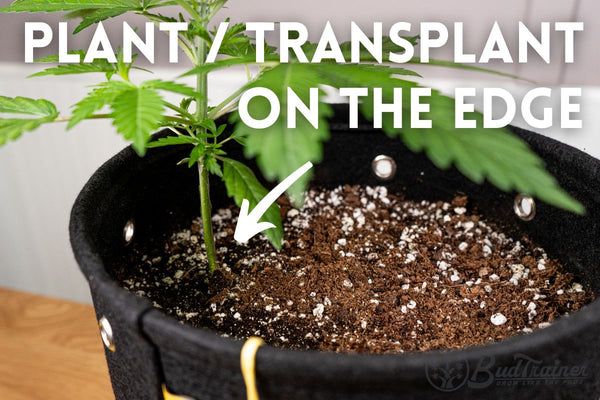
Tip: Plant on the Edge of Your Pot
Before starting Stage 1, there is one setup detail that makes a significant difference. Rather than planting or transplanting your seedling in the center of your pot, place it 1.5 inches from the edge, right next to one of the grommets. This gives your main stalk more room to travel as you bend it sideways across the pot, allowing you to grow a longer, thicker trunk and use your pot area much more effectively.
Stage 1: Training the Main Stalk
When: When the 5th node appears (roughly 3-4 weeks from germination).
Stage 1 is about transforming your main stalk from a vertical trunk into a horizontal one, which increases your plant's canopy area and exposes all the lower branches to direct light. This is the core move of LST - everything else builds on it.
Step 1. Bend and Anchor the Main Stalk
Cut a short piece of garden wire and attach one end to the grommet on the pot that is closest to your plant. Attach the other end around the base of the seedling, about 1 to 1.5 inches from the soil. This base anchor keeps the stalk from bending at ground level and snapping into the soil.


Once the base is secure, bend the seedling at roughly 90 degrees and tie the top of the plant to the opposite grommet on the pot. The two pieces of wire together - one at the base, one at the top - will hold the seedling in the horizontal position. If your wire does not reach the opposite grommet, you can push one end into the soil as an anchor instead.

After training, your plant will keep trying to grow upward over the next few days. To continue growing it sideways, move the wire up to the next node as the plant gets taller. Repeat this until the main stalk has traveled across the pot to the opposite side.

Step 2. Prune the 1st Node
After bending the main stalk, trim off both the leaves and growth sites at the 1st node. The 1st node sits closest to the soil and will never develop into a strong branch. Removing it redirects energy to all the remaining upper nodes, which will now receive a surge of growth hormones thanks to the broken apical dominance.

Stage 2: Training Side Branches
When: 2 weeks after Stage 1. Repeat every 1-2 weeks throughout the vegetative stage.
Stage 2 is where you spread and manage the side branches that have now shot up following Stage 1. It has 3 steps: a light defoliation, training the branches outward, and optionally topping the main stalk. You can repeat this stage every 1-2 weeks for as long as your plant is still in veg. For outdoor grows with several months of veg time, consistent weekly training here is one of the most effective ways to build an even, multi-cola canopy.

Step 1. Light Defoliation
By week 6 or later of veg, some of your leaves will be over 30 days old. At this age, they begin consuming nearly as much energy as they produce - and the older they get, the more they drain. Remove them now so your plant can redirect that energy to younger, more productive growth.
Removing main stalk leaves: The leaves on the first 3 nodes are the oldest. Even if they look big and healthy, remove them. Once those large old leaves are gone, the remaining younger leaves will often double in size within 1-2 days.

Removing shaded leaves and branches: Any leaf or branch sitting in the shade is a net drain on your plant - like a solar panel installed under a roof. It produces less than it consumes. Remove them now before they carry into the flowering stage where they would become larfy popcorn buds. For a deeper explanation of the defoliation process at each stage, see our full guide on How to Defoliate Cannabis.

Small, shaded branches left in place will not catch up. They will carry into flower, produce nothing useful, and waste energy that should be going to your top colas.
Step 2. Training Side Branches
Once the plant is clear of old and shaded growth, bend the side branches outward using a combination of garden wire and LST clips.
Bottom nodes (older, longer branches): Cut a 4-6 inch piece of garden wire, attach one end to the grommet closest to the branch, and pull the branch down to your desired height. Loop the wire around the branch to create a hook - make the hook at least twice as wide as the branch to avoid strangling it as it grows. Secure the wire around the pot and adjust as needed. Spread all the bottom branches outward so they fan out from the center.


Top nodes (newer, shorter branches): The upper branches will be too small for garden wire hooks. Use LST clips instead. Clips clamp directly onto the branch and hold it bent outward without needing an anchor point on the pot, making them ideal for smaller growth that is still close to the main stalk.

Optional: Top the Main Stalk
Once the main stalk reaches the far edge of your pot, it has nowhere left to travel - and it will start growing upward again. At this point, you have the option to top it. Topping here prevents the main stalk from becoming a tall central cola that throws the canopy off balance, and it sends an additional surge of energy to all the remaining side branches. It is optional, but recommended if you have the space and veg time to let the plant recover for 1-2 weeks before flipping to flower.

How to Fix a Broken Branch
Breaking a branch during training is a normal part of growing - it happens to experienced growers too. A broken branch will not ruin your grow. Cannabis is resilient and will redirect energy to the remaining branches. If the break is a partial snap with both sides still connected, wrap it immediately with plant tape, making sure both sides of the broken tissue are touching. Add extra tape if the branch is heavy for support.


Stage 3: Bud Support During Flower
When: Days 21-25 of flowering (right after mid-flower defoliation).
Stage 3 is not about shaping anymore - it is about keeping your buds upright as they get heavy. Before starting Stage 3, complete your mid-flower defoliation (removing all lower leaves and shaded branches, also called lollipopping) between days 21-25 of flower. Then come back here for bud support.
Around weeks 3-4 of flowering, your plant stops stretching and begins bulking up. As buds swell and become top-heavy, unsupported branches will start leaning and drooping - which reduces airflow around the buds and increases mold risk. You have two options for support.


Option 1. Garden Ties
The quickest way to support your buds is to tie opposite branches together so they hold each other up. Pick branches that are directly across from each other - 180 degrees apart - and connect them with a piece of garden wire. Do not pull them toward each other; tie them as they naturally sit so the support is balanced. You can also run a single large loop of wire around all the branches at canopy height, like a tomato cage, and tie it to 3-4 branches to keep it from sliding down.


Option 2. Trellis Netting
A trellis net offers stronger and more comprehensive support but requires a fixed structure - the corner poles of a grow tent, or a wood or PVC frame outdoors. Once a net is in place, you cannot move the plant until harvest. We recommend using a net with 3-inch holes, which supports roughly one large cola per hole.
Unlike garden ties (which you add around week 3 of flower), you can install a trellis net at the very start of the flowering cycle and use it for both training and support. During the stretch phase, tuck each branch under the net as it grows 3-4 inches above the line - this bends it horizontal and spreads your canopy wider. Once the plant stops stretching at the end of week 3, stop tucking. From this point on, the net shifts from holding branches down to holding buds up as they swell.


Once the plant stops stretching, let the branches grow freely through the net. From here, it is all about maintaining your watering and feeding routine while the buds fatten up. As you approach harvest, trichomes will begin forming and the aromas from the terpenes will intensify. For what comes next, read our guides on pre-harvest defoliation and harvesting.

How to LST Autoflowers
LST is the recommended training method for autoflowers because it does not require the plant to stop and recover from a cut. Autoflowers have a fixed lifecycle - typically 75-100 days from seed to harvest - and any significant stress-induced stall eats directly into that window. LST lets you train continuously without triggering that kind of slowdown.
Follow the same 3-stage process described above, with two adjustments. First, start Stage 1 as early as possible - ideally the moment the 4th or 5th node appears, rather than waiting. Autoflowers transition to flower on their own schedule, so every day of veg training counts. Second, be gradual and gentle with every bend. Do not force a stiff stem all at once - instead, bend it a little further every day over 3-5 days rather than taking it all the way to 90 degrees in a single session. This is especially important for Stage 1 and any Stage 2 branch training.
For Stage 3 bud support, autoflowers follow exactly the same process as photoperiod plants - no differences needed.
LST vs High-Stress Training: The Difference
LST is classified as low-stress because it does not involve cutting or removing plant material during the training itself - it only bends and repositions branches. This means your plant experiences minimal disruption and continues growing at full speed throughout the process.
High-stress training (HST) techniques like topping or mainlining involve cutting the plant, which forces a recovery period of several days before growth resumes. HST can push yield potential further than LST alone, but it carries more risk and requires more recovery time - which is why LST is the recommended starting point for most growers, and why it works so well for autoflowers that cannot afford to stall.
The two methods are also frequently combined. A common and effective approach is to top once during veg, then use LST to spread and manage the resulting branches throughout the rest of the vegetative stage. This is exactly what the BudTrainer Method does in Stage 1 and Stage 2 below.
Common LST Mistakes to Avoid
- Starting too late: Stems become woody (lignified) quickly. If your main stalk feels stiff and resists bending, you are past the ideal window. Start at node 4-5, not later.
- Bending too aggressively in one session: Take the stalk to 45 degrees first, let it adjust for a day, then take it to 90. Forcing a cold stem to 90 degrees in one move is the most common cause of snapped branches.
- Tying too tight: Wire or ties that are snug now will strangle the branch as it grows thicker. Always create a hook at least twice the diameter of the branch and check it every 2-3 days during active veg.
- Not adjusting ties regularly: Plants grow fast. A wire that was positioned correctly 3 days ago may now be restricting growth. Check your anchor points every 2-3 days during veg and daily during the stretch phase.
- Letting one branch dominate: If one branch outgrows the others, bend it down further or clip it lower. The goal is a flat canopy - the moment one top rises higher than the rest, it reasserts apical dominance and starts suppressing the others.
- Training during the stretch phase: Aggressive bending after the plant has entered flower and is actively stretching can stress it at the wrong moment. Tuck branches under a trellis net during the stretch, but avoid forcing stems into new positions at this stage.
Frequently Asked Questions
When should I start LST on my cannabis plant?
Start when the 5th node appears, typically 3-4 weeks from germination. At this stage the main stalk is still flexible enough to bend to 90 degrees without snapping. Starting earlier gives you more training time in veg; starting after the stalk has lignified (become woody) makes bending much harder and increases the risk of breaking the main stem.
Can you LST an autoflower?
Yes - LST is the best training method for autoflowers because it does not require a recovery period. Follow the same 3 stages, but start as early as node 4-5 and be more gradual with every bend. Take the main stalk toward horizontal over several days rather than all at once, and check your ties daily since autoflowers grow fast and stems thicken quickly.
What is the difference between LST and HST?
LST (low-stress training) bends and repositions branches without cutting the plant. The plant never stops growing and requires no recovery time. HST (high-stress training) involves cutting or removing plant material - topping, FIMing, or mainlining - which forces a recovery period of several days. LST is safer and more beginner-friendly; HST can push yields further but carries more risk. The two are often combined: top once, then use LST to manage the resulting branches.
Does LST increase yield?
Yes. By breaking apical dominance and creating an even canopy, LST exposes all bud sites to the same light intensity rather than concentrating light on a single top cola. Commercial operations consistently report 30-50% yield improvements with LST compared to untrained plants in the same setup - which is why over 95% of commercial cannabis producers use it as standard practice.
How often should I adjust my LST ties?
During active vegetative growth, check and adjust every 2-3 days. During the stretch phase of early flowering (days 1-21), check daily - plants grow fast enough that a wire snug today can be strangling the branch by tomorrow. After the stretch ends and buds begin forming, stop repositioning branches and focus on support rather than training.
Can you LST during the flowering stage?
You can tuck branches under a trellis net during the first 3 weeks of flowering (the stretch phase) to widen the canopy. However, avoid aggressive bending of stems once the stretch ends and buds are forming - the stems have lignified and forcing them risks snapping. From day 21-25 onward, switch to bud support (Stage 3) rather than active training.
What is the best pot for LST?
A fabric pot with pre-installed grommets or anchor points is the most effective setup for LST. The grommets give you fixed, evenly spaced tie-down points around the pot, so you can anchor garden wire to hold branches in any position without drilling holes or improvising with clips. Fabric pots also improve root health and drainage compared to plastic, which supports faster overall growth.
What happens if I break a branch during LST?
If the break is partial and both sides are still connected, wrap it with plant tape immediately - bring both sides of the broken tissue together and wrap firmly. The branch will heal within about a week. If the branch came off completely, it cannot be saved, but the plant will redirect energy to the remaining branches and recover well. Breaking branches is a normal part of training and will not ruin your grow.
Do I need LST clips or can I use garden wire for everything?
Garden wire works for larger, longer branches on the lower nodes because you have room to create a hook and anchor it to the pot. LST clips are better for the upper nodes where branches are still small and close to the main stalk - clips clamp directly onto the branch without needing an anchor point, making them much faster to use on young growth. Using both tools together covers all parts of the plant.
How is LST different from ScrOG?
LST and ScrOG (Screen of Green) both aim to create an even canopy, but they work differently. LST uses ties and clips to hold individual branches in position. ScrOG uses a horizontal trellis net stretched above the plant - branches are tucked under the net as they grow through the holes, which holds them flat and fills the screen evenly. ScrOG is effectively LST with a net as the training tool, and is particularly effective for indoor grows where you want to fill a specific footprint. The two approaches can also be combined, as described in Stage 3 above.


