Few things in a grow are as deflating as spotting a little yellow banana in a bud you have spent ten weeks on. The internet's answer is usually a list of things you did wrong: a light leak, a hot day, a rough bend, a late harvest. This guide takes a different line, because the research does. It shows you exactly what the two kinds of hermaphrodite flower look like and where they hide, how to tell them from the five things that only look like them, what the research actually says about the cause, and what to do in the first ten minutes after you find one. Then it covers what pollination costs your harvest, why feminized seeds are hermaphrodites made on purpose, and how to keep hermies out of your next grow.
If you are still working out whether a young plant is male or female in the first place, start with our guide to telling male and female weed plants apart. This article picks up where that one leaves off: a plant you already know is female that has started growing male parts.
What Is a Hermaphrodite Cannabis Plant?
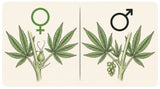
Cannabis normally comes in two separate sexes. A female plant carries two X chromosomes (XX) and grows the resin-covered flowers you are growing for; a male carries an X and a Y (XY) and grows pollen. Botanists call a species like this dioecious, which just means the sexes live on separate plants. A hermaphrodite, or "hermie," is a plant that grows both kinds of flower. In practice, the hermie a home grower meets is almost always a female (XX) plant that has started growing some male flowers, not a male that has started growing buds.
That a female can do this at all is now explained at the gene level. In 2026, a 32-author team led by Sarah Carey and Alex Harkess reported that the switch deciding a female flower sits on the X chromosome, in a gene involved in making the plant hormone ethylene, and that fully working male flowers can develop with no Y chromosome present.3 In plain terms: every female plant carries the instructions for male flowers. Ethylene signaling keeps them switched off, and when that signal weakens or a plant's genes hold it loosely, male flowers appear.
Those male flowers are real. They make real pollen, and that pollen can fertilize the plant's own pistils (the white hairs on each flower) and every other female in the room. A single fertilized flower makes a single seed. A bud full of fertilized flowers is a bud full of seeds.
A hermie is not a male
A male plant shows its sex early, often before the switch to flower and almost always within the first two weeks after it, grows nothing but pollen sacs, and should be gone from a bud grow before any of them open. A hermie is a female you have already kept, often for weeks, that grows male parts somewhere among her buds. That timing is what makes hermies dangerous: by the time they appear, you have usually stopped looking.
The Two Kinds of Hermie: Pollen Sacs and Nanners
Female cannabis shows male parts in two different ways, and growers use different names for them. Both make pollen; they just look different and turn up in different places.

Pollen sacs on a branch
The first kind looks exactly like a male plant's flowers, only on a female. Smooth, round to oval green balls, each smaller than a peppercorn, hang in small clusters on short stalks, usually at a node (the point where a leaf stem joins a branch) or low on a branch. They have no white hairs. When one is mature it splits into five small pale petals and dangles its anthers, the pollen-making parts, underneath. In a commercial facility survey, Oliver found every case of male flowers on the stem or on small flowers low on the main stem, never at the tops.4

Anthers in the bud ("nanners")
The second kind skips the sac. Bare anthers grow straight out of the female flowers, pale cream to lemon-yellow, curved like tiny bananas, which is where the name "nanners" comes from. They grow singly or in small clusters from inside the calyxes, the little leafy pods that wrap each female flower; Punja and Holmes measured a whole cluster at 2 to 3 mm (about a tenth of an inch) long, so a single anther is smaller still.1 They are small, often the same color as the pale sugar leaves around them, and easy to miss without a loupe.

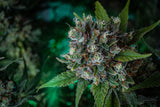
In Punja and Holmes's facility the anthers appeared from around week 4 of flower, stayed visible through weeks 4 to 7 and were still there at harvest. On 2 of the roughly 1,000 plants they watched, whole flower clusters turned into masses of anthers.1 That is the extreme end. A bad but more typical case, with anthers poking out of many calyxes across one bud, looks like this:

For comparison, this is a true male plant. Its sacs grow from the top of the plant down, in hanging clusters, with no white-haired female flowers anywhere on it. If your plant looks like this from the first weeks of flower, it is a male, not a hermie, and our male plant removal steps apply.

When and Where Hermies Show Up
Hermies follow a pattern, and knowing it is most of the job. These are the measured facts from the two commercial counts we have, then our scouting routine built on them.
| Question | What was measured | Where it comes from |
|---|---|---|
| How often? | 5 to 10% of plants; 28 of 403 plants (6.9%) in a second facility | Punja and Holmes 2020; Oliver 2024 |
| When? | From around week 4 of flower, visible weeks 4 to 7, still present at harvest | Punja and Holmes 2020 |
| Where on the plant? | Anthers inside the buds; male flowers low on the main stem and on small low flowers | Punja and Holmes 2020; Oliver 2024 |
| How big? | Anther clusters 2 to 3 mm (about 1/10 in) long | Punja and Holmes 2020 |
| Which plants? | Some cultivars and not others; in Oliver's facility every case came from one cultivar | Oliver 2024 |

Two things stand out. First, hermies are not rare: one plant in ten to twenty is a normal rate in a working facility. Second, they show up in the middle of flower, after the stretch is over and after most growers have stopped inspecting individual buds, and they show up low and inside the plant where nobody looks.
Our scouting routine
We check every plant once a week from week 3 of flower, a week before the earliest anthers Punja and Holmes saw, and twice a week from week 4 until harvest. The rule is ours, built from their timeline; nobody has tested a scouting schedule against hermies. A check takes a few minutes per plant:
- Look at the small buds low on the plant and close to the main stem first, then the top colas.
- Check the nodes along the main stem and lower branches for green balls with no hairs.
- Use a jeweler's loupe or your phone camera at 2x to 3x zoom on any bud that has pale yellow in it. A whole cluster of anthers is only 2 to 3 mm (about 1/10 in) long and the same color as a sugar leaf tip.
- Look under the plant: a fine pale yellow dust on the lower leaves, which smears yellow on a fingertip, means something above has already opened.

Fold this into the weekly walk you already do for pests (our pest scouting routine uses the same loupe and the same ten minutes). The loupe you use to time your harvest is the same tool; the harvest guide shows how to hold it.

Five Things That Look Like a Hermie (and Are Not)
Every grow forum has a thread titled "is this a hermie?" and most of the answers are no. Before you pull a plant, rule these out.
1. Foxtails
Foxtails are new female flowers stacking up on top of older ones, making spiky towers on the tops of the buds. They are pale green to lime and they carry fresh white pistils. Nanners are pale yellow, smooth, curved and have no hairs. Our foxtailing guide covers what causes them; they do not make pollen.

2. Swollen calyxes
In the last weeks of flower the calyxes swell into plump, round pods. To a nervous eye they can look like pollen sacs. The test is the hairs: a calyx always has a pistil (or two) growing out of its tip, even when the pistil has turned orange and curled. A pollen sac never has one.

3. Stipules
Stipules are the two thin green spikes at every node, on every plant, of both sexes. They are not flowers. They matter more when sexing young plants, but they fool people in flower too; our stipule check shows the difference.

4. Yellowing sugar leaf tips and dried pistils
Late in flower, the tips of the small leaves inside a bud turn pale yellow, and dried pistils clump into little tan curls. Both can look like anthers at arm's length. Under a loupe a leaf tip is flat and serrated and a pistil is a hair. An anther is a smooth, plump, curved sac with a faint groove down its length.

5. A seed (which means it already happened)
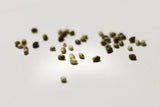
If you open a calyx and find a small, plump, teardrop-shaped seed, you are not looking at a hermie. You are looking at its result: pollen reached that flower days or weeks ago. Seeds start pale green and darken to the familiar striped gray-brown as they mature. A seed means there is an open pollen source somewhere, on this plant or one nearby, and it is time to find it.
What Actually Causes Hermaphrodite Cannabis? What the Research Says
Ask a grow forum and you will get a confident list: light leaks, heat stress, an irregular light schedule, nutrient problems, physical damage, harvesting late. Ask the research and you get a more interesting answer. No controlled study on drug-type cannabis has shown that any of those stresses causes hermaphrodite flowers, and the two that tried found nothing. Stress can flip sex in hemp, but only under conditions you will never create in a grow tent. Here is the evidence, both ways.
The evidence for genetics
Four lines of evidence point at the plant's own genes:
- The trait is inherited. In 1954, Borthwick and Scully at the USDA compared 588 hemp females whose mothers had grown male flowers with 582 whose mothers had not. 34% of the first group grew male flowers against 23% of the second; a second experiment gave 13.7% against 4.9%.5 The tendency passes from mother to daughter.
- It sits in specific genes. Carey and colleagues crossed female and monoecious hemp (hemp bred to carry both sexes on one plant) and genotyped 887 offspring; all 19 genetic markers linked to growing both kinds of flower mapped to the X chromosome, the same chromosome every female carries two copies of.3
- It follows cultivars, not rooms. In Oliver's facility, all 28 hermaphrodite plants out of 403 belonged to one cultivar.4
- It happens with no stress at all. At the University of Guelph, Hesami, Pepe and Jones grew feminized White Widow in a tightly controlled growth room with no pruning or training, and some plants grew male flowers from day 76 of 12/12, about three weeks after the cultivar is normally ready at day 56.6 In Flajšman's trial, even some untouched control plants grew a few male flowers; the authors suggest either spontaneous hermies or drift from the silver spray next door.2
The stress tests on drug-type cannabis
Flajšman, Slapnik and Murovec in Slovenia set out to make high-CBD medical cannabis plants grow male flowers for breeding, and tried the methods growers recommend alongside silver. Cutting plants back to two nodes at the flip gave 1.7 flower clusters with male flowers per plant against 1.0 on untouched plants, not a statistically significant difference, while silver gave over 50. A week of continuous darkness, or a week of continuous light, before 12/12 gave no male flowers at all. In their words, the intensive cut "did not produce positive results."2 The samples were small, 12 plants per treatment for the cut and 3 for the light treatments, and each test was run once, so this is not proof that stress never matters. It is the best direct evidence there is, and it points the same way as everything else.

The only look at light leaks in drug-type cannabis is an undergraduate report from a licensed Canadian facility. Oliver compared plants near leaky doors with plants far from them and found no link; one cultivar even had more male flowers in its dark rooms than its leaky ones. The report is honest about its limits: the light was never measured and there was no control.4 On drought, a 2023 hemp study by Sydney Wizenberg's group cut water to all its females to provoke hermies and got 7 plants with male flowers, but it had no fully watered group to compare with.7
Where stress did flip sex: old hemp experiments
The stress idea is not invented. It comes from fiber hemp research, and the results are real:
- Very short days. Borthwick and Scully found 8 or 11 hour days made 25 to 45% of females grow male flowers, while 14-hour days made none.5 In 2023, Schilling and colleagues in Ireland saw about one in five plants of the dioecious grain hemp Finola carry both sexes under 8-hour days, and none at 12, 16 or 24 hours.8
- Cold around flowering. Two weeks at 55°F (13°C) instead of 70°F (21°C) raised the share in Borthwick and Scully's plants from 47% to 73%, and from about 12% to 71% when the cold fell in the dark periods of flowering.5
- Dim winter greenhouses. In the 1920s, John Schaffner at Ohio State grew hemp on shallow greenhouse benches through the winter: 48 of 54 females planted in December reversed sex, and the rate tracked day length, from near 0% for plantings in mid-August to 90% or more in December and back to 0% by May.9
- Stripping every flower. In 1916, Pritchard at the USDA cut all the flowers and buds off field hemp; every stripped female that flowered again grew stamens, and none of 28 untouched females did.10

Read the conditions, though. Borthwick and Scully's plants came from "female seed," lines bred for three generations from females that grew male flowers, so they were already prone to it. Schaffner's plants were winter-sown on shallow benches with short, dim days, every stress at once. Eight-hour days are a third shorter than a 12/12 schedule. Nothing here resembles a home tent. And two results run against the folklore: cold raised the rate, not heat, and in Schaffner's work well-fed plants reversed while every one of 26 females in nitrogen-poor sand stayed female.9 Starving a plant did not make it hermie.

Our reading: hermaphroditism is a genetic trait that some cultivars carry and others do not. Extreme conditions can tip hemp plants, and probably tip prone plants of any kind, but no stress a home grower is likely to cause has been shown to turn a stable drug-type female. A prone cultivar will hermie in a perfect tent. When a plant hermies, look at the genetics first, then at whether you left it too long.
The Usual Suspects, Ranked by Evidence
None of this means you should ignore your environment. Most of the usual suspects cost you something real even if they never cause a hermie. Here is each one, what the evidence actually shows, and what we do about it.
| Suspect | What the evidence shows | What we do |
|---|---|---|
| Genetics | Strongest evidence: inherited, mapped to the X chromosome, follows cultivars | Retire a cultivar that hermies; never keep its seeds or clones |
| Cold around the flip | 55°F (13°C) raised male flowers in prone fiber hemp lines | Keep lights-off temperatures in the flowering band |
| Short days | 8 to 11 hour days raised male flowers in hemp; 12 hours and longer gave none | Run 12/12; do not cut light hours below 12 to finish faster |
| Light leaks | No link found in drug-type plants, and a week of total darkness or total light made no male flowers; leaks do disrupt flowering | Fix every leak anyway |
| Heat | No study links heat to hermies; the old hemp work found cold, not heat | Hold flower temperatures for bud quality, not for hermies |
| Drought | One hemp study, no control group | Water by pot weight |
| Nutrients | No drug-type study; in old hemp work, nitrogen-starved females did not reverse and well-fed ones did | Feed to the stage |
| Physical damage | A hard cut-back at the flip made no difference in drug-type plants; stripping every flower off hemp did | Finish training in veg; never re-flower a harvested plant |
| Late harvest | Unstressed White Widow grew male flowers about three weeks past its normal harvest day | Harvest on the trichomes, not weeks later |
A few of these deserve a sentence more. Light leaks may not be proven to cause hermies, but an interrupted night is the one thing every photoperiod plant reads, and our light leak checklist takes ten minutes. The zipper and the little indicator light on a power strip are the two we find most often.

Light hours: some growers drop to 11 or 10 hours of light near the end to speed up ripening. In the hemp experiments, 8 and 11 hour days raised male flowers and 12 hours or more did not, so we would not shorten the day below 12 hours on a cultivar you do not know; our light schedule guide explains why 12/12 is the default. Temperature: the bands that matter for the buds themselves are on our flowering stage guide, and grow tent temperature control covers keeping the night from dropping too far. Water: water when the pot has lost about half the weight it gained, as in our watering guide. Damage: structural training belongs in veg, where gentle bends with LST clips like the BudClips do the shaping without crushing stems, and a branch that snaps can be splinted with BudSavers tape. Neither is about hermies; both are just better growing.

That little orange light on a power strip is lit all night, every night, and it is the leak growers miss most often because they stop seeing it.
What to Do When You Find a Hermie
The goal is simple: get the pollen out of the room before it opens, without spreading it while you do it. These are the steps we follow. They are written for a tent, and they work the same in a room or a garden.
Step 1 - Confirm it under a loupe
Rule out the five look-alikes above. You are looking for smooth, hairless, pale yellow anthers in a bud, or smooth green balls on short stalks at a node. If you see a seed, assume there is an open source nearby and keep looking.
Step 2 - Turn off the fans and work gently
Switch off the circulation fans before you touch anything. The same air movement that keeps your buds healthy carries pollen across the tent. Put on gloves and move slowly.

Step 3 - Judge how bad it is
Count what you find. A few anther clusters in one or two buds on one plant is a mild case. Pollen sacs on branches, anthers in many buds, more than one plant, or pale yellow dust on the leaves below is a bad case. Then check the calendar: how many weeks until this plant is ready to harvest?

Pollen dust like this means the anthers above have already opened, which makes it a bad case whatever else you find. The whole decision fits on one card:

Step 4 - Pluck a mild case into a bag
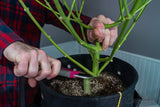
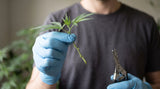
For a mild case, lift each anther cluster or sac out with fine-tipped tweezers and drop it straight into a small zip bag held under the bud. Wipe the tweezer tips on a damp paper towel between buds so you do not carry pollen from one to the next. Seal the bag and take it out of the room. Mark the plant with a tag so you know to check it first every time.

Step 5 - Remove a bad case, bag first
For a bad case, the plant goes. Slip a large trash bag over the whole plant from the top, close it around the main stem, cut the stem below the bag and carry it out sealed. It is the same method we use for a male plant, because the problem is the same.

Step 6 - Recheck every plant for two weeks
Check the marked plant every two to three days and every other plant in the room twice a week. A plant that keeps growing anthers after you pluck them is a bad case; remove it. In Punja and Holmes's facility the change from a normal bud to an anther-bearing one took about three weeks,1 so one clean check does not mean you are clear.
If you find it late in flower
Timing changes the math. A seed needs weeks to grow. Flajšman and colleagues could already count developing seeds two weeks after pollination,2 but in hemp a single seed takes three to five weeks to mature,11 so pollen that lands in the last two weeks before harvest leaves small, immature seeds at most. If you find a mild case in that last stretch, pluck what you can see and harvest that plant on the early side of its window. If you find a bad case with more than a few weeks to go, remove it; a plant that keeps shedding pollen for a month can seed everything around it. A bad case inside those last two weeks can usually be treated the same way as a mild one: pluck what you can and harvest that plant early. Where exactly your harvest window sits is covered in the harvest guide linked above; the cut-off of two weeks here is our rule of thumb, not a measured number.

The other side of the calendar matters too. Hesami, Pepe and Jones saw male flowers appear on unstressed plants about three weeks after their normal harvest day,6 so a plant you leave running long to fatten up is a plant to keep checking.
How Far Hermie Pollen Travels and How Long It Lasts
One reassurance first: hermies make much less pollen than males. Punja and Holmes noted that the "prolific release of pollen" seen from male flowers did not happen from hermaphrodite ones,1 and in Wizenberg's hemp work a true male plant made 223% more pollen in total than a plant carrying both sexes.7 Less is not none, though. Their hermaphrodite pollen still germinated 10 to 30% of the time in the lab, and three hermaphrodite buds held 34, 48 and 22 seeds.1
Pollen also does not live long in a warm room. In a separate study, Wizenberg's group found fresh hemp pollen germinated about 39% of the time, falling to zero by two weeks at 72°F (22°C).12 So a plucked anther in a sealed bag that leaves the room is the end of it; a stray grain on a pant leg will not seed your next grow. Wind is the opposite story outdoors: pollen drifts a long way downwind, which is why outdoor growers with a hermie plant on the upwind side of the garden should treat it as urgent.
Seeds in Your Buds: What a Hermie Costs Your Harvest
Finding a few seeds at trim time is annoying. The real cost is less visible. When a female flower is fertilized, the plant starts putting its effort into the seed instead of the resin. Carni Lipson Feder and colleagues at the Technion and the Volcani Center in Israel pollinated two drug-type females indoors and measured the result: total cannabinoids fell by an average of 75% in the THC-rich plant and 60% in the CBD-rich one, and the monoterpenes behind most of the aroma fell 60 to 80% in the THC-rich plant.13 The cannabinoid profile stayed the same; there was just much less of it.

One caveat the paper leaves open: it does not say whether the seeds were taken out before the buds were tested, so part of that drop may be seed weight diluting the flower. Even so, a fully seeded bud is a much weaker bud. A few seeds from a mild, late hermie cost far less, because only the flowers that pollen reached were fertilized.

Can you still smoke buds from a hermie?
Yes. A bud with a few seeds is safe; pick the seeds out at trim or before grinding, because a seed that burns tastes harsh and can pop. If your buds came out seeded, our trimming guide is the place to deal with them. Expect less potency and aroma from heavily seeded flower, for the reasons above.

Should You Grow Seeds From a Hermie?
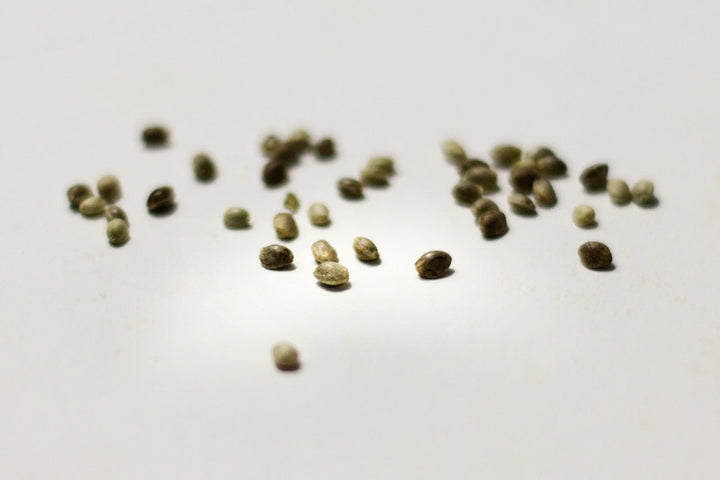
Seeds from a hermie that pollinated itself are close to all female. Punja and Holmes grew hermaphrodite seed from two cultivars and tested the seedlings with a DNA marker: every one was female, and the seeds germinated 90 to 95% of the time.1 That makes sense: both parents are the same XX plant, so there is no Y chromosome to pass on.

The catch is what else they inherit. Borthwick and Scully's numbers show that daughters of plants that grew male flowers grow them more often themselves.5 A seed from a hermie is a female seed with a higher chance of becoming a hermie. We do not grow them, and we would not give them away. The same logic applies to clones: a clone is a genetic copy of its mother, so a cutting from a plant that hermied carries the same tendency. If you keep mother plants, retire any that hermies; our cloning guide covers choosing a mother worth keeping.
Feminized Seeds Are Hermaphrodites on Purpose
Here is the twist most hermie guides skip: every feminized seed you have bought started with a hermaphrodite. Breeders take a female plant and make her grow male flowers on purpose, then use that pollen on another female. With no male parent there is no Y chromosome, so the seeds come out female.
The tool is silver. Ethylene tells a female flower to stay female, and silver ions block the plant from responding to ethylene. Spray a female with silver and the new flowers that form come out male. Jessica Lubell and Mark Brand at the University of Connecticut sprayed hemp on short days with silver thiosulfate (STS) at 3 mM three times, a week apart: 95 to 100% of the flowers on the main flower clusters came out male, while plants sprayed with water grew none.14 On drug-type cannabis with 17 to 25% THC, Adrian Monthony and colleagues used the same 3 mM spray once a week for three weeks and saw sex change in more than 80% of treated flower clusters, and none in plants sprayed with water.15 Many home breeders use colloidal silver instead; in Flajšman's trial on high-CBD medical cannabis it worked only when sprayed every day (about 290 male flowers per plant), while a single spray gave almost none.2

Our video shows the home version of the process: reversing one female to make pollen and using it on another.

▶ Watch how to make feminized seeds on YouTube
Two things follow from this. First, the parent of a feminized seed is a plant chosen for being female and then forced to make pollen; a careful breeder picks parents that do not hermie on their own, and a careless one does not. Second, "feminized seeds hermie more" is a claim we could not find measured anywhere. No peer-reviewed study has compared hermaphrodite rates in feminized and regular seed. What the inheritance data does say is that the parents matter, which is why the seed source matters more than the seed type. Our guide to choosing seeds covers regular, feminized and autoflower seed and where each fits.
How to Prevent Hermaphrodite Cannabis Plants
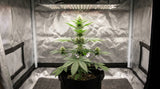
Put together, prevention is mostly about which plants you grow and how closely you watch them, with the environment a distant third. The payoff is a tent like this one: every plant female, every bud seedless.

The list we work from:
- Start from stable genetics. Buy from a breeder that tests its lines. If a cultivar hermies, note its name and do not grow it again; that one line in your grow log is worth more than any environmental fix.
- Never keep seeds or clones from a hermie. They carry the tendency forward.
- Keep the night dark and the schedule steady. Run 12/12, fix every leak, and do not cut the day below 12 hours to finish early.
- Harvest on time. Read the trichomes and cut in the window; a plant left weeks past it can start making male flowers with no stress at all.
- Do not let nights get cold around the flip. Cold was the one temperature effect that raised male flowers in the research.
- Finish structural training in veg. From the flip, the only training we do is tucking under a net until the stretch ends, around day 21, as our training guide explains.
- Scout from week 3 of flower. Weekly, then twice a week from week 4, looking low and inside the plant.
- Autoflowers too. An autoflower can hermie like any female; nobody has measured whether it happens more or less often. It starts flowering on its own, usually around week 3 to 5 from seed, as our growth stages guide explains; count its weeks of flower from there and scout on the same calendar.
Hermaphrodite Terms, Decoded
| Term | What it means |
|---|---|
| Hermaphrodite (hermie, herm) | A plant that grows both female and male flowers; in cannabis, nearly always a female growing some male ones |
| Nanners | Bare male anthers growing out of female buds, pale yellow and banana-shaped |
| Anther | The part of a male flower that makes pollen |
| Pollen sac | A closed male flower bud: a smooth green ball on a short stalk that opens to release pollen |
| Calyx | The small leafy pod around each female flower; it swells late in flower and holds the seed if one forms |
| Pistil | The white hair on a female flower that catches pollen; it turns orange as it ages |
| Stipule | A thin green spike at every node on every plant; not a flower |
| Dioecious | A species whose sexes grow on separate plants, as cannabis normally does |
| Monoecious | A plant that carries both sexes; some hemp is bred this way |
| XX / XY | The sex chromosomes: XX is female, XY is male |
| Ethylene | A plant hormone; in cannabis it keeps female flowers female |
| STS | Silver thiosulfate, the silver spray breeders use to make a female grow male flowers |
| Feminized seed | Seed from two female parents, one forced to make pollen, so it grows into a female |
| Sinsemilla | "Without seeds": flower from a female that was never pollinated |
Frequently Asked Questions
What does a hermaphrodite cannabis plant look like?
A hermie looks like a normal female with male parts added. Either clusters of pale yellow, banana-shaped anthers, each cluster only 2 to 3 mm (1/10 in) long, poke out of the buds, or small clusters of smooth green balls on short stalks hang at a node or low on a branch. Neither has white hairs. Check the small buds low and inside the plant with a loupe, because that is where they usually hide.
What causes a cannabis plant to turn hermaphrodite?
Mostly genetics. The tendency is inherited, sits on the X chromosome and follows particular cultivars. On drug-type cannabis, the only controlled stress tests, a hard cut-back at the flip and a week of total darkness, made no more male flowers than untouched plants. Old hemp experiments flipped sex with 8-hour days, dim winter greenhouses or stripping every flower, conditions nothing like a grow tent. Leaving a plant weeks past harvest can also do it.
Do light leaks cause hermies?
Nobody has shown it. An undergraduate report from a Canadian facility found no link between leaky doors and male flowers, though it never measured the light, and a week of total darkness or total light before 12/12 gave no male flowers in a Slovenian trial. Fix every leak anyway: an interrupted night disrupts flowering in every photoperiod plant, and a door zipper or power strip light takes minutes to cover.
When do hermaphrodite flowers appear?
In the one commercial count on drug-type cannabis, anthers appeared from around week 4 of flower, were visible through weeks 4 to 7 and stayed until harvest, on 5 to 10% of plants. They can also appear late: unstressed White Widow grew male flowers about three weeks past its normal harvest day. We check every plant weekly from week 3 of flower and twice a week from week 4.
Should I remove a hermaphrodite plant?
It depends on how bad it is and how close harvest is. A few anther clusters on one plant can be plucked into a bag with tweezers, and the plant watched every two to three days. Pollen sacs on branches, anthers in many buds, or a plant that keeps growing them means remove it, bagged first. In the last two weeks, pluck and harvest that plant early instead.
Can you smoke buds from a hermaphrodite plant?
Yes. Buds from a hermie are safe to smoke once you pick out any seeds, which taste harsh and can pop when they burn. Heavily seeded buds are weaker: when Lipson Feder and colleagues pollinated drug-type plants, total cannabinoids fell by about 75% in a THC-rich plant and 60% in a CBD-rich one. A few late seeds cost much less.
Can a hermie pollinate itself?
Yes. Its anthers make working pollen, and the plant's own pistils are the closest target. Punja and Holmes found hermaphrodite pollen germinated 10 to 30% of the time and counted 34, 48 and 22 seeds in three hermaphrodite buds. Hermies release far less pollen than true males, but it is enough to seed the plant and anything downwind of a fan.
Are seeds from a hermaphrodite plant feminized?
Nearly. A hermie that pollinates itself has no Y chromosome to pass on, and in Punja and Holmes's work every seedling tested from hermaphrodite seed was female. They also inherit the tendency: daughters of plants that grew male flowers grow them more often themselves. We do not grow seeds from a hermie, and we would not keep its clones either.
Do feminized seeds turn hermaphrodite more often than regular seeds?
Nobody has measured it. We could not find a single peer-reviewed comparison of hermaphrodite rates in feminized and regular seed. What the research does show is that the tendency is inherited, so a feminized seed is only as stable as the two plants it came from. The breeder matters more than the seed type.
Is colloidal silver how feminized seeds are made?
Silver is how they are made. Silver blocks the plant's response to ethylene, the hormone that keeps female flowers female, so a sprayed female grows male flowers. Breeders mostly use silver thiosulfate (STS); in trials, 3 mM sprayed three times a week apart turned 95 to 100% of the main flowers male. Daily colloidal silver sprays also worked, while a single colloidal silver spray did almost nothing.
Is it a hermie or just swollen calyxes?
Look for hairs. A calyx always has a pistil growing out of its tip, even when the pistil has turned orange and curled, and it swells into a plump pod late in flower. A pollen sac has no hair at all, and a nanner is a smooth, pale yellow, curved sac. Under a loupe the difference is obvious; at arm's length it is not.
Can autoflowers turn hermaphrodite?
Yes. An autoflower is a female like any other and can grow male flowers the same way. Nobody has measured whether autoflowers hermie more or less often than photoperiod plants, so treat them the same: count their weeks of flower from when they start flowering on their own, around week 3 to 5 from seed, and scout from week 3 of flower.
How long does pollen from a hermie stay alive?
Not long in a warm room. In hemp, fresh pollen germinated about 39% of the time and fell to zero by two weeks at 72°F (22°C). That is why a plucked anther sealed in a bag and taken out of the room is the end of it. Pollen does travel far on moving air, so switch off the fans before you start removing anything.
References
- Punja, Z. K., & Holmes, J. E. (2020). Hermaphroditism in marijuana (Cannabis sativa L.) inflorescences - impact on floral morphology, seed formation, progeny sex ratios, and genetic variation. Frontiers in Plant Science, 11, 718. https://doi.org/10.3389/fpls.2020.00718
- Flajšman, M., Slapnik, M., & Murovec, J. (2021). Production of feminized seeds of high CBD Cannabis sativa L. by manipulation of sex expression and its application to breeding. Frontiers in Plant Science, 12, 718092. https://doi.org/10.3389/fpls.2021.718092
- Carey, S. B., Bentz, P. C., Lovell, J. T., et al., & Harkess, A. (2026). An X-linked sex determination mechanism in cannabis and hop. Nature Communications, 17, 6866. https://doi.org/10.1038/s41467-026-73233-7
- Oliver, W. (2024). Investigating the effects of dark period light exposure on sex expression in female Cannabis sativa. Studies by Undergraduate Researchers at Guelph (SURG), 15. https://doi.org/10.21083/surg.v15i1.7697
- Borthwick, H. A., & Scully, N. J. (1954). Photoperiodic responses of hemp. Botanical Gazette, 116(1), 14-29. https://doi.org/10.1086/335843
- Hesami, M., Pepe, M., & Jones, A. M. P. (2023). Morphological characterization of Cannabis sativa L. throughout its complete life cycle. Plants, 12(20), 3646. https://doi.org/10.3390/plants12203646
- Wizenberg, S. B., Muir-Guarnaccia, J., & Campbell, L. G. (2023). Cosexuality reduces pollen production and fitness in Cannabis sativa L. Plants, 12(21), 3731. https://doi.org/10.3390/plants12213731
- Schilling, S., Melzer, R., Dowling, C. A., Shi, J., Muldoon, S., & McCabe, P. F. (2023). A protocol for rapid generation cycling (speed breeding) of hemp (Cannabis sativa) for research and agriculture. The Plant Journal, 113(3), 437-445. https://doi.org/10.1111/tpj.16051
- Schaffner, J. H. (1925). The influence of the substratum on the percentage of sex reversal in winter-grown hemp. Ohio Journal of Science, 25(4), 172-176. Ohio State University Knowledge Bank
- Pritchard, F. J. (1916). Change of sex in hemp. Journal of Heredity, 7(7), 325-329. https://doi.org/10.1093/oxfordjournals.jhered.a110739
- Mediavilla, V., Jonquera, M., Schmid-Slembrouck, I., & Soldati, A. (1998). A decimal code for growth stages of hemp (Cannabis sativa L.). Journal of the International Hemp Association, 5(2), 65-74. http://www.internationalhempassociation.org/jiha/jiha5201.html
- Wizenberg, S. B., Dang, M., & Campbell, L. G. (2022). Methods for characterizing pollen fitness in Cannabis sativa L. PLoS ONE, 17(7), e0270799. https://doi.org/10.1371/journal.pone.0270799
- Lipson Feder, C., Cohen, O., Shapira, A., Katzir, I., Peer, R., Guberman, O., Procaccia, S., Berman, P., Flaishman, M., & Meiri, D. (2021). Fertilization following pollination predominantly decreases phytocannabinoids accumulation and alters the accumulation of terpenoids in Cannabis inflorescences. Frontiers in Plant Science, 12, 753847. https://doi.org/10.3389/fpls.2021.753847
- Lubell, J. D., & Brand, M. H. (2018). Foliar sprays of silver thiosulfate produce male flowers on female hemp plants. HortTechnology, 28(6), 743-747. https://doi.org/10.21273/HORTTECH04188-18
- Monthony, A. S., Roy, J., de Ronne, M., Carlson, O., Murch, S. J., & Torkamaneh, D. (2026). Sex-specific ethylene responses drive floral sexual plasticity in Cannabis sativa. The Plant Journal, 125(3), e70721. https://doi.org/10.1111/tpj.70721

About the Author
Henrique Dias is the CEO and co-founder of BudTrainer. He is a mechanical engineer who also holds a graduate certificate in Commercial Cannabis Production from Niagara College in Ontario, Canada - the first college-level cannabis cultivation program in North America. Before founding BudTrainer, Henrique worked with Health Canada licensed cannabis producers, where he gained hands-on experience in cultivation, processing, and post-harvest management of cannabis at commercial scale. He started BudTrainer to bring that same level of craft to home growers through better-designed gardening tools and clear, science-backed education.
DISCLAIMER: Everything taught and sold by BudTrainer® is to be used strictly for legal purposes. We do not endorse the production of illegal substances and it is your duty to ensure that you are complying with the law. The words "hemp," "cannabis," "weed," and "marijuana" are used interchangeably to refer to the same plant (legal hemp with less than 0.3% THC) for the purposes of this lesson.