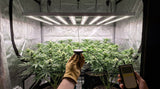
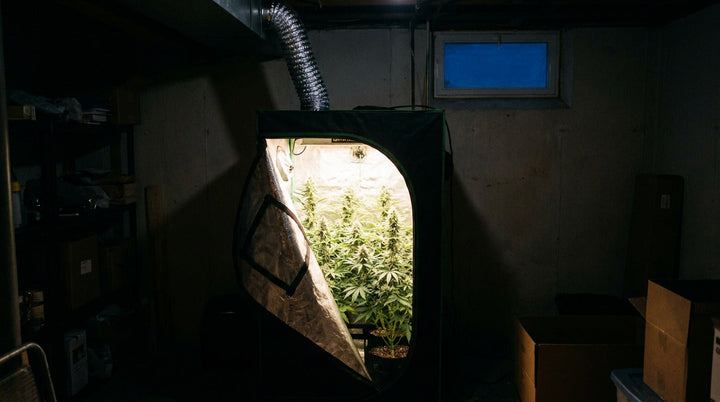
Most guides to CO2 for a grow tent are shopping lists ranked by price. They skip the only question that matters: where the CO2 goes after you release it. A grow tent is a box with a fan on top pulling room air through it, and the fan does not care what is in that air.
This guide does that arithmetic: what CO2 does and what the research measured, where it goes in a vented tent, why your exhaust fan is your most important CO2 equipment, every way to add CO2 compared by what it can deliver, a seven-step sealed-room setup, and how to stay safe around an invisible gas. If heat is what is limiting your tent rather than CO2, our grow tent temperature guide is the place to start.
The Short Answer: Does a Grow Tent Need CO2?
It depends on whether your grow space trades air with the rest of the house. Find your setup below.
| Your setup | Add CO2? | What to do instead, or as well |
|---|---|---|
| A tent with an exhaust fan running most of the lights-on period (most home tents) | No. It goes out the duct. | Keep the exhaust running so the tent stays at room CO2, spend the money on light and an even canopy |
| A tent with a small, slow or passive exhaust | No | Check for depletion first: a weak exhaust can leave the tent 100 ppm or more below room air all day |
| A tent inside a closed room that has its own air conditioner and dehumidifier | Yes, enrich the room | Let the tent exhaust into the room, not outdoors, and run CO2 on a controller with a canopy sensor |
| A sealed grow room, no air exchanged with outside while the lights are on | Yes | A cylinder and regulator on a controller, 800 to 1,200 ppm, lights-on only |
| Seedlings, clones and mother plants | Not worth it | Small plants need little; fresh air is plenty |
The target, when you can hold one, is 800 to 1,200 ppm while the lights are on. In Westmoreland's trials, going from 420 to 800 ppm delivered about 70% of the total yield gain, and 1,200 ppm delivered 90% of it.1 Above 1,200 ppm you are paying for the last tenth.

What CO2 Does for a Cannabis Plant
A plant builds itself out of air. Light supplies the energy, the roots supply water, and carbon dioxide (CO2) comes in from the air through tiny pores on the underside of the leaf, called stomata. Inside the leaf, photosynthesis turns the CO2 and water into sugar, and the sugar becomes stems, roots and buds. Every bit of carbon in a dried flower was CO2 in the air of your tent a few weeks earlier.

Outdoor air holds about 425 parts per million (ppm) of CO2: 425 molecules of CO2 in every million molecules of air. NOAA's Mauna Loa record put the 2024 average at 424.6 ppm and the preliminary 2025 average at 427.4.2 That is far less than a cannabis leaf can use. The enzyme that grabs CO2 inside the leaf (rubisco) works faster with more CO2 around it and wastes less energy grabbing oxygen by mistake, so photosynthesis climbs as CO2 rises, well past outdoor levels.
At the other end, a cannabis leaf stops taking in CO2 altogether at about 50 ppm. Westmoreland measured that floor, the CO2 compensation point, at 50 ppm, give or take 5.1 Between 50 and 425 ppm, every ppm the plant loses costs it growth.
A leaf reading is not a yield
The best-known cannabis CO2 numbers came from Suman Chandra, Hemant Lata, Ikhlas Khan and Mahmoud ElSohly at the University of Mississippi. They clamped single leaves into a measuring chamber and found that raising CO2 from 350 to 750 ppm raised photosynthesis by 50% and more than doubled water use efficiency, while dropping CO2 to 250 ppm cut photosynthesis by half.3 A follow-up on four high-THC varieties found that 700 ppm raised photosynthesis significantly over 390 ppm, while 545 ppm made no significant difference in most cases.4 A modest bump does little.
Those are short readings on single leaves, taken in minutes. A whole plant adjusts over weeks. Elizabeth Ainsworth and Alistair Rogers pooled the big outdoor CO2 trials and found that light-saturated photosynthesis in plants like cannabis rose by 31% under long-term elevated CO2, less than short-term readings predict, because the leaves turn down part of their CO2-fixing machinery once CO2 is plentiful.5 Westmoreland saw the same thing in cannabis: the short-term gain in leaf and canopy photosynthesis was bigger than the long-term gain in yield.1 So the number to plan around is a yield number, and until recently cannabis did not have one.
What the Research Actually Says About CO2 and Cannabis Yield
The first controlled yield measurement we know of is Westmoreland's 2024 PhD research at Utah State University, supervised by Bruce Bugbee.1 He grew two high-CBD cultivars, Luck and Peach, in 1.4 m² (15 sq ft) growth chambers for eight weeks of flowering. One study held CO2 at 480, 1,000 and 1,400 ppm under two light levels, 750 and 1,500 µmol/m²/s (micromoles of light per square meter per second, the PPFD a light meter reads), which over a 12-hour day is a daily light integral of 32 and 65 mol/m²/day. Our DLI calculator does that sum for any light and schedule. The second held 460, 800 and 1,200 ppm under 1,000 µmol/m²/s. CO2 came from compressed liquid CO2, it was measured continuously with a laboratory gas analyzer, and it was not enriched at night.

What he found:
- Yield rose 43% from 420 to 1,400 ppm, and above-ground biomass 39%. In the second study, going from 460 to 1,200 ppm raised yield 34%.
- The gain was the same at moderate and very bright light. The relative increase held across cultivars and across a daily light integral from 32 to 65 mol/m²/day. Doubling the light doubled yield on its own, and CO2 added its 40-odd percent on top.
- Most of the gain comes early. 420 to 800 ppm accounted for about 70% of the yield increase, and 90% of it was in hand at 1,200 ppm.
- Cannabinoid concentration did not change consistently. It fell about 25% in one treatment and was unaffected in the rest. CO2 is a yield tool, not a potency tool.
- Falling below room air costs more than rising above it gains. His model put the loss from 420 down to 320 ppm at 15% and from 420 to 220 ppm at 40%, while 100 ppm above ambient added 10% and 200 ppm added 20%.
- Buds ran warmer and leaves took up less calcium and magnesium. Flowers sat 2 to 5°C (4 to 9°F) above the air temperature, and raising CO2 from 480 to 1,400 ppm added about 2°C (3.6°F) more. Calcium and magnesium in leaves and flowers fell about 10%. He fed a double-strength solution as needed to keep the runoff at an EC of 1.0 mS/cm (EC measures how much fertilizer is dissolved in the water), because plants at 1,200 ppm use less water per gram of growth and so take in less of whatever the water carries.
Two caveats keep this honest. It is one lab, two high-CBD cultivars and a dissertation rather than a journal paper, so treat 43% as the best number available, not a law. And it was measured in an ideal environment, which is exactly the point: Westmoreland concluded the yield benefit of elevated CO2 is about 40% across crops like cannabis "when other environmental factors are non-limiting". His figure also lines up with the broad record. Bruce Kimball's 1983 review of 430 observations across 37 crops predicted a 33% yield increase for a doubling of CO2.6
One more thing it settles. You will read that CO2 only helps above 1,000 µmol/m²/s of light, so a home light is too weak for it. Westmoreland's gain was the same at 750 µmol/m²/s as at 1,500. Our grow light distance guide lists the light targets by stage. Light and CO2 stack. And light keeps paying without any CO2 at all: in Victoria Rodriguez-Morrison, David Llewellyn and Youbin Zheng's trial at the University of Guelph, run at ordinary room CO2 (437 ppm with the lights on), yield rose in a straight line all the way to 1,800 µmol/m²/s.7 The obstacle to CO2 in a home grow is not the light. It is the air.
Where the CO2 in a Vented Tent Actually Goes
Take a 4 ft by 4 ft (120 x 120 cm) tent, 6.5 ft (200 cm) tall, flowering under a 480 W LED. Our temperature guide sizes the exhaust for heat: about 0.63 CFM (cubic feet per minute) of real airflow per watt, so about 302 CFM for this light. The popular rule of one tent volume a minute gives about 112 CFM. Either way, the air in the tent is replaced every 20 seconds to a minute.
To hold that tent at 1,200 ppm while the fan pulls in room air at 425 ppm, every cubic foot that leaves takes 775 ppm of your CO2 with it. CO2 weighs about 1.8 grams per liter at 77°F (25°C), so:
- At 112 CFM the exhaust carries away about 265 g (9.3 oz) of CO2 an hour.
- At 302 CFM it carries away about 715 g (25 oz) an hour.
- The plants themselves take in about 6 g (0.2 oz) an hour. That is our estimate for a dense flowering canopy filling 1.5 m² (16 sq ft), taking in 25 µmol of CO2 per square meter of floor per second. Double it and nothing below changes.

So the fan removes 45 to 120 times what the plants use, and 1 to 2 percent of the CO2 you pay for ever reaches a leaf. A 20 lb (9 kg) cylinder, the common size at a welding or beverage gas supplier, lasts about 34 hours of lights-on at 112 CFM and about 13 hours at 302 CFM. In a 12/12 flowering room that is one to three days per cylinder, for eight to ten weeks.
This is why CO2 kit instructions often tell you to switch the exhaust off while the CO2 is on. That works for CO2 and breaks everything else, because the exhaust was the thing removing the heat from the light and the water from the plants. A 480 W light in a closed tent is a 480 W heater in a closed box; our temperature guide works through why a tent's temperature is its intake air plus a rise set by the watts and the airflow, and with the airflow at zero the rise has no ceiling. The plants also put most of the water you pour back into the tent air, which our grow tent humidity guide puts at about 5.6 pints (2.6 L) a day per plant in a 5 gallon (19 L) pot in mid flower. Turn the fan off and something else has to take that heat and water out.
The half measure: CO2 only while the fan rests
Some controllers inject CO2 only while the exhaust is idle and lock it out when the fan starts. It wastes less, but in a typical LED tent in flower the fan runs most of the lights-on period and flushes the enriched air in under a minute each time it starts. It is a way to waste less, not a way to hold 1,200 ppm.
Your Exhaust Fan Is Already Your Most Important CO2 Equipment
Turn the problem around. A tent of flowering plants under a strong light eats CO2 quickly, and the only thing refilling it is the air your exhaust pulls in. Our model of the same 4 ft by 4 ft (120 x 120 cm) tent, with no CO2 added, shows how fast that matters:
- Sealed, no air in or out: the canopy pulls the tent from 425 ppm to about 300 ppm in under 10 minutes and under 200 ppm in about 20.
- A 10 CFM trickle, a passive vent or a very small fan: the tent settles near 300 ppm and stays there all day.
- 40 CFM: about 380 ppm, 45 below the room.
- 112 CFM, one tent volume a minute: about 410 ppm, within about 15 ppm of the room.

Put those against Westmoreland's model and the slow-exhaust tent is the expensive one. A tent stuck near 300 ppm is about 125 ppm below room air, and his model puts a 100 ppm shortfall at 15% of yield. That is a bigger number than most growers would ever get from adding CO2 to a vented tent, and fixing it costs a correctly sized fan.

The model is ours, with stated assumptions: room air at 425 ppm, the canopy taking in 25 µmol/m²/s at room CO2 and less as CO2 falls, down to nothing at 50 ppm. Real tents leak through zippers and seams, so a "sealed" tent falls somewhat slower. The shape does not change: a tent that does not exchange its air runs short of CO2 within minutes of lights-on. Greenhouse growers know the same effect from winter, when the vents stay shut to hold heat: Westmoreland notes that CO2 in a closed greenhouse can fall more than 200 ppm below outdoor air.

Three things keep a vented tent at room level:
- Run the exhaust through the whole lights-on period, sized for heat as worked out above. Do not put it on a timer that stops it for long stretches with the lights on.
- Give it a real intake. A tent with every port zipped shut makes the fan pull through the seams. Open a low passive vent or run an intake duct from a cool, airy part of the house.
- Move air inside the canopy. A dense canopy holds still air between its leaves, and that pocket runs low on CO2 even when the tent air above it is fine. A small fan at canopy height keeps it mixed.

Inside the canopy is where it shows first. Air moves freely over the tops, but between dense leaves it sits still, and the leaves there use up the CO2 around them faster than it diffuses back in.

The same goes for the room the tent breathes from. A small closed room with people in it can sit well above outdoor CO2, and a tent in a well ventilated basement will sit near outdoor levels. A cheap CO2 monitor in the room tells you which you have.

When CO2 Enrichment Is Worth It
Enrichment pays when the CO2 you add stays around the plants for hours, not seconds. You need every line of this list.
- The space is closed while the lights are on. A sealed grow room, or a tent that exhausts into a closed room rather than to the outdoors or the rest of the house.
- An air conditioner removes the heat. Sized from the plug watts, as our air conditioner sizing section shows. A dual-hose portable, a window unit or a ductless mini-split.
- A dehumidifier removes the water, sized to the water you pour, as in our humidity guide.
- Everything else is already right. An even canopy under enough light, the right feed and pH, no pests. CO2 multiplies what you have; it does not fix a canopy with three tall colas and twenty shaded sites. Nor does it license commercial tricks: our defoliation guide explains why the heavy leaf stripping some CO2-enriched commercial rooms use costs a home grow yield.
- A controller with a sensor, not a timer, decides when the gas flows.

With those in place the economics flip. Take a 10 ft by 10 ft (3 x 3 m) room, 8 ft (2.4 m) tall, holding one 4 ft by 4 ft tent's worth of flowering plants. A closed room in a house still leaks; at half an air change an hour, meaning half the room's air leaks out every hour (our assumption; a closed interior room can be tighter), holding 1,200 ppm loses about 16 g (0.6 oz) an hour through the walls and door. Add the plants' 6 g an hour and a 12-hour day uses about 260 g (9 oz). The same 20 lb (9 kg) cylinder that lasts a day in a vented tent lasts about five weeks in that room.

If none of that describes your grow, the money is better spent elsewhere. In Westmoreland's chambers, doubling the light doubled yield at every CO2 level, room air included, and Rodriguez-Morrison and colleagues saw yield climb with light at room CO2 too. An even, trained canopy puts more of the light you already pay for onto bud sites, which our canopy science guide covers in detail. In a vented home tent, a flat canopy under a stronger light is the CO2 upgrade.

Every Way to Add CO2, Compared
There are five common ways to put CO2 into a grow space. The useful way to compare them is not price but grams: how much CO2 each can actually deliver against what the space uses. A sealed 4 ft by 4 ft tent's plants use about 71 g (2.5 oz) in a 12-hour day. The same tent with its exhaust running at 112 CFM needs about 3,200 g (7 lb) a day to hold 1,200 ppm.

| Source | What it delivers | Control | Side effects | Verdict |
|---|---|---|---|---|
| Cylinder, regulator and controller | As much as you set; 9 kg (20 lb) per cylinder | Exact, with a sensor | None in the room | The one to use in a sealed room or small room |
| Propane or natural gas burner | About 3 lb of CO2 per lb of propane | Good, on a controller | Heat, water, a flame, carbon monoxide risk | Large sealed rooms only, never a tent |
| Mushroom CO2 bag | At most about 11 g a day, by mass | None | None | Too little to measure in a vented tent |
| Yeast and sugar bottle | About half the sugar's weight, over a week or two | None | Smell, fruit flies, refills | A science project |
| Baking soda and vinegar | About half the soda's weight, in minutes | None | A bucket of vinegar | Gone before it does anything |
Cylinder, regulator and controller
This is how most sealed home rooms do it, and how the research was done. A cylinder of compressed liquid CO2, the kind welding and beverage gas suppliers fill or swap, feeds a CO2 regulator. A grow-room regulator does three jobs: a gauge shows the cylinder pressure, a flow meter (the clear tube with a ball in it) sets how many liters a minute come out, and an electric solenoid valve opens and closes the flow when the controller tells it to. Common kits include ones from AC Infinity, Titan Controls and Vivosun.

The controller is the part that matters. It reads CO2 with an infrared (NDIR) sensor hung at canopy height and opens the solenoid only when the reading drops below your setpoint, so you get the level you asked for whatever the plants and the leaks are doing. A timer-only setup releases a fixed amount whether the room needs it or not, and is guesswork. Good controllers also have a light sensor or a daytime-only mode so they never inject in the dark.

A 5 lb (2.3 kg) cylinder is easier to carry and lasts about nine days in the sealed room example above; a 20 lb (9 kg) cylinder lasts about five weeks. Many gas suppliers swap cylinders rather than refill yours, so ask before you buy one.

Propane and natural gas burners
A CO2 generator burns propane or natural gas in a row of small jets inside a metal box that hangs above the canopy. Burning propane makes about three times its own weight in CO2: the US Energy Information Administration lists 12.68 lb of CO2 per gallon of propane, which works out to about 3 lb per lb.8 The catch is everything else the flame makes. Each pound of propane also releases about 1.6 lb (0.7 kg) of water and about 20,000 BTU of heat (our arithmetic from the chemistry), and any flame indoors can make carbon monoxide if it burns badly.

Scaled to a tent, it is absurd. Holding a 4 ft by 4 ft tent at 1,200 ppm with its exhaust at 112 CFM would mean burning about 90 g (3 oz) of propane an hour, which puts about 1,100 W of heat into the tent, on top of the light. Burners are built for large sealed rooms where the air conditioning is sized for them. In a home tent or a small room, use a cylinder.
Mushroom CO2 bags (ExHale and similar)
A CO2 bag is a sealed grow bag of grain or similar substrate colonized by fungal mycelium. The fungus slowly digests the substrate and breathes out CO2 through a filter patch, the way any living thing does. ExHale is the best-known brand. Retailer listings say the bag raises CO2 by about 500 ppm on average in a space up to 4 ft by 4 ft or 128 cubic feet (3.6 m³), for up to six months, and list it at 4.5 lb (2 kg). We found no independent measurement of its output.

The mass sets a ceiling. CO2 cannot come out of a bag that was not in it. If every gram of a 2 kg (4.5 lb) bag, water and plastic included, turned into CO2 over six months, which is chemically impossible, that would be about 11 g (0.4 oz) a day. Holding a 500 ppm rise in a vented 4 ft by 4 ft tent at 112 CFM takes about 2,000 g (4.4 lb) a day. Even in a sealed tent with no exhaust, the plants alone use about 71 g a day, so the bag's absolute best case is a seventh of their use. A mushroom bag does release CO2, and a bag in a tiny sealed cabinet may nudge the reading. In a vented tent, it cannot move the number you care about.
Yeast and sugar
Yeast fermenting sugar water makes alcohol and CO2. A sealed bottle with a tube through its cap is the classic do-it-yourself version. The chemistry caps it at about half the sugar's weight: 2 cups (400 g) of sugar makes at most about 200 g (7 oz) of CO2, over a week or two of fermentation, with the rate falling as the yeast tires. That is about 15 to 30 g (0.5 to 1 oz) a day, with no way to control when it comes out, a sour smell and a magnet for fruit flies. It is a fine science project and a poor way to feed a tent.

Baking soda and vinegar
Baking soda and vinegar give off about half the soda's weight as CO2, and they give it all at once. A cup (220 g) of baking soda makes about 115 g (4 oz) of CO2 in a few minutes. In a vented tent it is out the duct before it reaches the canopy, and in a sealed tent it is a single spike the plants use up in under an hour. It does not work as enrichment.

CO2 Levels by Stage: How Much, and When
Hold CO2 only while the lights are on. In the dark, a plant does not photosynthesize; it only breathes, giving off CO2, so enrichment at night is wasted gas. Westmoreland did not enrich at night either.1

| Stage | CO2 with lights on | Why |
|---|---|---|
| Seedlings and clones | Room air, about 425 ppm | Small plants use little CO2; clones under a dome need fresh air and steady humidity, not CO2 |
| Vegetative growth | 800 to 1,200 ppm, sealed rooms only | Faster growth, but veg is short and cheap; many growers save the gas for flower |
| Flowering | 800 to 1,200 ppm, sealed rooms only | This is where the measured 34 to 43% yield gain comes from; 90% of it is in hand at 1,200 |
| Any stage, at night | Off | No photosynthesis in the dark |
We stop at 1,200 ppm for three reasons. The trial shows diminishing returns above it. Every extra ppm leaks out of a real room at the same rate, so the gas cost climbs while the yield gain flattens. And it keeps a wide margin under the levels that start to affect people, below.
What changes when you run CO2

Enriched plants close their stomata partway. Chandra and colleagues measured stomatal conductance down about 42% and transpiration down about 29% at 750 ppm.3 Less water leaving the leaf means three practical changes:
- The buds run warmer. Water leaving the leaf is how a plant cools itself, so less of it means warmer tissue. In Westmoreland's trial, flowers were already 2 to 5°C (4 to 9°F) above the air, and enrichment added about 2°C (3.6°F) more.1 Watch the tops, as our foxtailing guide explains, and use our VPD guide's leaf-temperature check rather than the air thermometer alone.
- The plants drink less per gram of growth. The pot dries back more slowly, so water by pot weight, as our watering guide describes, rather than by the calendar.
- Calcium and magnesium can run short. These two move into the plant with the water, so less water carries less of them; Westmoreland measured both about 10% lower at 1,400 ppm. Watch for the early signs in our deficiencies guide and keep the feed strength right, as our nutrients guide covers.

How to Set Up CO2 in a Sealed Grow Room, Step by Step
These steps assume the room passes every line of the "worth it" list above: closed while the lights are on, with an air conditioner and a dehumidifier carrying the heat and water.
Step 1 - Close the room and check it holds
Seal the room's door with weatherstripping, close or block any duct to the rest of the house, and set any tent inside it to exhaust into the room rather than out of it.

Then test the room: release CO2 until a meter in the room reads about 1,000 ppm, turn the gas off, and watch how fast the reading falls with the lights off. A room that drops back to room air within an hour or two leaks too much to enrich; find the gaps first.

Step 2 - Chain the cylinder upright outside the canopy
Stand the cylinder upright in a corner of the room, away from the lights and any heater, and chain or strap it to the wall so it cannot fall. A falling cylinder can snap its valve. Keep it out of direct sun and anywhere it can get hot.
Step 3 - Fit the regulator and solenoid
Screw the regulator onto the cylinder valve by hand and then snug it with a wrench, with the sealing washer that came with it in place. Open the cylinder valve slowly, check the gauge, and brush soapy water over the joints; bubbles mean a leak. Set the flow meter to a low rate to start, about 1 to 2 liters a minute for a small room; the controller decides how long it flows.

Step 4 - Run the tube to just above the canopy
Run the tube from the solenoid up to the ceiling and out over the middle of the canopy, a little above the tops. CO2 is about one and a half times as heavy as air, so it settles downward: release it above the plants and let it fall into them, not at floor level where it pools under the pots.

Hang the end of the tube from hooks so it cannot drift down into the plants. Some growers run a length of tube with small holes punched along it across the canopy to spread the gas.

Step 5 - Hang the sensor at canopy height and wire the controller
Hang the controller's sensor at the height of the tops, in the middle of the canopy, out of the direct stream from the tube and away from the light. Plug the solenoid into the controller's outlet. Set the target to 1,000 to 1,200 ppm and turn on its daytime-only mode or light sensor so it never runs in the dark.
Step 6 - Lock out any exhaust while the CO2 runs
If the room still has an exhaust fan to the outside for emergencies or for the night, set the controller or a fan controller so the CO2 is off whenever that fan runs. Otherwise the two fight, and the fan wins.
Step 7 - Watch the plants for a week, then adjust
Watch the readings for the first few days: the room should reach the setpoint within minutes of lights-on and hold it. Check leaf and bud temperature at the tops, the pot weight before watering, and the newest leaves for the first signs of calcium or magnesium shortage. Adjust the room temperature and feed rather than the CO2.
CO2 Safety: What Is Dangerous, and How to Stay Below It
CO2 is not poisonous the way carbon monoxide is; we breathe it out all day. But at high concentrations it causes headaches, drowsiness and shortness of breath, and at very high concentrations it is dangerous. You cannot see it or smell it, so the only way to know the level is a meter.

The US exposure limits, from the NIOSH Pocket Guide to Chemical Hazards:9
- 5,000 ppm averaged over an 8-hour working day: the OSHA permissible limit and the NIOSH recommended limit.
- 30,000 ppm for any 15 minutes: the NIOSH short-term limit.
- 40,000 ppm: immediately dangerous to life or health.
A grow room held at 1,200 ppm sits a long way below the first line. The danger is a fault: a stuck solenoid, a cracked tube or a cylinder left open overnight in a small closed room. CO2 is heavier than air, so it collects low, in a basement or at the floor of a closet. The rules that keep you safe:
- Put a CO2 monitor with an alarm in the room, at head height, separate from the controller's sensor. If the controller fails, the second meter is the one that tells you.
- Burners only with a carbon monoxide alarm in the same room, and only in rooms built for them.
- Never enrich a bedroom, a closet in a living space, or any room someone sleeps in.
- Close the cylinder valve at the end of the day if your controller does not cut the flow reliably, and whenever you leave the grow for more than a day.
- If you feel a headache or short of breath in the room, leave, open the door, and check the meter before you go back in.
- Keep children and pets out of an enriched room.

Common CO2 Mistakes
Adding CO2 to a tent with the exhaust running
The most common one, and the most expensive: 98 to 99 percent of the gas goes out the duct. If you cannot close the space, do not buy the cylinder.
Starving the tent with a weak exhaust
The quiet mistake. A tent with a tiny fan, a fan on a long off-cycle, or every port zipped shut can run 100 ppm or more below the room for the whole day, which costs more yield than CO2 could ever add.

Using a timer instead of a sensor
A timer releases the same amount whatever the room is doing. Some days that is too little, and on a day the plants use less it is too much. A controller reads the air.
Expecting CO2 to raise potency
It raised yield in the trials and did not consistently change cannabinoid concentration. Buy it for grams, not for percent THC.
Adding CO2 before the basics are right
CO2 multiplies a good grow. An uneven canopy that topping and low-stress training would have leveled, a weak light, the wrong pH or a pest problem will still be there at 1,200 ppm, and it will still be the thing limiting your harvest.
Frequently Asked Questions
Does a grow tent need CO2?
No. A vented grow tent needs fresh air, not added CO2. With an exhaust fan running, the tent stays close to room air, about 425 ppm, which grows excellent cannabis. Added CO2 only pays in a space that is closed to outside air while the lights are on, with an air conditioner and dehumidifier doing the exhaust fan's job. In a vented tent most of it leaves through the duct within a minute.
What is the ideal CO2 level for a grow tent?
In a vented tent, the goal is room air, about 425 ppm, and never below it; a tent that falls 100 ppm under room air loses more yield than enrichment adds. In a sealed room, hold 800 to 1,200 ppm with the lights on. In growth-chamber trials, 800 ppm gave about 70% of the full yield gain and 1,200 ppm gave 90% of it.
How much does CO2 increase cannabis yield?
In Mitchell Westmoreland's 2024 Utah State trials, raising CO2 from about 420 to 1,400 ppm raised flower yield by 43%, and 460 to 1,200 ppm raised it 34%. The gain held at moderate and very bright light and in both cultivars tested. Cannabinoid concentration did not change consistently. It was measured in sealed growth chambers, with everything else ideal.
Is CO2 worth it in a 4x4 grow tent?
Not if the tent vents outside the room. Holding a 4 ft by 4 ft tent at 1,200 ppm with its exhaust at 112 CFM takes about 265 g of CO2 an hour, so a 20 lb cylinder lasts about 34 hours of lights-on. It is worth it if the tent sits in a closed room with its own air conditioner and dehumidifier, exhausting into that room.
Do ExHale CO2 bags work?
Not in a vented tent. A mushroom bag does release CO2, but its mass caps the output: even if all 4.5 lb (2 kg) of the bag turned into CO2 over six months, which is impossible, that is about 11 g a day. A vented 4 ft by 4 ft tent loses around 3,000 g a day at 1,200 ppm, and even sealed plants use about 71 g.
Does baking soda and vinegar make CO2 for plants?
Yes, but all at once and not much. A cup (220 g) of baking soda gives off about 115 g of CO2 within minutes. In a vented tent it leaves through the exhaust before it does anything, and in a sealed tent it is a brief spike the plants use within an hour. It cannot hold a level, so it does not work as enrichment.
How long does a 20 lb CO2 tank last in a grow room?
It depends on how much air leaves the room. In a vented 4 ft by 4 ft tent held at 1,200 ppm it lasts 13 to 34 hours of lights-on. In a closed 10 ft by 10 ft room with one tent's worth of plants, leaking half an air change an hour, it lasts about five weeks of 12-hour days. Tightness, not plant count, sets the answer.
Should I turn off my exhaust fan when using CO2?
Only if something else removes the heat and humidity, an air conditioner and a dehumidifier sized for the room. Otherwise the tent overheats and the humidity climbs within minutes of lights-on. A controller can lock the CO2 out whenever the exhaust runs, which wastes less gas, but in most LED tents the fan runs too often for that to hold a level.
Should CO2 run at night?
No. Plants take in CO2 only while photosynthesizing, which needs light. In the dark they give off CO2 instead. Run enrichment only during lights-on, using a controller with a daytime mode or a light sensor; the yield research did not enrich at night.
Do I need CO2 if my light is under 1,000 PPFD?
Light is not what decides it. In Westmoreland's trials the relative yield gain from CO2 was the same at 750 µmol/m²/s as at 1,500. What decides it is whether the space can hold the CO2. And at room CO2, yield keeps rising with more light, so in a vented tent a stronger light and an even canopy are the better upgrade.
Is CO2 dangerous in a grow room?
At 1,200 ppm, no. The US workplace limit is 5,000 ppm averaged over 8 hours, 30,000 ppm for 15 minutes, and 40,000 ppm is immediately dangerous. The risk is a fault, such as a stuck valve or an open cylinder in a small closed room. Keep a separate CO2 alarm at head height, and never enrich a room anyone sleeps in.
Does CO2 increase THC?
Not reliably. In the only controlled cannabis yield trial we found, enrichment to 1,400 ppm raised flower yield by up to 43%, but cannabinoid concentration fell in one treatment and was unchanged in the rest. More grams of flower means more total cannabinoids per plant, but not a higher percentage in each bud.
Do plants need more water or nutrients with CO2?
Less water per gram of growth, and a closer eye on feed. CO2 partly closes the leaf pores, so plants transpire less: Chandra and colleagues measured transpiration down about 29% at 750 ppm. Calcium and magnesium travel in with the water, and Westmoreland measured both about 10% lower at 1,400 ppm, so watch for early shortages and keep feed strength right.
Where to Go From Here
For most home grows the CO2 work is done by the exhaust fan, so the next step is making sure it is sized and running properly, which our indoor growing guide covers alongside the light, the tent and the timer. The bigger yield lever in a vented tent is the light you already have: our light schedule guide shows how hours and intensity add up to a daily dose, and our flowering stage guide sets the light and climate for the weeks that make the harvest. Training is how you spread that light: LST clips like the BudClips hold branches out into an even canopy in veg, and fabric pots like the BudPots give the roots the air and the steady dry-back that every one of these upgrades depends on.
References
- Westmoreland, F. M. (2024). Environmental physiology of medical cannabis [Doctoral dissertation, Utah State University; committee chair B. Bugbee]. Chapter 6, Exploring the limits of crop productivity from photosynthesis to yield: response to elevated CO2. https://doi.org/10.26076/1d25-9d05
- NOAA Global Monitoring Laboratory. Mauna Loa CO2 annual mean data (2024: 424.61 ppm; 2025, preliminary: 427.35 ppm). https://gml.noaa.gov/ccgg/trends/data.html
- Chandra, S., Lata, H., Khan, I. A., & ElSohly, M. A. (2008). Photosynthetic response of Cannabis sativa L. to variations in photosynthetic photon flux densities, temperature and CO2 conditions. Physiology and Molecular Biology of Plants, 14(4), 299-306. https://doi.org/10.1007/s12298-008-0027-x
- Chandra, S., Lata, H., Khan, I. A., & ElSohly, M. A. (2011). Photosynthetic response of Cannabis sativa L., an important medicinal plant, to elevated levels of CO2. Physiology and Molecular Biology of Plants, 17(3), 291-295. https://doi.org/10.1007/s12298-011-0066-6
- Ainsworth, E. A., & Rogers, A. (2007). The response of photosynthesis and stomatal conductance to rising [CO2]: mechanisms and environmental interactions. Plant, Cell & Environment, 30(3), 258-270. https://doi.org/10.1111/j.1365-3040.2007.01641.x
- Kimball, B. A. (1983). Carbon dioxide and agricultural yield: an assemblage and analysis of 430 prior observations. Agronomy Journal, 75(5), 779-788. https://doi.org/10.2134/agronj1983.00021962007500050014x
- Rodriguez-Morrison, V., Llewellyn, D., & Zheng, Y. (2021). Cannabis yield, potency, and leaf photosynthesis respond differently to increasing light levels in an indoor environment. Frontiers in Plant Science, 12, 646020. https://doi.org/10.3389/fpls.2021.646020
- US Energy Information Administration. Carbon dioxide emissions coefficients by fuel. https://www.eia.gov/environment/emissions/co2_vol_mass.php
- National Institute for Occupational Safety and Health. NIOSH Pocket Guide to Chemical Hazards: carbon dioxide. Centers for Disease Control and Prevention. https://www.cdc.gov/niosh/npg/npgd0103.html

About the Author
Henrique Dias is the CEO and co-founder of BudTrainer. He is a mechanical engineer who also holds a graduate certificate in Commercial Cannabis Production from Niagara College in Ontario, Canada - the first college-level cannabis cultivation program in North America. Before founding BudTrainer, Henrique worked with Health Canada licensed cannabis producers, where he gained hands-on experience in cultivation, processing, and post-harvest management of cannabis at commercial scale. He started BudTrainer to bring that same level of craft to home growers through better-designed gardening tools and clear, science-backed education.
DISCLAIMER: Everything taught and sold by BudTrainer® is to be used strictly for legal purposes. We do not endorse the production of illegal substances and it is your duty to ensure that you are complying with the law. The words "hemp," "cannabis," "weed," and "marijuana" are used interchangeably to refer to the same plant (legal hemp with less than 0.3% THC) for the purposes of this lesson.