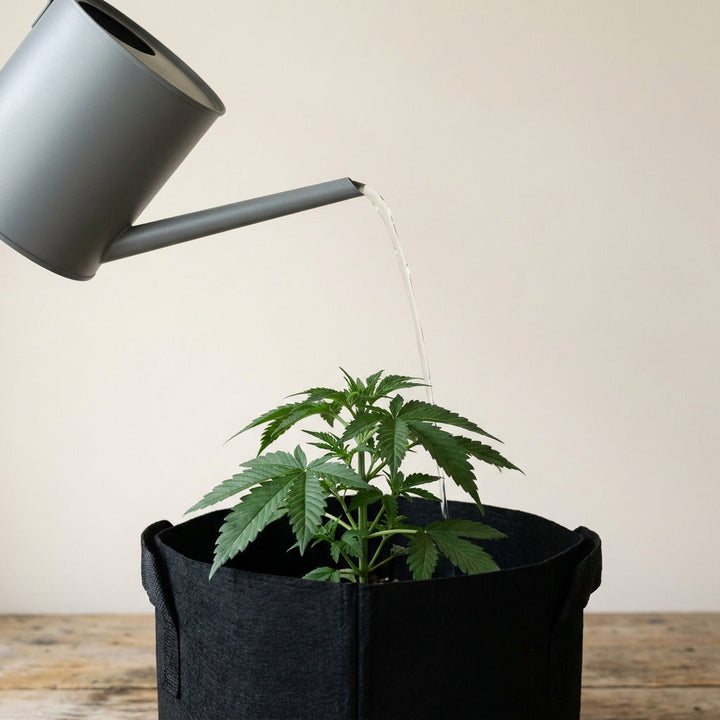
Root rot is the problem growers find last. By the time anyone lifts a net pot or tips a plant out of its pot, the leaves have usually been drooping for days, and the grower has already tried more feed, less feed and a pH correction. This guide is built around that order of events. It shows you what rotten roots look like next to healthy ones, the five things that only look like root rot, what actually causes it in soil, coco and deep water culture (DWC), and what to do in the first hour after you find it. Then it covers the treatments people reach for, ranked by what the research behind them actually found, and how to set up a grow so root rot never gets started.
If you want the root biology first, why roots need oxygen at all and what the wet-dry cycle does for them, our root development science guide covers the physiology. This article is the practical side: how to spot root rot, how to save the plant, and how to keep it out.
What Is Cannabis Root Rot?
Root rot is not one disease. It is the name growers give to roots that have turned brown, soft and slimy and stopped working, whatever killed them. On cannabis, the organisms that do it have been identified by Zamir Punja's lab at Simon Fraser University, which sampled sick plants from licensed producers in Canada and California for several years.
In hydroponically grown plants sampled from 2014 to 2017, Punja and Rodriguez found root rot caused by two species of Pythium, Pythium dissotocum and P. myriotylum, and two Fusarium species, F. oxysporum and F. solani. When they put the Pythium back onto healthy plants, every isolate browned the roots, shrank the root mass and stunted the plant.4 A later survey of seven licensed greenhouses pulled 95 Pythium isolates from 140 diseased plants: 43 were P. myriotylum, 35 P. dissotocum, 12 P. catenulatum, 3 P. aphanidermatum and 2 P. ultimum. In a coco and perlite mix, P. myriotylum killed plants within 14 days.1

Pythium: the water mold
Pythium looks and behaves like a fungus, but it is not one. It belongs to the oomycetes, the water molds, a separate branch of life that also includes the potato blight. The difference matters for one practical reason: Pythium spreads by zoospores, single cells with two tails that swim through water toward roots. Sutton and colleagues, reviewing the hydroponic research on Pythium, call zoospores the main source that starts and spreads root rot epidemics, and note that they gather where water moves slowly.5 Water is not just where Pythium lives. It is how Pythium travels.
Pythium is also fast once it is in. In Gold and Stanghellini's hydroponic spinach trial, Pythium threads were inside the roots within 15 minutes of zoospores being added to 73°F (23°C) water, and P. aphanidermatum caused severe root rot or killed plants within three to four days at 70 and 81°F (21 and 27°C).6
Fusarium: the one that rides in on cuttings
Fusarium is a true fungus. On cannabis, F. oxysporum browned roots and caused crown rot, a brown, discolored stem base, with staining up through the pith (the soft core of the stem) and the water-carrying tissue, and sometimes wilting. Punja and Rodriguez found it in the recirculating nutrient solution, and found that rooted cuttings bought from commercial propagators already carried Fusarium root infection that later stunted, yellowed and occasionally killed the plants.4 If you buy clones, that is the route to worry about.

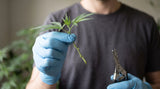
A clean clone looks like this one: bright white roots coming out of the cube, no brown, no slime and a firm, green stem base. Look before it goes anywhere near your other plants.
What Root Rot Looks Like
The roots tell you everything; the leaves tell you almost nothing until it is late. Here are the signs in the order you will check them.
The roots: brown, slimy, and the skin slides off
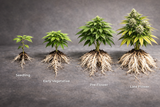
Healthy cannabis roots are white to cream, firm and fuzzy with fine root hairs. Punja's team describe healthy roots grown in air as white with many side branches and root hairs.1 Rotten roots are tan to coffee brown, limp and matted together into slimy ropes, and they often smell sour or swampy. In DWC the brown usually starts on the lower roots and the tips while the roots near the top stay white for a while.


The healthy roots on the left are bright, separate and fuzzy. The rotten ones on the right are brown, wet and clumped together, with only a few pale roots left near the net pot. The difference is that obvious once you look, and that is the main lesson: look.
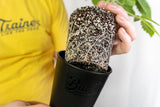
In soil or coco you see the outside of the root ball only. Tip the plant out and check the roots on the surface. Brown, soft, broken roots with few white tips mean trouble. White roots on the outside of a wet root ball mean the roots are fine and the problem is somewhere else.


The slide test: one root, two fingers
This is the single most useful check. Pinch a brown root between thumb and finger and pull gently along it. On a rotten root, the soft brown outer layer slides off like a wet sleeve and leaves a thin, pale thread behind: the root's inner core, the part that carries water. Penn State Extension describes exactly this for Pythium: the brown outer tissue "easily pulls off," leaving a strand of vascular tissue exposed.7 Greenhouse growers call it rat-tail. A root that is only stained brown stays firm and does not peel.

The plant: wilting in a wet pot
Above ground, the classic sign is a plant that droops even though its pot is heavy and wet, or its roots are sitting in water. Roots that have rotted cannot move water to the leaves, so a plant drowning at the bottom looks thirsty at the top. Sutton's review adds a warning: leaves often stay green and healthy-looking while root rot is already severe, stunting comes before wilting, and foliage discolors only once the roots are almost entirely rotted.5

Other signs follow from the same cause: slow growth compared with a sibling, lower leaves yellowing, leaf edges browning, and symptoms that look like nutrient deficiencies but do not respond to feeding. A plant with rotten roots cannot take up what you give it, so adding more food makes nothing better and can make the root zone worse.

The stem base: crown rot
When Fusarium or Pythium moves up from the roots, the base of the main stem at the soil line turns tan to brown, dry and sunken, and the outer skin cracks and peels. Punja's team found this crown rot on cannabis caused by Fusarium and Pythium together, with the crown sunken and mold visible on the surface, and found the pith inside the stem discolored.8 A brown, sunken stem base is a much worse sign than brown roots, because the plant cannot grow new roots past it.

Seedlings and clones: damping-off
In seedlings the same organisms cause damping-off: the stem pinches thin, brown and water-soaked right at the soil line and the seedling keels over. Punja's group found Fusarium spreading through rockwool blocks and killing cuttings at the cut end the same way.8 A seedling that has damped off cannot be saved. The fix is the next one: a small container, a light hand with water, and a clean start, which our planting guide walks through.

Five Things That Look Like Root Rot (and Are Not)
Brown roots and drooping leaves have other causes. Before you treat anything, rule these out. The slide test and a sniff settle most of them.

1. Roots stained by nutrients
Organic nutrients, teas and some additives dye DWC roots tan or brown. Stained roots are evenly colored all over, every strand stays separate, crisp and fuzzy, new tips are white, nothing is slimy and nothing smells. The plant above them looks healthy. If the roots pass the slide test, it is a stain, not rot.

2. Overwatering without rot
A pot that never dries out droops a plant long before anything rots. The roots are white, the soil is wet, the leaves are firm but hang down from the stem. Waterlogging alone can brown roots too, Buirs and Punja note, so treat brown roots after a flood as a watering problem whether or not Pythium has moved in; the first fix is the same.9 This is the stage before root rot, and it is fixed by waiting: let the pot dry back to the weight trigger in our guide to telling an overwatered plant from an underwatered one, and it recovers within a day or two.

3. Underwatering
An underwatered plant droops too, but its leaves go thin, papery and limp, the pot is light, and it perks up within an hour or two of watering. Root rot droops in a heavy, wet pot and does not perk up when you water it again. Lift the pot before you decide.

4. Root-bound
A plant that has filled its container slows down, dries out fast and yellows from the bottom. Tip it out and the roots are white and wound round the outside in thick circles. That is a plant that needs a bigger pot, not a treatment. Our transplanting guide covers when to move it up.
5. A real nutrient problem
Yellowing and spotting can be a deficiency, a pH problem or nutrient burn, all with healthy roots. The tell is the root check: white roots plus leaf symptoms means the leaves are the problem. Work through our deficiency guide before you blame the roots, and check your pH first.
What Actually Causes Root Rot? What the Research Says
Pythium and Fusarium are common. They travel in water and on infected plants, and Punja's team found Pythium causing crown and root rot in licensed greenhouses in British Columbia, Ontario and California.1 You cannot keep it out of a home grow completely. What decides whether it rots your roots is the conditions you give it. Three conditions carry most of the weight, and they are all things you control.
1. Warm water
Temperature is the factor with the strongest evidence. Punja, Scott and Lung put the disease optimum of P. myriotylum and P. aphanidermatum, the aggressive species on cannabis, at 77 to 97°F (25 to 36°C); P. ultimum prefers 59 to 68°F (15 to 20°C).1 Sutton's review describes P. aphanidermatum causing severe root rot at root-zone temperatures of about 73 to 81°F (23 to 27°C) or higher, and symptoms getting progressively worse from 68 to 90°F (20 to 32°C) in chrysanthemum.5 In Gold and Stanghellini's spinach trial, 73°F (23°C) was the point that decided which Pythium species took over the roots.6

Sutton's group also report something from their own observations that every DWC grower should know: roots heavily colonized by Pythium at 61 to 64°F (16 to 18°C) stayed almost symptomless, then developed severe symptoms within hours when the water was raised to 75 to 82°F (24 to 28°C).5 A reservoir that runs cool most of the time and spikes on a hot afternoon is exactly the setup that turns a quiet infection into a dead plant.
Cool water is not a cure for every species, though. In hydroponic lettuce, Stanghellini and Kronland found P. dissotocum cut yield by 35 to 54% at 64°F (18°C) with no visible root or leaf symptoms at all.10 Cold water hides some infections rather than stopping them, which is one more reason to look at roots and not only at leaves.
2. Low oxygen
Roots breathe. Sutton's review sums up the hydroponic research plainly: root rot increases when oxygen levels are low, and growers have been advised to keep dissolved oxygen above 5 mg per liter.5 The clearest test is Chérif, Tirilly and Bélanger's: tomatoes inoculated with Pythium were grown at three oxygen levels. The high-oxygen plants stayed healthy throughout and had significantly less Pythium in their roots, while the moderate and low-oxygen plants showed root decay within six days.2
Temperature and oxygen are linked. Warm water holds less oxygen, and warm roots and microbes use more of it. Pure water at sea level holds about 10.1 mg of oxygen per liter at 59°F (15°C), 9.1 at 68°F (20°C), 8.3 at 77°F (25°C) and 7.6 at 86°F (30°C) (the USGS solubility tables). Sutton's group point out that the bigger problem is the other half: oxygen demand from roots and microbes climbs sharply as the water warms.5 A hot reservoir is short of oxygen from both ends.

3. Wounded roots and standing water
Zoospores swim to roots and get in fastest through damage: broken or torn roots, roots twisted when a net pot is lifted and dropped back, roots burned by a strong feed. Punja's team trimmed roots on purpose to make their infections take, and noted that a stock plant with brown roots had been kept saturated for long periods on tables flooded at least twice a day.1 That saturation point is an observation from their facility, not a controlled test, and we found no container trial that has measured it. But Pythium's zoospores need free water to swim, and in containers Penn State Extension flags pots sitting in puddles as a problem.7 In a pot, standing water is the road the spores travel on.
Soil, coco and DWC: three ways to get there

Soil. In soil, root rot almost always starts with a pot that stays wet: a small plant in a huge pot, a saucer full of runoff, a heavy mix with too little perlite, or watering on a schedule instead of by weight. The bottom of the pot stays saturated for days, and the roots that reach it rot first. Our soil guide explains the air side: a container mix needs 20 to 25 percent air by volume, which takes about 30 percent perlite in a bagged soil.

A seedling like this one, in a pot many times its size, is sitting in a wet root zone its roots cannot reach yet. Nothing dries the bottom of that pot but evaporation, and the bottom is exactly where root rot starts.
Coco. Coco holds more air than soil and is fed more often, so it is more forgiving of frequent watering and less forgiving of a clogged drain or a pot sitting in its own runoff. A coco pot standing in a tray of its own drained water is a DWC bucket without the air stone.
DWC and hydro. In deep water culture the roots live in water full time, so everything depends on the water: its temperature, its oxygen and how clean the bucket is. This is where root rot is most common and fastest, and where a hot week can take a healthy plant to brown roots in days.

The other contributors
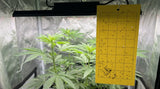
A few other things make root rot more likely, though none of them causes it alone. Fungus gnat larvae feed on roots and spread Pythium and Fusarium; Penn State notes that gnat larvae and shore flies may help move Pythium around a greenhouse,7 and our pest guide covers gnats as the watering problem they are, including the sticky cards that tell you they are there. Light leaking into a reservoir grows algae, which uses oxygen at night and leaves dead matter in the water. Dead roots and leaf bits in the bucket feed the microbes. Reused pots and soil from a sick plant carry the problem into the next grow, which is why our soil guide says never to reuse a mix from a plant that had root rot.

How to Save a Cannabis Plant With Root Rot
Work through these steps in order. The first three take under an hour and matter more than anything you add to the water. In Step 4, only DWC roots get trimmed; roots in soil or coco stay where they are.
Step 1 - Confirm it is root rot
Lift the net pot or tip the plant out of its pot. Look for brown, slimy, matted roots, smell them, and run the slide test on two or three roots. Brown roots whose outer skin slides off, on a drooping plant in a wet pot, is root rot. White roots or evenly stained firm roots are not, and the problem is elsewhere. Then check the stem base: if it is brown, sunken and cracked at the soil line, read the section on when to give up before you go further.
Step 2 - Cool the water or the root zone
Get the root zone into the band our root development guide gives for cannabis roots, 65 to 72°F (18 to 22°C), and keep it under 75°F (24°C) at all times, the line above which the aggressive Pythium species take over. In DWC, a water chiller is the reliable fix. For an emergency, use frozen bottles of water. Melting a 1.5 L bottle of ice soaks up enough heat to cool 4 gallons (15 L) of reservoir water by about 18°F (10°C) if no heat came back in (our arithmetic). A warm room puts that heat back within hours, which is why you swap bottles twice a day and why this buys you days, not a fix. Cooling the room helps both soil and hydro; our guide to cooling a grow tent covers it.
Step 3 - Get oxygen back to the roots
In DWC: run the air stone 24 hours a day, use a pump big enough to keep the surface rolling, clean or replace a clogged stone, and lower the water so there is an air gap of about 2 inches (5 cm) between the bottom of the net pot and the water. The roots crossing that gap breathe moist air. The 2 inch (5 cm) gap is a common grower rule of thumb, not a tested number. In soil and coco: stop watering. Do not water again until the pot has lost about half the weight it gained at its last watering, the trigger in our watering guide. Empty the saucer, raise the pot on feet or a rack so it drains freely, and point a fan across the soil surface.

Drying back is not the same as drying out. Del Castillo Múnera, Belayneh, Lea-Cox and Swett grew potted tomatoes infected with Phytophthora, a close water-mold relative of Pythium, at three moisture levels. Cutting the water to 15% of the pot's volume from a well-watered 20% changed nothing and saved 17% of the water, but holding the mix at 10%, dry enough to stress the plants, made infected plants wilt faster and rot worse, and more of their fine roots were infected than in well-watered plants.11 A rotting plant that also goes thirsty is fighting on two fronts. Let it dry back to the weight trigger, then water normally.

In DWC, the bucket itself is part of the fix. Here is what a setup that keeps root rot out looks like.

Step 4 - Clean house, and cut away dead roots in DWC
In DWC, move the plant into a clean bucket with fresh nutrient solution mixed at a light strength, pH 5.8 to 6.0. Before it goes back in, trim off roots that are fully brown and mushy with clean scissors dipped in 10 percent household bleach for 2 minutes and rinsed, the disinfection standard we use for cloning tools. Leave anything white or cream, even if it is stained. Scrub the old bucket, lid, air stone and tubing, soak them in the same bleach dilution, and rinse well before reuse. A slimy air stone is not worth saving; replace it.

In soil or coco, do not wash or trim the roots. Pulling a wet root ball apart wounds the roots that are still working. Let it dry back instead. Repot only if the pot cannot drain at all, and then into a pot of the same size, not a bigger one.

Step 5 - Add a tested biological, if you have one
The two products that protected cannabis roots from Pythium in Scott and Punja's trial were RootShield Plus WP (Trichoderma harzianum T-22 and T. virens) and Lalstop, sold as Prestop in some markets (Gliocladium catenulatum J1446).3 Both are beneficial fungi that colonize roots and crowd the pathogen out, and both are registered biological fungicides: RootShield Plus WP and Lalstop G46 WG are on Colorado's list of pesticides allowed on cannabis (checked September 2026), and Trichoderma and Gliocladium products are registered for cannabis in Canada.9 Check your own state or province's list before you buy. Be clear about what the trial tested: the products went on a week before the Pythium did. They are prevention that you start now so the new roots grow in protected, not a cure for the roots already lost. Follow the label rate.
Step 6 - Watch for new white roots
Keep the feed at half the strength on the bottle, the rule in our nutrient guide for any plant you are unsure of, keep the light schedule normal and keep your hands off the roots. In DWC, look once after three or four days and again at a week. New white roots growing from the crown or the upper root mass mean the plant is recovering, even though the old brown roots will not turn white again. Brown leaves will not turn green either; judge recovery by new growth at the top and new white roots at the bottom.

This is what recovery looks like in DWC: a fresh flush of white roots growing out from under the net pot over the old brown ones. Leave the old roots alone unless they are slimy and falling apart; the new ones will take over.
When to give up on a plant
Our rule of thumb: a plant that grows new white roots within about a week of these fixes is worth keeping. One that has no new white roots after 10 to 14 days, keeps wilting with cool water and full oxygen, or has a brown, sunken stem base, is not recovering, and every day it stays it is a source of zoospores for the plants around it. Bag it, bin it, and clean everything it touched. If it is in late flower and the trichomes are close to your window in our harvesting guide, harvesting early beats watching it die. In a shared DWC system or a tent with several plants, remove a dying plant sooner rather than later.

Root Rot Treatments, Ranked by Evidence
Most root rot advice is a list of products. Here is what the research behind each one actually found, from strongest to weakest. None of these replaces Steps 2 and 3; every one works better in cool, oxygenated water.
| Treatment | What it is | What the evidence shows | Our verdict |
|---|---|---|---|
| Cooler water, more oxygen | Chiller, air stone, air gap, dry-back in pots | Strongest. Disease optimum 77 to 97°F (25 to 36°C) for the main cannabis species; high-oxygen tomato roots stayed healthy | Do this first, every time |
| RootShield Plus WP | Trichoderma fungi | Among the two best against Pythium on cannabis: kept root weight up, applied 7 days before infection | Use as prevention from day one |
| Lalstop / Prestop | Gliocladium catenulatum fungus | The best: cut Pythium disease in both experiments and kept roots as heavy as uninfected plants in one | Use as prevention from day one |
| Hydroguard and other Bacillus amyloliquefaciens products | Beneficial bacteria | Sold as a root inoculant with no disease claim; not on Colorado's cannabis pesticide list. Stargus, the same species, cut Pythium disease in one of two cannabis experiments but did not protect root weight in either | Unproven for Pythium; fine as an extra, not as the plan |
| Hydrogen peroxide | Oxidizer added to the water | No root-zone trial against Pythium found; 37.5 mg/L three times a week stunted or killed DWC lettuce | Clean equipment with it, not roots |
| UV sterilizer on the reservoir | Kills spores in the water | Killed Pythium in the water but gave little or no root rot suppression in several crops | Not worth it in a home grow |
The first row is the summary of everything above. The rest deserve a few lines each.
Beneficial microbes: preventive, not curative
Scott and Punja compared five commercial biological products on cannabis. For Pythium, they drenched rooted plants seven days before adding P. myriotylum, then kept them in a growth chamber at 86°F (30°C), the warmth P. myriotylum likes. Lalstop cut disease in both experiments; in the second, all four products did. But only RootShield Plus and Lalstop kept the roots significantly heavier than infected, untreated plants. Asperello (Trichoderma asperellum) and Stargus (Bacillus amyloliquefaciens) were, in the authors' words, less effective against Pythium and had no significant effect on root weight in either experiment. Against Fusarium in rooting cuttings, the best products cut disease severity by 30 to 56 percent at 14 days.3 The authors' own reading is that these products protect through pre-emptive colonization: they get to the roots first.

That word "first" is the whole lesson. Sutton's review says the same of hydroponic biocontrol generally: start it at the seedling or rooted-cutting stage.5 Hydroguard, the best-known root product among home growers, is a Bacillus amyloliquefaciens product, and Botanicare's own product page describes it as a root inoculant that decomposes organic matter, with no claim about root rot or Pythium. It is also not on Colorado's list of pesticides allowed on cannabis, the list where both root products that worked in the trial do appear. We found no published trial of it against Pythium on cannabis or in hydroponics, and in the one cannabis trial of its species, Stargus eased Pythium symptoms in one experiment out of two and did not protect root weight in either. It may do no harm. It is not the plan.
Does hydrogen peroxide cure root rot?
Hydrogen peroxide is the most common root rot advice online, and the evidence for it in a live root zone is thin. We found no controlled trial of hydrogen peroxide treating Pythium root rot in any crop's root zone, soil or hydro. What we did find points the other way. Lau and Mattson grew lettuce in DWC with hydrogen peroxide added three times a week: with conventional nutrients, both 37.5 and 75 mg per liter led to stunted growth or death.12 (In a fish-based organic nutrient, where microbes and slime use up the oxygen, 37.5 mg per liter nearly matched the yield of the conventional control, so peroxide is not poison in every system. Neither result tested Pythium.) They also measured the dissolved oxygen it adds falling back after each dose, so a dose does not keep working. And in Buirs and Punja's lab tests, a peroxide-based product (ZeroTol) slowed Pythium in liquid culture but can also slow beneficial Trichoderma, the fungus in RootShield, one of the two biologicals that protected roots.9
The usual forum dose is 2.5 to 3 mL of drugstore 3% peroxide per liter of water (about 9.5 to 11 mL per gallon). Do the arithmetic: 3% is 30,000 mg per liter, so 3 mL in a liter of water is about 90 mg per liter, more than twice the 37.5 mg per liter that stunted Lau and Mattson's lettuce. Peroxide does have a job in a grow: cleaning empty buckets, trays and tools, which is how Buirs and Punja recommend peroxide products such as ZeroTol for cannabis rooms, and the short seed soak in our germination guide. Keep it out of a reservoir with roots in it.

UV sterilizers and filters
Commercial hydroponic systems sometimes treat the recirculating water with UV light, filtration or heat. Sutton's group found UV-C at doses that kill Pythium gave little or no suppression of root rot in lettuce, chrysanthemum, tomato and commercial pepper, and concluded that treating the solution outside the crop commonly has a minor effect; the roots are where the battle is.5 For a home DWC bucket, cool water, oxygen and a clean change between grows do more.
What about fungicides?
No chemical fungicide was registered for Pythium on cannabis in Canada when Punja's team wrote,1 and we found no published efficacy data for one on cannabis. The registered root products are the biologicals above. Use only a product that your state or province lists for cannabis and whose label covers the use, and never one sold only for ornamentals.
How to Prevent Root Rot
Root rot prevention is mostly setup. Get these right once and you will rarely see brown roots.
- Keep the root zone at 65 to 72°F (18 to 22°C) and never above 75°F (24°C). In DWC, check the water temperature daily in summer and plan a chiller before the first heat wave, not after.
- Keep the water moving and full of air. An air stone running around the clock, a pump with headroom, and an air gap of about 2 inches (5 cm) under the net pot.
- Make the reservoir lightproof. Opaque buckets and lids, no light leaking through net pot holes. No light, no algae.
- Water pots by weight, not by the calendar, and never leave a pot standing in its runoff. A fabric pot like the BudPots drains from every side and dries faster than plastic: in Million and Yeager's nursery trial, fabric containers needed 66% more irrigation than plastic ones because water leaves through the walls.13 That is the direction you want if you tend to overwater; the tradeoff, a little more water in the tent air, is covered in our grow tent humidity guide.

Fabric walls let water out and air in through the sides as well as the base. The rest of the setup:
- Size the pot to the plant. A seedling in a huge pot of wet soil is the classic soil root rot setup. Start small and move up as the roots fill each pot; self-draining starter pots like the BudCups let you check the root ball before you transplant, and the transplant ladder covers the sizes.
- Use a mix with real air in it. About 30 percent perlite in bagged soil, 70:30 coco to perlite in coco.
- Start biologicals on day one. A drench of RootShield Plus or Lalstop at planting or transplant is the only biological step with cannabis evidence behind it, and it only works preventively.
- Handle roots gently. Lift net pots as little as possible, never twist or crush the root mass, and keep feeds light; burned roots are open doors.
- Clean between grows. Scrub and bleach buckets, lids, air stones and trays, and wash reusable pots; our BudCups cleaning guide shows the routine. Do not reuse soil from a plant that had root rot.
- Quarantine clones. Bought cuttings can carry Fusarium in their roots. Keep new clones apart for two weeks and check the roots before they join the main grow.
- Control fungus gnats. Let the top of the pot dry and put up yellow sticky cards.

Squeeze a handful of the damp mix: it should hold the shape of your fist without water running out, then crumble when you poke it. A mix that drips is a mix that will stay wet at the bottom of the pot.
Root Rot Terms, Decoded
| Term | What it means |
|---|---|
| Pythium | A water mold (an oomycete, not a true fungus) and the most common cause of cannabis root rot. Spreads by swimming spores. |
| Fusarium | A true fungus that causes root and crown rot and damping-off. Often arrives on bought cuttings. |
| Zoospore | A single swimming spore with two tails that Pythium releases into water to reach new roots. |
| Oomycete | Water mold. A group of organisms that look like fungi but are not related to them. |
| Crown rot | Rot at the base of the main stem, at or just below the soil line. |
| Damping-off | Seedlings or cuttings collapsing because the stem rots at the soil line. |
| Rat-tail | A rotten root whose brown outer layer has slid off, leaving a thin pale core. |
| DWC | Deep water culture: a hydroponic system where roots hang in an aerated bucket of nutrient solution. |
| Dissolved oxygen (DO) | Oxygen held in water, in mg per liter. Roots in water need it the way roots in soil need air pockets. |
| Chiller | A small refrigeration unit that cools a hydroponic reservoir. |
| Biological, biocontrol | A product containing living beneficial microbes that colonize roots and crowd out pathogens. |
| Subclinical | An infection that is already costing growth before any symptom shows. |
Frequently Asked Questions
What does root rot look like on cannabis?
Rotten cannabis roots are tan to coffee brown, limp, slimy and matted into ropes, and often smell sour. Pinch one and pull: the brown outer layer slides off and leaves a thin pale core. Healthy roots are white to cream, firm and fuzzy. Above ground the plant droops in a wet pot, grows slowly and yellows from the bottom, and the leaves can stay green until the roots are almost gone.
What causes root rot in cannabis?
Mostly Pythium, a water mold that swims to roots as spores, plus Fusarium on cuttings and stems. Both are common, so what decides whether they rot your roots is the conditions: warm water, low oxygen, wounded roots and pots that stay saturated. On cannabis, the main Pythium species do their worst at 77 to 97°F (25 to 36°C). Keep the root zone cool, oxygenated and drying back between waterings.
Can a cannabis plant recover from root rot?
Often, if the stem base is still sound. Cool the root zone to 65 to 72°F (18 to 22°C), restore oxygen, change to a clean bucket in DWC or let a soil pot dry back, and trim away fully rotten roots in hydro. If new white roots appear within about a week, the plant is recovering. No new roots after 10 to 14 days, or a brown sunken stem base, means it is time to remove it.
Is hydrogen peroxide good for root rot?
We do not recommend it for roots. We found no controlled trial of hydrogen peroxide curing Pythium root rot in any crop's root zone, and in a DWC lettuce trial 37.5 mg per liter three times a week stunted or killed the plants. The usual forum dose of 3 mL of 3% peroxide per liter is about 90 mg per liter. Use peroxide or bleach to clean empty buckets and tools instead.
Does Hydroguard cure root rot?
There is no published evidence that it does. Botanicare sells Hydroguard as a Bacillus amyloliquefaciens root inoculant that decomposes organic matter, makes no root rot claim, and it is not on Colorado's cannabis pesticide list. In the one cannabis trial of that species, Stargus did not protect root weight against Pythium. RootShield Plus and Lalstop did, applied a week before infection.
What water temperature prevents root rot in DWC?
Keep the reservoir at 65 to 72°F (18 to 22°C) and never let it pass 75°F (24°C). Above about 73 to 77°F (23 to 25°C), the aggressive Pythium species take over, and roots that were quietly colonized in cool water can turn brown within hours of a warm spike. A water chiller is the reliable fix; frozen water bottles buy a few days in an emergency.
How do I tell root rot from nutrient-stained roots?
Stained roots are evenly tinted all over but stay firm, crisp and separate, with fuzzy root hairs and white new tips, and they do not smell. Rotten roots are slimy, matted and smell sour, and their brown outer skin slides off when you pull a root between two fingers. A healthy-looking plant above tan roots in a nutrient tea is almost always a stain, not rot.
Can root rot happen in soil?
Yes. In soil it usually starts with a pot that never dries out: a small plant in a huge pot, a saucer full of runoff, a heavy mix with little perlite, or watering by the calendar. Water by pot weight, let the pot lose about half the weight it gained before watering again, empty saucers, and use about 30 percent perlite in bagged soil.
Should I cut off brown roots?
In DWC and coco, trim roots that are fully brown and mushy with scissors disinfected in 10 percent bleach for 2 minutes and rinsed, and leave anything white or cream. In soil, do not wash or trim the root ball. Pulling wet soil off the roots wounds the ones still working, and wounds are how Pythium gets in. Let a soil pot dry back instead.
What is the best treatment for root rot?
Cooler water and more oxygen, before any product. After that, the only biologicals shown to protect cannabis roots from Pythium are RootShield Plus WP (Trichoderma) and Lalstop G46 WG, also sold as Prestop (Gliocladium), both on Colorado's cannabis pesticide list. In Scott and Punja's trial both went on a week before infection, so treat them as prevention for new roots, not a cure.
Can root rot spread to other plants?
Yes. Pythium spreads through water as swimming spores, so plants sharing a reservoir, a flood table or runoff can pass it along, and fungus gnat larvae can carry it between pots. Fusarium has been found in recirculating nutrient solution and on bought cuttings. Isolate a sick plant, never share water with it, and bleach everything it touched.
Can I reuse soil after root rot?
No. Do not reuse a mix from a plant that had root rot, Fusarium or a serious pest problem; the pathogen stays in the old roots and soil. Bin it, and scrub and soak the pots, trays and buckets in 10 percent bleach for 2 minutes before reusing them. Wash fabric pots and let them dry fully.
Where to Go From Here
Root rot is a root zone problem first, and the root zone is where most cannabis problems start. For the biology of what healthy roots need, go back to our root development guide. For the habit that prevents most soil root rot, go back to our watering guide and its weight method. And if the rot you are fighting is in the buds rather than the roots, that is a different disease: see our guide to bud rot.
References
- Punja, Z. K., Scott, C., & Lung, S. (2022). Several Pythium species cause crown and root rot on cannabis (Cannabis sativa L., marijuana) plants grown under commercial greenhouse conditions. Canadian Journal of Plant Pathology, 44(1), 66-81. doi:10.1080/07060661.2021.1954695
- Chérif, M., Tirilly, Y., & Bélanger, R. R. (1997). Effect of oxygen concentration on plant growth, lipidperoxidation, and receptivity of tomato roots to Pythium F under hydroponic conditions. European Journal of Plant Pathology, 103, 255-264. doi:10.1023/A:1008691226213
- Scott, C., & Punja, Z. K. (2023). Biological control of Fusarium oxysporum causing damping-off and Pythium myriotylum causing root and crown rot on cannabis (Cannabis sativa L.) plants. Canadian Journal of Plant Pathology, 45(3), 238-252. doi:10.1080/07060661.2023.2172082
- Punja, Z. K., & Rodriguez, G. (2018). Fusarium and Pythium species infecting roots of hydroponically grown marijuana (Cannabis sativa L.) plants. Canadian Journal of Plant Pathology, 40(4), 498-513. doi:10.1080/07060661.2018.1535466
- Sutton, J. C., Sopher, C. R., Owen-Going, T. N., Liu, W., Grodzinski, B., Hall, J. C., & Benchimol, R. L. (2006). Etiology and epidemiology of Pythium root rot in hydroponic crops: current knowledge and perspectives. Summa Phytopathologica, 32(4), 307-321. doi:10.1590/S0100-54052006000400001
- Gold, S. E., & Stanghellini, M. E. (1985). Effects of temperature on Pythium root rot of spinach grown under hydroponic conditions. Phytopathology, 75(3), 333. doi:10.1094/Phyto-75-333
- Moorman, G. W. (2023). Pythium. Penn State Extension. extension.psu.edu/pythium
- Punja, Z. K., Collyer, D., Scott, C., Lung, S., Holmes, J., & Sutton, D. (2019). Pathogens and molds affecting production and quality of Cannabis sativa L. Frontiers in Plant Science, 10, 1120. doi:10.3389/fpls.2019.01120
- Buirs, L., & Punja, Z. K. (2024). Integrated management of pathogens and microbes in Cannabis sativa L. (cannabis) under greenhouse conditions. Plants, 13(6), 786. doi:10.3390/plants13060786
- Stanghellini, M. E., & Kronland, W. C. (1986). Yield loss in hydroponically grown lettuce attributed to subclinical infection of feeder rootlets by Pythium dissotocum. Plant Disease, 70, 1053-1056. doi:10.1094/PD-70-1053
- Del Castillo Múnera, J., Belayneh, B., Lea-Cox, J., & Swett, C. L. (2019). Effects of set-point substrate moisture control on oomycete disease risk in containerized annual crops based on the tomato-Phytophthora capsici pathosystem. Phytopathology, 109(8), 1441-1452. doi:10.1094/PHYTO-03-18-0096-R
- Lau, V., & Mattson, N. (2021). Effects of hydrogen peroxide on organically fertilized hydroponic lettuce (Lactuca sativa L.). Horticulturae, 7(5), 106. doi:10.3390/horticulturae7050106
- Million, J. B., & Yeager, T. H. (2022). Fabric containers increased irrigation demand but decreased leachate loss of nitrogen and phosphorus compared with conventional plastic containers during production of dwarf Burford holly. HortScience, 57(7), 743-749. doi:10.21273/HORTSCI16570-22

About the Author
Henrique Dias is the CEO and co-founder of BudTrainer. He is a mechanical engineer who also holds a graduate certificate in Commercial Cannabis Production from Niagara College in Ontario, Canada - the first college-level cannabis cultivation program in North America. Before founding BudTrainer, Henrique worked with Health Canada licensed cannabis producers, where he gained hands-on experience in cultivation, processing, and post-harvest management of cannabis at commercial scale. He started BudTrainer to bring that same level of craft to home growers through better-designed gardening tools and clear, science-backed education.
DISCLAIMER: Everything taught and sold by BudTrainer® is to be used strictly for legal purposes. We do not endorse the production of illegal substances and it is your duty to ensure that you are complying with the law. The words "hemp," "cannabis," "weed," and "marijuana" are used interchangeably to refer to the same plant (legal hemp with less than 0.3% THC) for the purposes of this lesson.